106 questions asked across 16 exam years, newest first
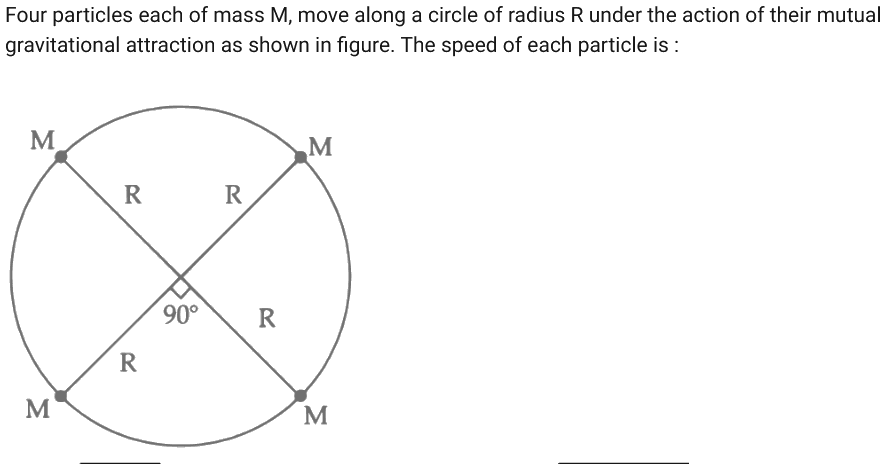
Answer: B
Two satellites revolve around a planet in coplanar circular orbits in anticlockwise direction. Their period of revolutions are 1 hour and 8 hours respectively. The radius of the orbit of nearer satellite is . The angular speed of the farther satellite as observed from the nearer satellite at the instant when both the satellites are closest is where x is ____.
Answer: 3
Two identical particles of mass 1 kg each go round a circle of radius R, under the action of their mutual gravitational attraction. The angular speed of each particle is :
Answer: B
The planet Mars has two moons, if one of them has a period 7 hours, 30 minutes and an orbital radius of . Find the mass of Mars.
Answer: D
The minimum and maximum distances of a planet revolving around the sun are and . If the minimum speed of the planet on its trajectory is then its maximum speed will be :
Answer: D
Consider a planet in some solar system which has a mass double the mass of earth and density equal to the average density of earth. If the weight of an object on earth is W, the weight of the same object on that planet will be :
Answer: C
The time period of a satellite in a circular orbit of radius R is T. The period of another satellite in a circular orbit of radius 9R is :
Answer: B
A planet revolving in elliptical orbit has : A. a constant velocity of revolution. B. has the least velocity when it is nearest to the sun. C. its areal velocity is directly proportional to its velocity. D. areal velocity is inversely proportional to its velocity. E. to follow a trajectory such that the areal velocity is constant. Choose the correct answer from the options given below :
Answer: B
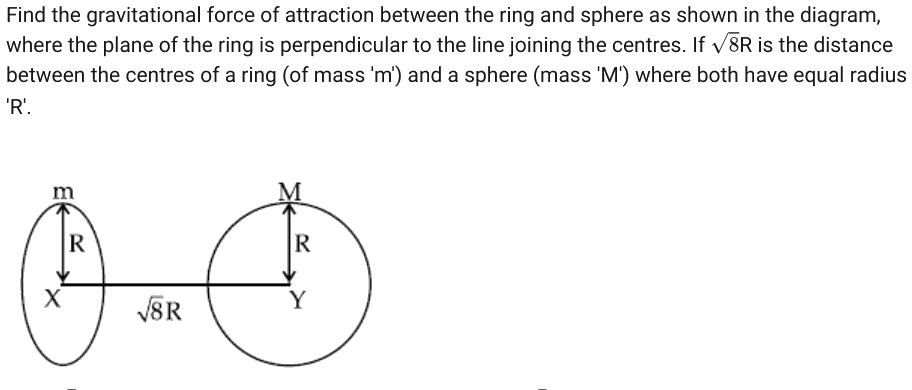
Answer: C
The initial velocity required to project a body vertically upward from the surface of the earth to reach a height of 10R, where R is the radius of the earth, may be described in terms of escape velocity such that . The value of x will be ______ .
Answer: 10
