106 questions asked across 16 exam years, newest first
A satellite is in an elliptical orbit around a planet P. It is observed that the velocity of the satellite when it is farthest from the planet is 6 times less than that when it is closest to the planet. The ratio of distances between the satellite and the planet at closest and farthest points is:
Answer: C
Two planets have masses M and 16 M and their radii are and , respectively. The separation between the centres of the planets is . A body of mass m is fired from the surface of the larger planet towards the smaller planet along the line joining their centres. For the body to be able to reach at the surface of smaller planet, the minimum firing speed needed is :
Answer: C
A satellite is moving in a low nearly circular orbit around the earth. Its radius is roughly equal to that of the earth's radius . By firing rockets attached to it, its speed is instantaneously increased in the direction of its motion so that it become times larger. Due to this the farthest distance from the centre of the earth that the satellite reaches is R. Value of R is :
Answer: B
The mass density of a planet of radius R varies with the distance r from its centre as . Then the gravitational field is maximum at :
Answer: D
Planet A has mass M and radius R. Planet B has half the mass and half the radius of Planet A. If the escape velocities from the Planets A and B are and , respectively, then . The value of n is :
Answer: C
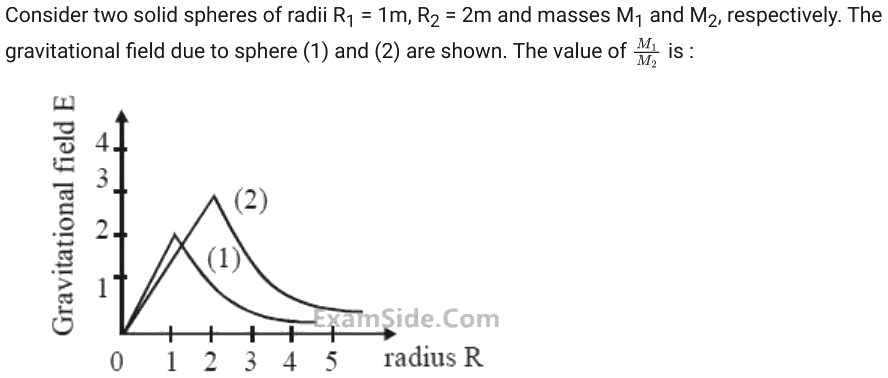
Answer: B
A ball is dropped from the top of a 100 m high tower on a planet. In the last before hitting the ground, it covers a distance of 19 m. Acceleration due to gravity (in ) near the surface on that planet is _______.
Answer: 8
An asteroid is moving directly towards the centre of the earth. When at a distance of 10R (R is the radius of the earth) from the earths centre, it has a speed of 12 km/s. Neglecting the effect of earths atmosphere, what will be the speed of the asteroid when it hits the surface of the earth (escape velocity from the earth is 11.2 km/s) ? Give your answer to the nearest integer in kilometer/s _____.
Answer: 16
A satellite of mass m is launched vertically upwards with an initial speed u from the surface of the earth. After it reaches height R (R = radius of the earth), it ejects a rocket of mass so that subsequently the satellite moves in a circular orbit. The kinetic energy of the rocket is (G is the gravitational constant; M is the mass of the earth) :
Answer: C
