106 questions asked across 16 exam years, newest first
Answer: B
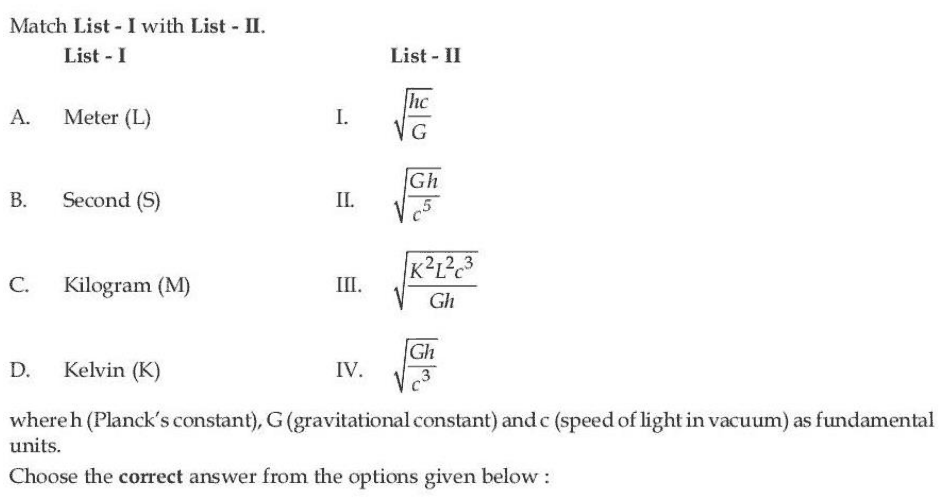
Match List - I with List - II. Choose the correct answer from the options given below :
Answer: C
Answer: B
A planet is moving around the star of mass in the orbit of radius . Another planet is moving around another star of mass in a orbit of radius . Ratio of time periods of revolution of and is ____.
Answer: B
Three masses , and are placed at the vertices of an equilateral triangle with sides . They are rearranged on the vertices of a bigger triangle of side and with the same centre. The work done in this process ____ J. (Gravitational constant )
Answer: B
A block is sliding down with constant velocity on an inclined plane of slope and at an instant this block is given an upward momentum so that it starts moving up on the inclined surface with velocity . The distance travelled by the block before its velocity become zero, is _____. ( gravitational acceleration)
Answer: C
The escape velocity from a spherical planet is . The escape velocity from another planet whose density and radius are of those of planet , is ____ .
Answer: D
Answer: A
Initially a satellite of 100 kg is in a circular orbit of radius . This satellite can be moved to a circular orbit of radius by supplying of energy. The value of is ____. (Take Radius of Earth and )
Answer: B
A spherical body of radius and density falls freely through a viscous liquid having density and viscosity and attains a terminal velocity . Estimated maximum error in the quantity is : (Ignore errors associated with and , gravitational acceleration)
Answer: C
Consider two identical metallic spheres of radius each having charge and mass . Their centers have an initial separation of . Both the spheres are given an initial speed of towards each other. The minimum value of , so that they can just touch each other is: (Take and assume where is the Gravitational constant)
Answer: D
