PaperYodha

Prepare

Mock TestsLive TestsPrevious Year PapersPractice
PaperYodha
Previous Year Papers· Real papers, shift-wise

PaperYodha

One platform for SSC, Defence and Engineering entrance exams: mocks in each exam's official pattern, weekly all-India live tests, real previous-year papers and topic-wise practice.

Coming soon: IBPS PO · SBI Clerk · MPPSC · CAT

SSC

  • SSC CGL
  • SSC CHSL
  • SSC MTS
  • SSC GD Constable

Defence & Engineering

  • NDA
  • JEE Main
  • JEE Advanced

Platform

  • Mock tests
  • Live tests
  • Previous year papers
  • Practice

AboutContactPrivacy noticeTerms of usePricingRefunds & cancellationYour data

PaperYodha is an independent preparation platform and is not affiliated with the Staff Selection Commission, UPSC, the National Testing Agency or the IITs. Mock questions are original. Exam patterns are taken from published sources; always confirm details in the official notification.

MocksLivePYQsPractice
Mock TestsLive TestsPrevious Year PapersPractice
MocksLivePYQsPractice
← JEE Main topics

Other Chemistry · JEE Main previous year questions

650 questions asked across 20 exam years, newest first

Other Chemistry has appeared 650 times in JEE Main papers between 2002 and 2026, about 4.7 questions per paper, from 25 per paper in 2002 to 2.6 per paper in 2026. Every question is listed below with its answer and the paper it came from. Use Practise this topic to attempt them as a timed set.

Year-wise papersTopic-wise questions
Practise this topic
All years 6502026 442025 342024 852023 962022 742021 582020 542019 552018 142017 142016 92015 62014 62012 282010 72009 52006 92005 132004 142002 25

2020 54 questions

  1. Q612020 · 9 Jan 2020 · Shift 2

    A, B and C are three biomolecules. The results of the tests performed on them are given below: ABC​Molisch’s TestPositivePositiveNegative​Barfoed TestNegativePositiveNegative​Biuret TestNegativeNegativePositive​ A, B and C are respectively :

    1. A.A = Lactose, B = Glucose, C = Albumin
    2. B.A = Lactose, B = Fructose, C = Alanine
    3. C.A = Lactose, B = Glucose, C = Alanine
    4. D.A = Glucose, B = Fructose, C = Albumin
    Show answer

    Answer: A

  2. Q652020 · 9 Jan 2020 · Shift 2

    The true statement amongst the following is :

    1. A.S is a function of temperature but ΔS is not a function of temperature.
    2. B.Both S and ΔS are not functions of temperature.
    3. C.Both ΔS and S are functions of temperature.
    4. D.S is not a function of temperature but ΔS is a function of temperature.
    Show answer

    Answer: C

  3. Q662020 · 9 Jan 2020 · Shift 2
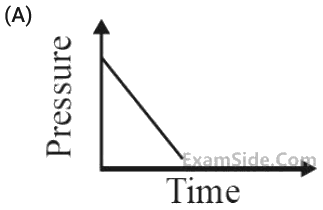
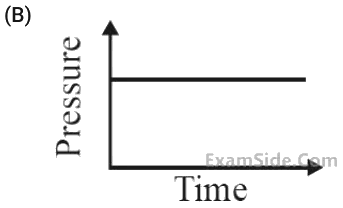
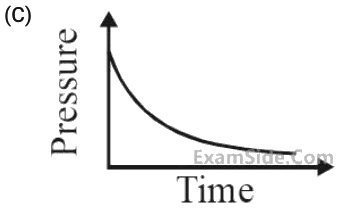
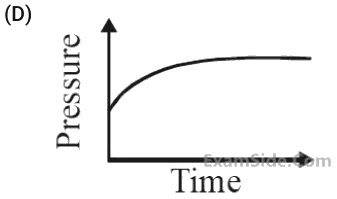
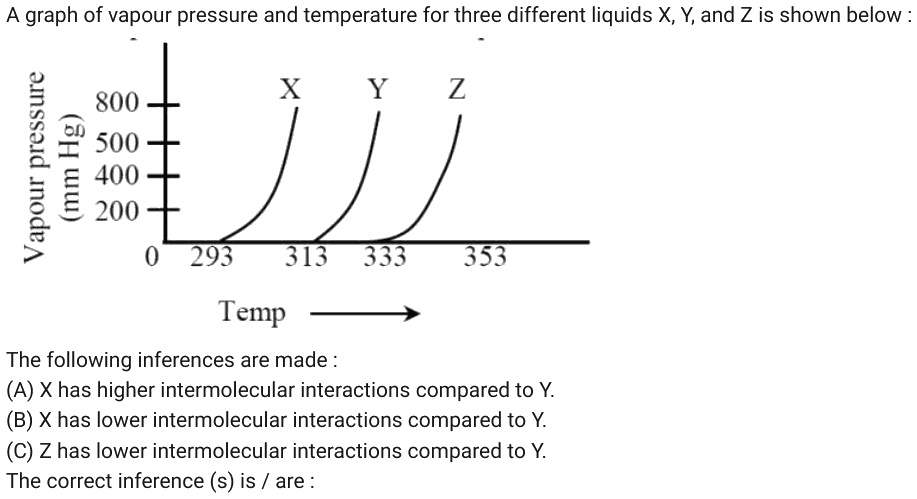
    Chemistry question 16 as printed in the paper
    1. A.Option 1
    2. B.Option 2
    3. C.Option 3
    4. D.Option 4
    Show answer

    Answer: C

  4. Q542020 · 8 Jan 2020 · Shift 1
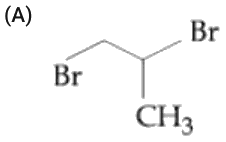
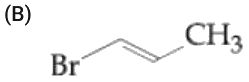
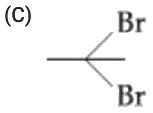
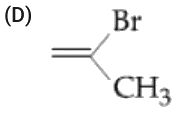
    Chemistry question 4 as printed in the paper
    1. A.(B)
    2. B.(A)
    3. C.(C)
    4. D.(A) and (C)
    Show answer

    Answer: A

  5. Q572020 · 8 Jan 2020 · Shift 1

    The predominant intermolecular forces present in ethyl acetate, a liquid, are:

    1. A.Dipole-dipole and hydrogen bonding
    2. B.hydrogen bonding and London dispersion
    3. C.London dispersion, dipole-dipole and hydrogen bonding
    4. D.London dispersion and dipole-dipole
    Show answer

    Answer: D

  6. Q582020 · 8 Jan 2020 · Shift 1

    A flask contains a mixture of isohexane and 3-methylpentane. One of the liquids boils at 63∘C while the other boils at 60∘C What is the best way to separate the two liquids and which one will be distilled out first ?

    1. A.fractional distillation, 3-methylpentane
    2. B.simple distillation, 3-methylpentane
    3. C.fractional distillation, isohexane
    4. D.simple distillation, isohexane
    Show answer

    Answer: C

  7. Q592020 · 8 Jan 2020 · Shift 2

    Arrange the following bonds according to their average bond energies in descending order : C–Cl, C–Br, C–F, C–I

    1. A.C–Br > C–I > C–Cl > C–F
    2. B.C–Cl > C–Br > C–I > C–F
    3. C.C–I > C–Br > C–Cl > C–F
    4. D.C–F > C–Cl > C–Br > C–I
    Show answer

    Answer: D

  8. Q642020 · 8 Jan 2020 · Shift 2

    Hydrogen has three isotopes (A), (B) and (C). If the number of neutron(s) in (A), (B) and (C) respectively, are (x), (y) and (z), the sum of (x), (y) an (z) is :

    1. A.3
    2. B.1
    3. C.4
    4. D.2
    Show answer

    Answer: A

  9. Q752020 · 8 Jan 2020 · Shift 2· Numerical answer

    NaClO3​ is used, even in spacecrafts, to produce O2​. The daily consumption of pure O2​ by a person is 492L at 1atm,300K. How much amount of NaClO3​, in grams, is required to produce O2​ for the daily consumption of a person at 1atm,300K? NaClO3​(s)+Fe(s)→O2​(g)+NaCl(s)+FeO(s) R=0.082L atm mol−1K−1

    Show answer

    Answer: 2120 to 2140

  10. Q512020 · 7 Jan 2020 · Shift 1

    Amongst the following statements, that which was not proposed by Dalton was :

    1. A.Matter consists of indivisible atoms.
    2. B.Chemical reactions involve reorganization of atoms. These are neither created nor destroyed in a chemical reaction.
    3. C.When gases combine or are produced in a chemical reaction they do so in a simple ratio by volume provided all gases are at the same T & P.
    4. D.All the atoms of a given element have identical properties including identical mass. Atoms of different elements differ in mass.
    Show answer

    Answer: C

  11. Q562020 · 7 Jan 2020 · Shift 1
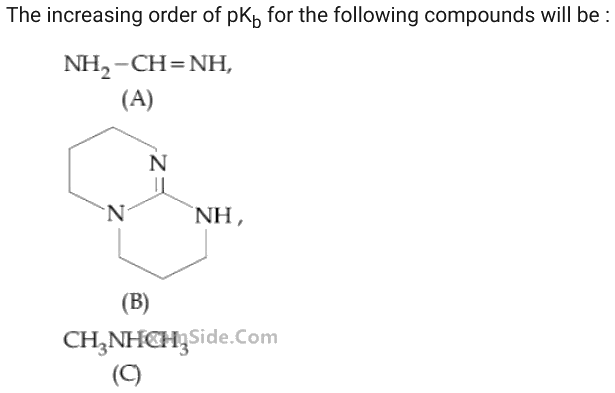
    Chemistry question 6 as printed in the paper
    1. A.(A)<(B)<(C)
    2. B.(C)<(A)<(B)
    3. C.(B)<(A)<(C)
    4. D.(B)<(C)<(A)
    Show answer

    Answer: C

  12. Q582020 · 7 Jan 2020 · Shift 1
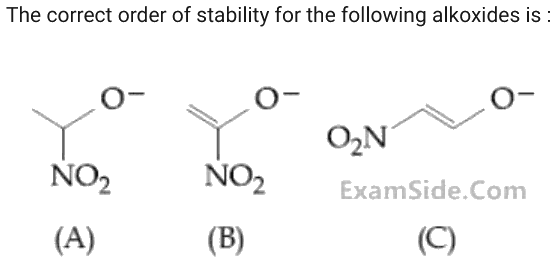
    Chemistry question 8 as printed in the paper
    1. A.Option 1
    2. B.Option 2
    3. C.Option 3
    4. D.Option 4
    Show answer

    Answer: A

  13. Q612020 · 7 Jan 2020 · Shift 1

    The relative strength of interionic/intermolecular forces in decreasing order is :

    1. A.dipole-dipole > ion-dipole > ion-ion
    2. B.ion-dipole > dipole-dipole > ion-ion
    3. C.ion-dipole > ion-ion > dipole-dipole
    4. D.ion-ion > ion-dipole > dipole-dipole
    Show answer

    Answer: D

  14. Q632020 · 7 Jan 2020 · Shift 1

    The dipole of CCl4​, CHCl3​ and CH4​ are in the order :

    1. A.CCl4​<CH4​<CHCl3​
    2. B.CH4​=CCl4​<CHCl3​
    3. C.CH4​<CCl4​<CHCl3​
    4. D.CHCl3​<CH4​=CCl4​
    Show answer

    Answer: B

  15. Q522020 · 7 Jan 2020 · Shift 2

    For the reaction 2H2​(g)+2NO(g)→N2​(g)+2H2​O(g) the observed rate expression is, rate=Kf​[NO]2[H2​]. The rate expression for the reverse reaction is :

    1. A.Kb​[N2​][H2​O]
    2. B.Kb​[N2​][H2​O]2/[H2​]
    3. C.Kb​[N2​][H2​O]2/[NO]
    4. D.Kb​[N2​][H2​O]2
    Show answer

    Answer: B

  16. Q532020 · 7 Jan 2020 · Shift 2
    Chemistry question 3 as printed in the paper
    1. A.(C) > (B) > (A)
    2. B.(C) > (A) > (B)
    3. C.(B) > (C) > (A)
    4. D.(B) > (A) > (C)
    Show answer

    Answer: A

  17. Q542020 · 7 Jan 2020 · Shift 2

    The equation that is incorrect is :

    1. A.(Λm0​)KCl​−(Λm0​)NaCl​=(Λm0​)KBr​−(Λm0​)NaBr​
    2. B.(Λm0​)NaBr​−(Λm0​)NaI​=(Λm0​)KBr​−(Λm0​)NaBr​
    3. C.(Λm0​)NaBr​−(Λm0​)NaCl​=(Λm0​)KBr​−(Λm0​)KCl​
    4. D.(Λm0​)H2​O​=(Λm0​)HCl​+(Λm0​)NaOH​−(Λm0​)NaCl​
    Show answer

    Answer: B

  18. Q612020 · 7 Jan 2020 · Shift 2

    Which of the following statements is correct ?

    1. A.Gluconic acid can form cyclic (acetal/hemiacetal) structure
    2. B.Gluconic acid is a partial oxidation product of glucose
    3. C.Gluconic acid is obtained by oxidation of glucose with (HNO3​)
    4. D.Gluconic acid is a dicarboxylic acid.
    Show answer

    Answer: B

  19. Q682020 · 7 Jan 2020 · Shift 2
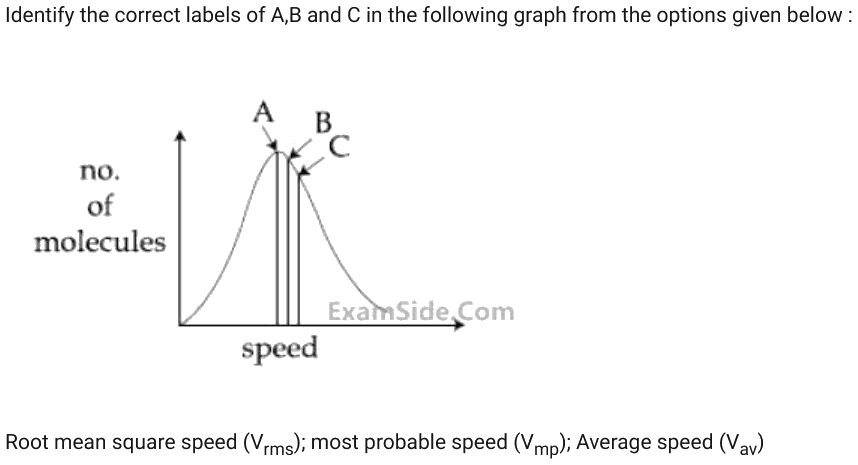
    Chemistry question 18 as printed in the paper
    1. A.A−Vav​;B−Vrms​;C−Vmp​
    2. B.A−Vrms​;B−Vmp​;C−Vav​
    3. C.A−Vmp​;B−Vav​;C−Vrms​
    4. D.A−Vmp​;B−Vrms​;C−Vav​
    Show answer

    Answer: C

  20. Q752020 · 7 Jan 2020 · Shift 2· Numerical answer

    The flocculation value of HCl for arsenic sulphide sol. is 30 m mol L−1 If H2​SO4​ is used for the flocculation of arsenic sulphide, the amount in grams, of H2​SO4​ in 250 ml required for the above purpose is _______. (molecular mass of H2​SO4​=98 g/mol)

    Show answer

    Answer: 0.36 to 0.38

2019 55 questions

  1. Q792019 · 12 Apr 2019 · Shift 1
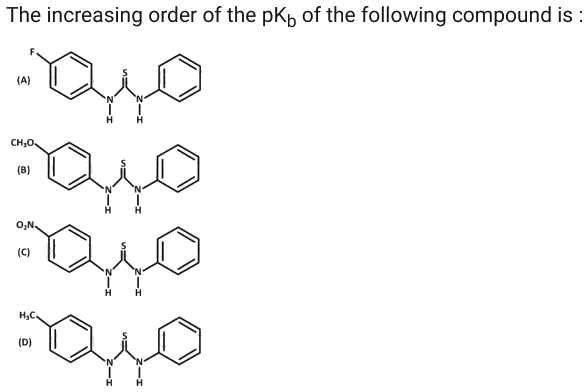
    Chemistry question 19 as printed in the paper
    1. A.(C)<(A)<(D)<(B)
    2. B.(B)<(D)<(C)<(A)
    3. C.(B)<(D)<(A)<(C)
    4. D.(A)<(C)<(D)<(B)
    Show answer

    Answer: C

  2. Q812019 · 12 Apr 2019 · Shift 1

    The correct statement among the following is :

    1. A.(SiH3​)3​N is planar and more basic than (CH3​)3​N
    2. B.(SiH3​)3​N is pyramidal and more basic than (CH3​)3​N
    3. C.(SiH3​)3​N is pyramidal and less basic than (CH3​)3​N
    4. D.(SiH3​)3​N is planar and less basic than (CH3​)3​N
    Show answer

    Answer: D

  3. Q902019 · 12 Apr 2019 · Shift 1

    The metal that gives hydrogen gas upon treatment with both acid as well as base is :

    1. A.mercury
    2. B.zinc
    3. C.iron
    4. D.magnesium
    Show answer

    Answer: B

  4. Q692019 · 12 Apr 2019 · Shift 2

    Thermal decomposition of a Mn compound (X) at 513 K results in compound Y, MnO2​ and gaseous product. MnO2​ reacts with NaCl and concentrated H2​SO4​ to give a pungent gas Z. X, Y and Z, respectively, are :

    1. A.KMnO4​, K2​MnO4​ and Cl2​
    2. B.K2​MnO4​, KMnO4​ and SO2​
    3. C.K3​MnO4​, K2​MnO4​ and Cl2​
    4. D.K2​MnO4​, KMnO4​ and Cl2​
    Show answer

    Answer: A

  5. Q702019 · 12 Apr 2019 · Shift 2

    The INCORRECT match in the following is :

    1. A.ΔG∘=0, K=1
    2. B.ΔG∘<0, K<1
    3. C.ΔG∘>0, K<1
    4. D.ΔG∘<0, K>1
    Show answer

    Answer: B

More Chemistry topics in JEE Main

  • Chemical & Ionic Equilibrium (277)
  • Organic Reactions & Conversions (262)
  • General Organic Chemistry & Isomerism (235)
  • p-Block Elements (193)
  • Mole Concept & Stoichiometry (179)
  • Atomic Structure (177)
  • Chemical Bonding (174)
  • Coordination Compounds (169)
← PreviousPage 18 of 26Next →