PaperYodha

Prepare

Mock TestsLive TestsPrevious Year PapersPractice
PaperYodha
Previous Year Papers· Real papers, shift-wise

PaperYodha

One platform for SSC, Defence and Engineering entrance exams: mocks in each exam's official pattern, weekly all-India live tests, real previous-year papers and topic-wise practice.

Coming soon: IBPS PO · SBI Clerk · MPPSC · CAT

SSC

  • SSC CGL
  • SSC CHSL
  • SSC MTS
  • SSC GD Constable

Defence & Engineering

  • NDA
  • JEE Main
  • JEE Advanced

Platform

  • Mock tests
  • Live tests
  • Previous year papers
  • Practice

AboutContactPrivacy noticeTerms of usePricingRefunds & cancellationYour data

PaperYodha is an independent preparation platform and is not affiliated with the Staff Selection Commission, UPSC, the National Testing Agency or the IITs. Mock questions are original. Exam patterns are taken from published sources; always confirm details in the official notification.

MocksLivePYQsPractice
Mock TestsLive TestsPrevious Year PapersPractice
MocksLivePYQsPractice
← JEE Main topics

Other Chemistry · JEE Main previous year questions

650 questions asked across 20 exam years, newest first

Other Chemistry has appeared 650 times in JEE Main papers between 2002 and 2026, about 4.7 questions per paper, from 25 per paper in 2002 to 2.6 per paper in 2026. Every question is listed below with its answer and the paper it came from. Use Practise this topic to attempt them as a timed set.

Year-wise papersTopic-wise questions
Practise this topic
All years 6502026 442025 342024 852023 962022 742021 582020 542019 552018 142017 142016 92015 62014 62012 282010 72009 52006 92005 132004 142002 25

2020 54 questions

  1. Q662020 · 6 Sept 2020 · Shift 2

    Reaction of an inorganic sulphite X with dilute H2​SO4​ generates compound Y. Reaction of Y with NaOH gives X. Further, the reaction of X with Y and water affords compound Z. Y and Z, respectively, are :

    1. A.S and Na2​SO3​
    2. B.SO2​ and NaHSO3​
    3. C.SO2​ and Na2​SO3​
    4. D.SO3​ and NaHSO3​
    Show answer

    Answer: B

  2. Q682020 · 6 Sept 2020 · Shift 2

    For a reaction, 4M(s)+nO2​(g)→2M2​On​(s) the free energy change is plotted as a function of temperature. The temperature below which the oxide is stable could be inferred from the plot as the point at which :

    1. A.the free energy change shows a change from negative to positive value
    2. B.the slope changes from positive to negative
    3. C.the slope changes from negative to positive
    4. D.the slope changes from positive to zero
    Show answer

    Answer: A

  3. Q702020 · 6 Sept 2020 · Shift 2

    Dihydrogen of high purity (> 99.95%) is obtained through :

    1. A.the electrolysis of acidified water using Pt electrodes
    2. B.the electrolysis of warm Ba(OH)2​ solution using Ni electrodes
    3. C.the electrolysis of brine solution
    4. D.the reaction of Zn with dilute HCl
    Show answer

    Answer: B

  4. Q512020 · 3 Sept 2020 · Shift 1

    It is true that :

    1. A.A first order reaction is always a single step reaction
    2. B.A zero order reaction is a multistep reaction
    3. C.A zero order reaction is a single step reaction
    4. D.A second order reaction is always a multistep reaction
    Show answer

    Answer: B

  5. Q552020 · 3 Sept 2020 · Shift 1
    Chemistry question 5 as printed in the paper
    1. A.Option 1
    2. B.Option 2
    3. C.Option 3
    4. D.Option 4
    Show answer

    Answer: D

  6. Q572020 · 3 Sept 2020 · Shift 1

    Of the species, NO,NO+,NO2+ and NO−, the one with minimum bond strength is :

    1. A.NO−
    2. B.NO
    3. C.NO+
    4. D.NO2+
    Show answer

    Answer: A

  7. Q592020 · 3 Sept 2020 · Shift 1

    Henry's constant (in kbar) for four gases α,β,γ and δ in water at 298 K is given below : | | α | β | γ | δ | | :--- | :--- | :--- | :--- | :--- | | KH​ | 50 | 2 | 2×10⁻⁵ | 0.5 | (density of water =103 kg m−3 at 298 K) This table implies that :

    1. A.solubility of γ at 308 K is lower than at 298 K
    2. B.The pressure of a 55.5 molal solution of δ is 250 bar
    3. C.α has the highest solubility in water at a given pressure
    4. D.The pressure of a 55.5 molal solution of γ is 1 bar
    Show answer

    Answer: A, B

  8. Q662020 · 3 Sept 2020 · Shift 1

    Aqua regia is used for dissolving noble metals (Au, Pt, etc.). The gas evolved in this process is :

    1. A.N2​O3​
    2. B.N2​
    3. C.N2​O5​
    4. D.NO
    Show answer

    Answer: D

  9. Q682020 · 3 Sept 2020 · Shift 1

    Thermal power plants can lead to :

    1. A.Ozone layer depletion
    2. B.Blue baby syndrome
    3. C.Eutrophication
    4. D.Acid rain
    Show answer

    Answer: D

  10. Q722020 · 3 Sept 2020 · Shift 1· Numerical answer

    The volume strength of 8.9 M H2​O2​ solution calculated at 273 K and 1 atm is _______. (R=0.0821 L atm K−1 mol−1) (rounded off ot the nearest integer)

    Show answer

    Answer: 100

  11. Q612020 · 3 Sept 2020 · Shift 2

    The incorrect statement is :

    1. A.In manganate and permanganate ions, the π-bonding takes place by overlap of p-orbitals of oxygen and d-orbitals of manganese
    2. B.Manganate ion is green in colour and permanganate ion is purple in colour
    3. C.Manganate and permanganate ions are paramagnetic
    4. D.Manganate and permanganate ions are tetrahedral
    Show answer

    Answer: C

  12. Q652020 · 3 Sept 2020 · Shift 2

    For the reaction 2A+3B+23​C→3P, which statement is correct ?

    1. A.dtdnA​​=dtdnB​​=dtdnC​​
    2. B.dtdnA​​=32​dtdnB​​=43​dtdnC​​
    3. C.dtdnA​​=23​dtdnB​​=43​dtdnC​​
    4. D.dtdnA​​=32​dtdnB​​=34​dtdnC​​
    Show answer

    Answer: D

  13. Q522020 · 2 Sept 2020 · Shift 1
    Chemistry question 2 as printed in the paper
    1. A.Option 1
    2. B.Option 2
    3. C.Option 3
    4. D.Option 4
    Show answer

    Answer: A

  14. Q622020 · 2 Sept 2020 · Shift 1

    While titrating dilute HCl solution with aqueous NaOH, which of the following will not be required?

    1. A.Pipette and distilled water
    2. B.Clamp and phenolphthalein
    3. C.Burette and porcelain tile
    4. D.Bunsen burner and measuring cylinder
    Show answer

    Answer: D

  15. Q642020 · 2 Sept 2020 · Shift 1

    In general the property (magnitudes only) that show an opposite trend in comparison to other properties across a period is

    1. A.Electron gain enthalpy
    2. B.Electronegativity
    3. C.Ionization enthalpy
    4. D.Atomic radius
    Show answer

    Answer: D

  16. Q652020 · 2 Sept 2020 · Shift 1
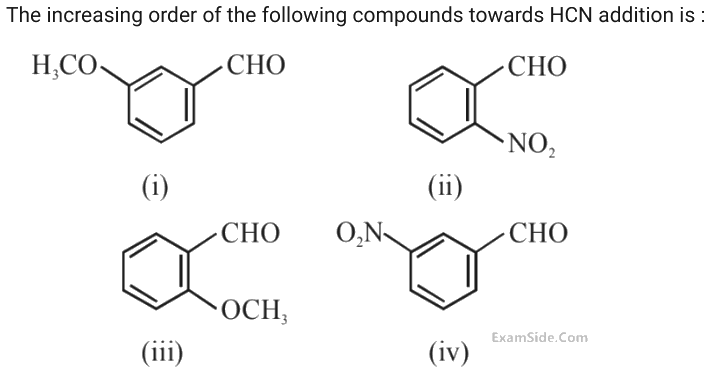
    Chemistry question 15 as printed in the paper
    1. A.(iii) < (iv) < (ii) < (i)
    2. B.(i) < (iii) < (iv) < (ii)
    3. C.(iii) < (i) < (iv) < (ii)
    4. D.(iii) < (iv) < (i) < (ii)
    Show answer

    Answer: C

  17. Q752020 · 2 Sept 2020 · Shift 1· Numerical answer

    The mass of gas adsorbed, x, per unit mass of adsorbate, m, was measured at various pressures, p. A graph between logmx​ and logp gives a straight line with slope equal to 2 and the intercept equal to 0.4771. The value of mx​ at a pressure of 4 atm is : (Given log3=0.4771)

    Show answer

    Answer: 48

  18. Q542020 · 2 Sept 2020 · Shift 2
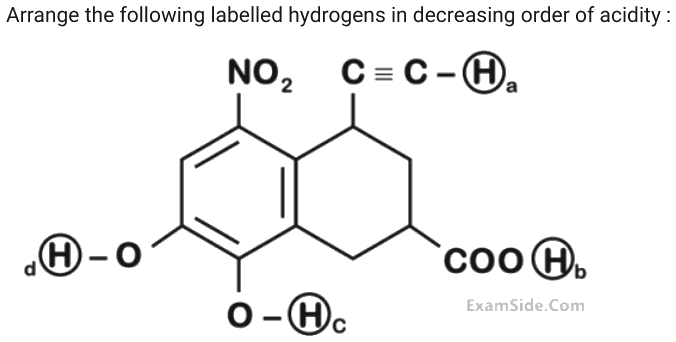
    Chemistry question 4 as printed in the paper
    1. A.b>c>d>a
    2. B.b>a>c>d
    3. C.c>b>d>a
    4. D.c>b>a>d
    Show answer

    Answer: A

  19. Q562020 · 2 Sept 2020 · Shift 2

    If you spill a chemical toilet cleaning liquid on your hand, your first aid would be

    1. A.aqueous NaOH
    2. B.aqueous NaHCO3​
    3. C.aqueous NH3​
    4. D.vinegar
    Show answer

    Answer: B

  20. Q582020 · 2 Sept 2020 · Shift 2

    The size of a raw mango shrinks to a much smaller size when kept in a concentrated salt solution. Which one of the following processes can explain this?

    1. A.Osmosis
    2. B.Reverse osmosis
    3. C.Diffusion
    4. D.Dialysis
    Show answer

    Answer: A

  21. Q592020 · 2 Sept 2020 · Shift 2

    Match the type of interaction in column A with the distance dependence of their interaction energy in column B | A | B | | :--- | :--- | | (i) ion-ion | (a) r1​ | | (ii) dipole-dipole | (b) r21​ | | (iii) London dispersion | (c) r31​ | | | (d) r61​ |

    1. A.(I)-(a), (II)-(b), (III)-(d)
    2. B.(I)-(b), (II)-(d), (III)-(c)
    3. C.(I)-(a), (II)-(b), (III)-(c)
    4. D.(I)-(a), (II)-(c), (III)-(d)
    Show answer

    Answer: D

  22. Q582020 · 9 Jan 2020 · Shift 1
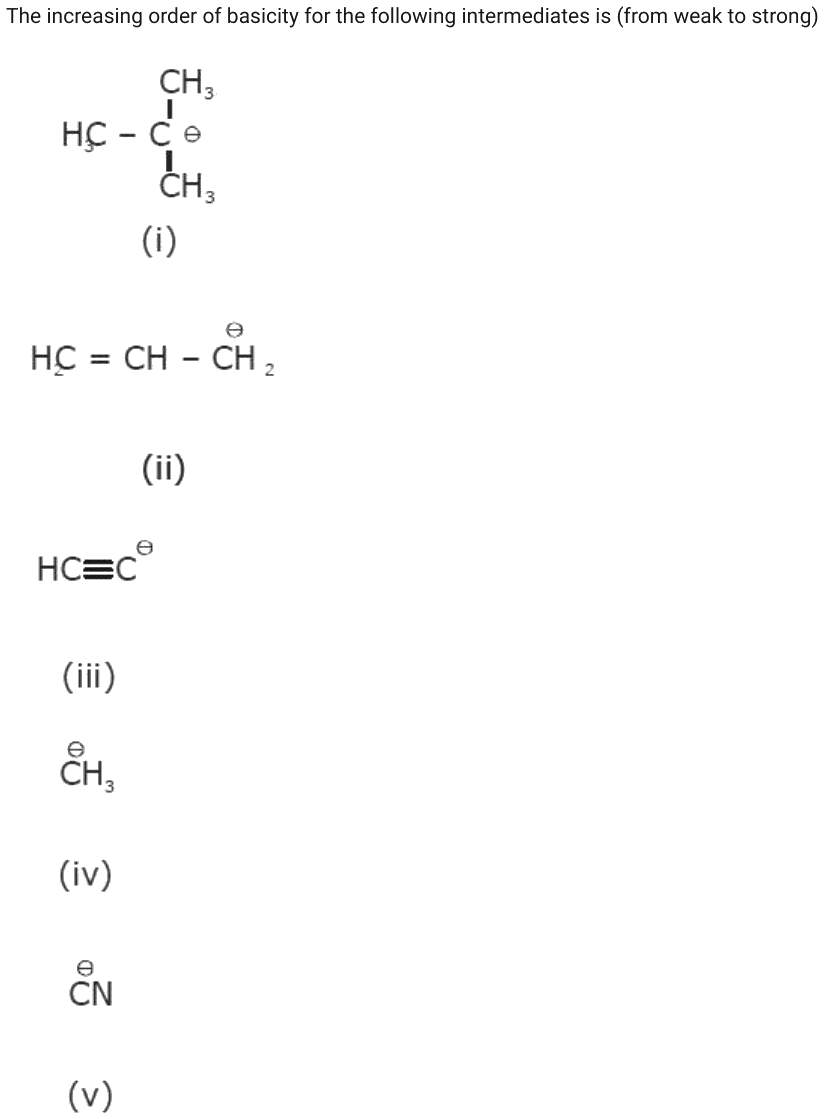
    Chemistry question 8 as printed in the paper
    1. A.(iii) < (i) < (ii) < (iv) < (v)
    2. B.(iii) < (iv) < (ii) < (i) < (v)
    3. C.(v) < (i) < (iv) < (ii) < (iii)
    4. D.(v) < (iii) < (ii) < (iv) < (i)
    Show answer

    Answer: D

  23. Q602020 · 9 Jan 2020 · Shift 1

    The acidic, basic and amphoteric oxides, respectively, are :

    1. A.Cl2​O, CaO, P4​O10​
    2. B.N2​O3​, Li2​O, Al2​O3​
    3. C.MgO, Cl2​O, Al2​O3​
    4. D.Na2​O, SO3​, Al2​O3​
    Show answer

    Answer: B

  24. Q692020 · 9 Jan 2020 · Shift 1

    'X' melts at low temperature and is a bad conductor of electricity in both liquid and solid state. X is :

    1. A.Mercury
    2. B.Carbon tetrachloride
    3. C.Zinc sulphide
    4. D.Silicon carbide
    Show answer

    Answer: B

  25. Q552020 · 9 Jan 2020 · Shift 2

    Which of the following has the shortest C-Cl bond?

    1. A.Cl−CH=CH−CH3​
    2. B.Cl−CH=CH−NO2​
    3. C.Cl−CH=CH−OCH3​
    4. D.Cl−CH=CH2​
    Show answer

    Answer: B

More Chemistry topics in JEE Main

  • Chemical & Ionic Equilibrium (277)
  • Organic Reactions & Conversions (262)
  • General Organic Chemistry & Isomerism (235)
  • p-Block Elements (193)
  • Mole Concept & Stoichiometry (179)
  • Atomic Structure (177)
  • Chemical Bonding (174)
  • Coordination Compounds (169)
← PreviousPage 17 of 26Next →