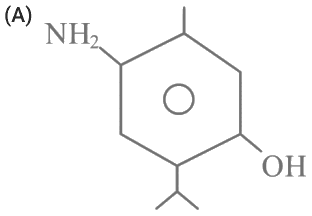
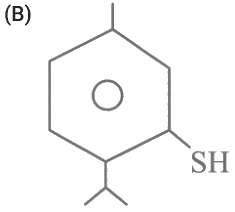
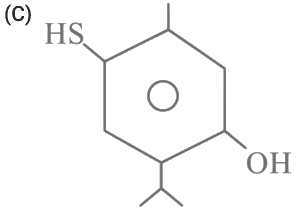
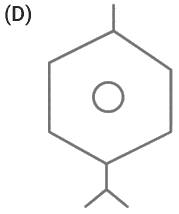
2-Methyl propyl bromide reacts with C2H5O− and gives 'A' whereas on reaction with C2H5OH it gives 'B'. The mechanism followed in these reactions and the products 'A' and 'B' respectively are :
1 g of a carbonate (M2CO3) on treatment with excess HCl produces 0.01 mol of CO2. The molar mass of M2CO3 is ___________ g mol−1. (Nearest integer)
At 600 K, the root mean square (rms) speed of gas X (molar mass=40) is equal to the most probable speed of gas Y at 90 K. The molar mass of the gas Y is ___________ gmol−1. (Nearest integer)
For a chemical reaction A+B→Product, the order is 1 with respect to A and B.
| Rate molL−1S−1 | [A]molL−1 | [B]molL−1 |
| :--- | :--- | :--- |
| 0.10 | 20 | 0.5 |
| 0.40 | x | 0.5 |
| 0.80 | 40 | y |
What is the value of x and y ?
Given
(A)(B)2CO(g)+O2(g)→2CO2(g)C(graphite)+O2(g)→CO2(g)ΔH10=−x kJ mol−1ΔH20=−y kJ mol−1ΔH0 for the reaction
C(graphite)+21O2(g)→CO(g) is :
Given below are two statements:
Statement I : Aqueous solution of K2Cr2O7 is preferred as a primary standard in volumetric analysis over Na2Cr2O7 aqueous solution.
Statement II : K2Cr2O7 has a higher solubility in water than Na2Cr2O7.
In the light of the above statements, choose the correct answer from the options given below:
Lime reacts exothermically with water to give 'A' which has low solubility in water. Aqueous solution of 'A' is often used for the test of CO2, a test in which insoluble B is formed. If B is further reacted with CO2 then soluble compound is formed, 'A' is :
At constant temperature, a gas is at a pressure of 940.3 mm Hg. The pressure at which its volume decreases by 40% is __________ mm Hg. (Nearest integer)