9 questions asked across 3 exam years, newest first
Three students , and are given a problem to solve. Consider the following events: : At least one of , and can solve the problem, : can solve the problem, given that neither nor can solve the problem, : can solve the problem and cannot solve the problem, : can solve the problem. For any event , let denote the probability of . If then is equal to
Answer: A
A factory has a total of three manufacturing units, , and , which produce bulbs independent of each other. The units , and produce bulbs in the proportions of , respectively. It is known that 20% of the bulbs produced in the factory are defective. It is also known that, of all the bulbs produced by , 15% are defective. Suppose that, if a randomly chosen bulb produced in the factory is found to be defective, the probability that it was produced by is . If a bulb is chosen randomly from the bulbs produced by , then the probability that it is defective is ____.
Answer: 0.27 to 0.33
A student appears for a quiz consisting of only true-false type questions and answers all the questions. The student knows the answers of some questions and guesses the answers for the remaining questions. Whenever the student knows the answer of a question, he gives the correct answer. Assume that the probability of the student giving the correct answer for a question, given that he has guessed it, is . Also assume that the probability of the answer for a question being guessed, given that the student's answer is correct, is . Then the probability that the student knows the answer of a randomly chosen question is
Answer: C
A bag contains balls out of which 3 balls are white, 6 balls are green, and the remaining balls are blue. Assume that the balls are identical otherwise. Three balls are drawn randomly one after the other without replacement. For , let , and denote the events that the ball drawn in the draw is a white ball, green ball, and blue ball, respectively. If the probability and the conditional probability , then equals ____.
Answer: 11
Let . Three distinct points , and are randomly chosen from . Then the probability that , and form a triangle whose area is a positive integer, is
Answer: B
Consider an experiment of tossing a coin repeatedly until the outcomes of two consecutive tosses are same. If the probability of a random toss resulting in head is , then the probability that the experiment stops with head is
Answer: B
Let be the set of all five digit numbers formed using 1,2,2,2,4,4,0. For example, 22240 is in while 02244 and 44422 are not in . Suppose that each element of has an equal chance of being chosen. Let be the conditional probability that an element chosen at random is a multiple of 20 given that it is a multiple of 5. Then the value of is equal to ____.
Answer: 31
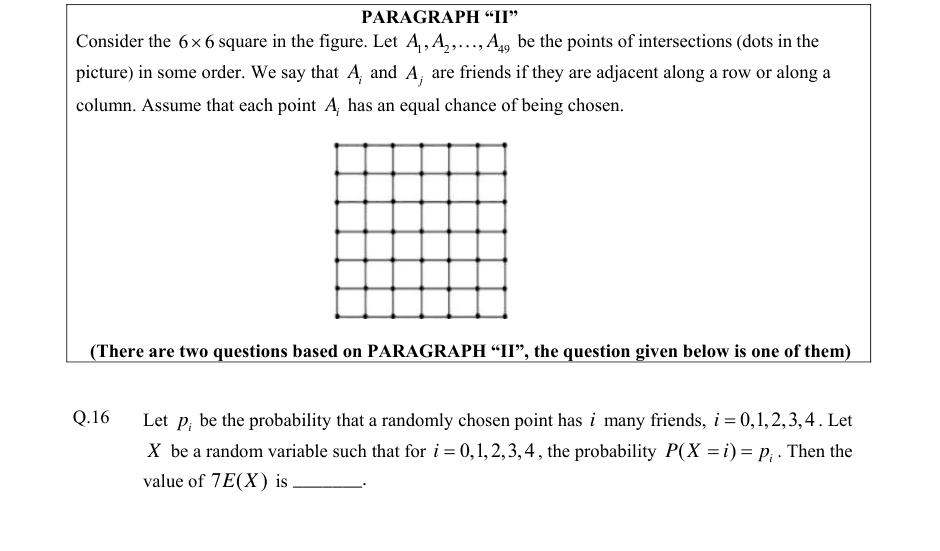
Answer: 23.99 to 24.01
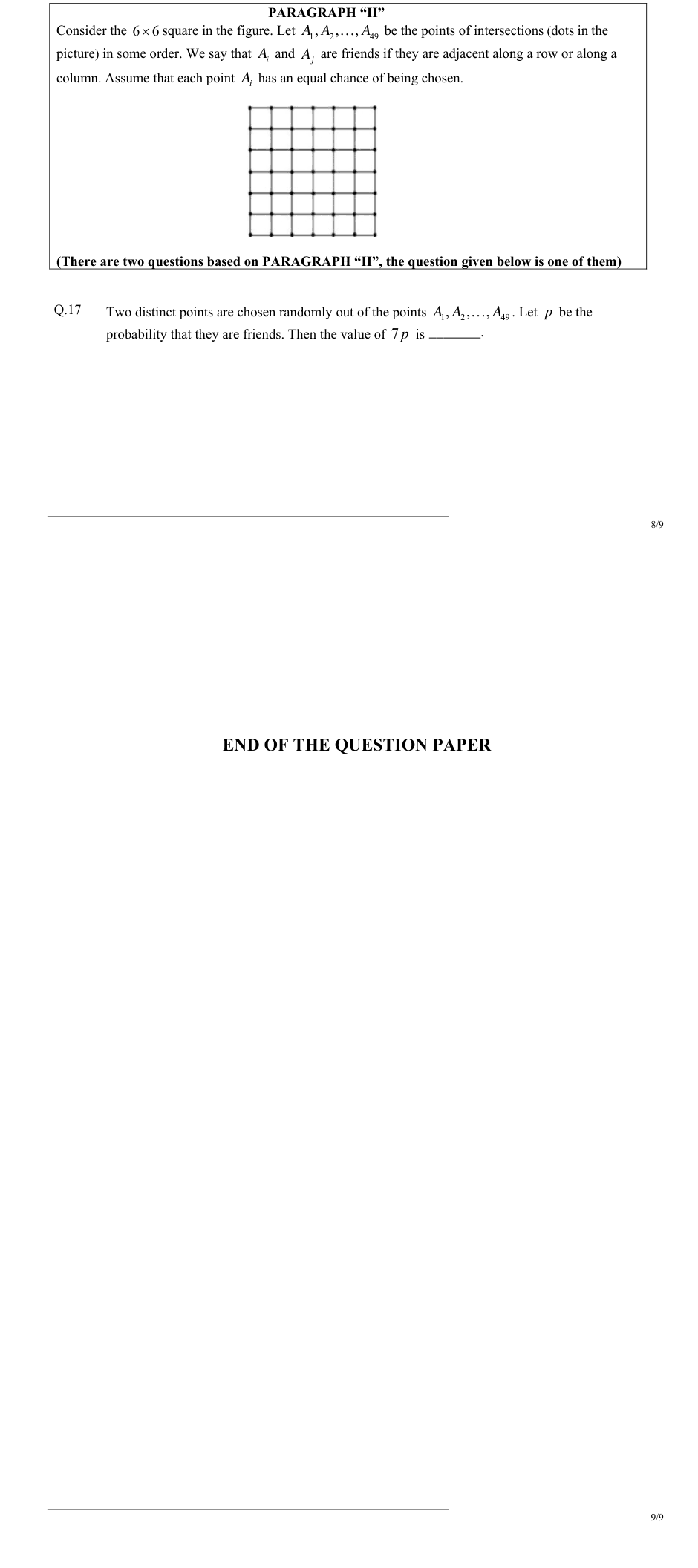
Answer: 0.49 to 0.51
