446 questions asked across 4 exam years, newest first
If the perimeter of an equilateral triangle is 36 units, then its area is (in square units):
Answer: B
In a circle, two chords MN and PQ intersect at O. If MO = 9 cm, ON = 5 cm and OQ = 6 cm, then the value of OP (in cm) is:
Answer: D
In ∆ PQR, M, N, and S are the mid-points of sides PQ, PR and QR, respectively. If the area of the ∆ PQR is 46 cm2, what is the area (in cm2) of the quadrilateral MNRQ?
Answer: B
Find the area of a square, one of whose diagonals is 4.8 m long.
Answer: D
A cuboid of dimensions 50 cm, 150 cm, 175 cm can be divided into how many identical largest cubes?
Answer: A
P and Q are centres of two circles whose radii are 7 cm and 3 cm, respectively. If the direct common tangents to the circles meet PQ extended at A, then A divides PQ _________.
Answer: B
X, Y, and Z are three points on a plane with XY = 11 cm, YZ = 13 cm, and XZ = 24 cm. The number of circles that travel through points X, Y, and Z is:
Answer: A
Two circles of radii 18 cm and 12 cm touch each other externally. Find the length (in cm) of their direct common tangent.

Answer: A
If a right circular cone of height 24 cm has a volume of 1232 cm3, then the total surface area of the cone is (use π = 22/7):
Answer: A
If the sum of three numbers is 18 and the sum of their squares is 36, then find the difference between the sum of their cubes and three times of their product.
Answer: D
The side of an equilateral triangle is 28 cm. Taking each vertex as the centre, a circle is described with a radius equal to half the length of the side of the triangle. Find the area of that part of the triangle which is not included in the circles (use and ).
Answer: B
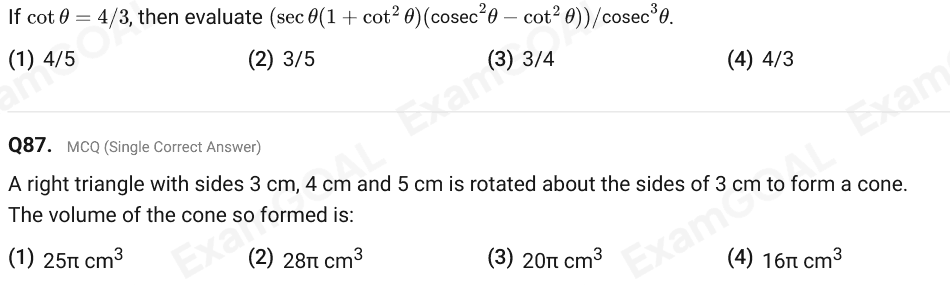
A right triangle with sides 3 cm, 4 cm and 5 cm is rotated about the sides of 3 cm to form a cone. The volume of the cone so formed is:
Answer: D
A rectangular piece of paper is 50 cm long and 22 cm wide. If a cylinder is formed by rolling the paper along its breadth, then the volume of the cylinder is:
Answer: A
What is the central angle of a sector of a circle whose area and perimeter are, respectively, equal to 209 cm2 and 63 cm if it is given that its radius is a non-negative integer (round up to one decimal place)?
Answer: A
The area of a square is square units. Find the perimeter of the square.
Answer: D
If the length of a common external tangent to two circles is 9 and that of a common internal tangent is 5, then the product of the radii of the two circles is:
Answer: B
What is the perimeter (in cm, rounded off to one decimal place) of the sector of a circle with a radius of 10 cm and of angle 30°? (Use π = 3.14)
Answer: B
Find the area (in cm) of the sector whose perimeter is cm and central angle is . (Use .)
Answer: D
Two triangles EFG and HIJ are congruent. If the area of ΔEFG is 124 cm2, then the area of ΔHIJ will be:
Answer: C
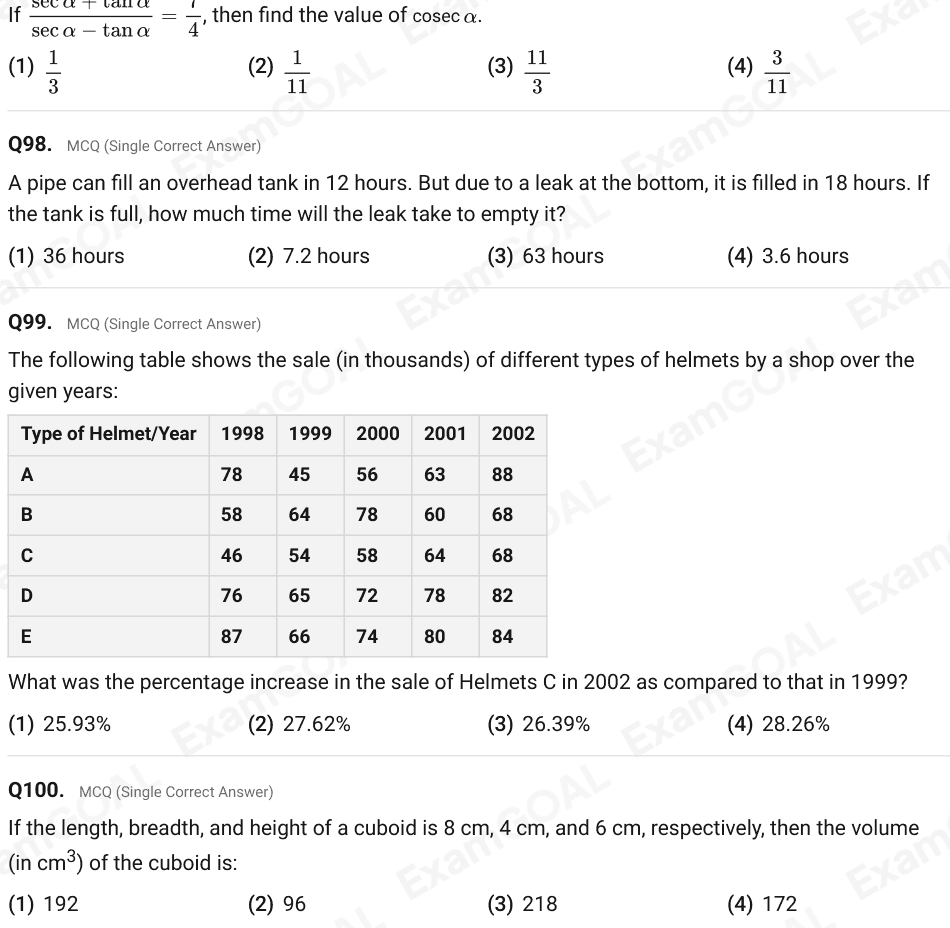
If the length, breadth, and height of a cuboid is 8 cm, 4 cm, and 6 cm, respectively, then the volume (in cm3) of the cuboid is:
Answer: A
What is the surface area (in cm2) of a spherical sculpture whose radius is 35 cm? (Take π = )

Answer: C
The area of a sector of a circle is 110 cm2 and the central angle of the sector is 56°, what is the radius of the circle? (Take π = 22/7)
Answer: D
Find the area of an equilateral triangle whose sides are 16 cm each.
Answer: C
If the side of a cubical box is 12 cm, then find its total surface area.
Answer: B
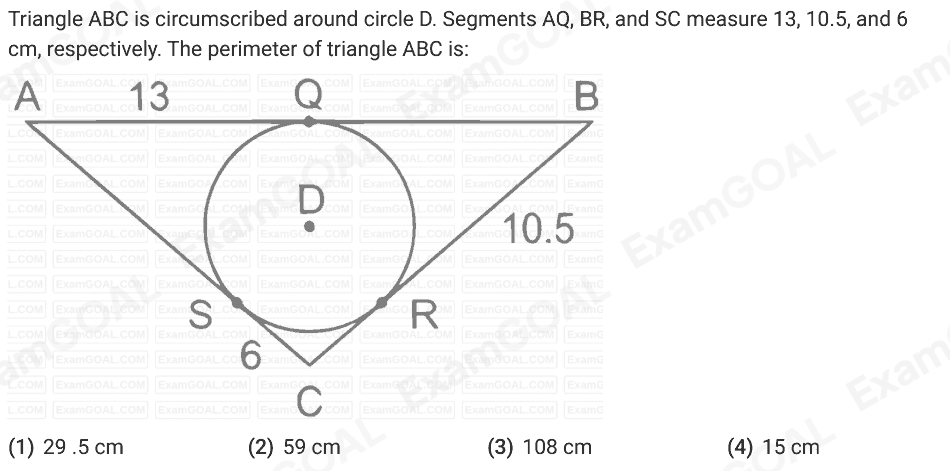
Triangle ABC is circumscribed around circle D. Segments AQ, BR, and SC measure 13, 10.5, and 6 cm, respectively. The perimeter of triangle ABC is:
Answer: B
