446 questions asked across 4 exam years, newest first
What is the surface area (in cm2) of a spherical sculpture whose radius is 35 cm? (Take π = )

Answer: C
The area of a sector of a circle is 110 cm2 and the central angle of the sector is 56°, what is the radius of the circle? (Take π = 22/7)
Answer: D
Find the area of an equilateral triangle whose sides are 16 cm each.
Answer: C
If the side of a cubical box is 12 cm, then find its total surface area.
Answer: B
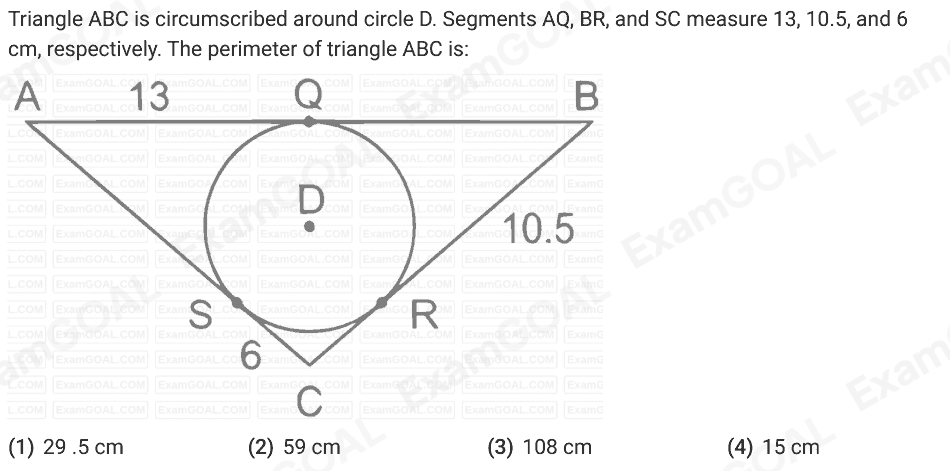
Triangle ABC is circumscribed around circle D. Segments AQ, BR, and SC measure 13, 10.5, and 6 cm, respectively. The perimeter of triangle ABC is:
Answer: B
The sum of the cubes of two given natural numbers is 9728, while the sum of the two given numbers is 32 . What is the product of the two given numbers?
Answer: C
If the volume of a cube is 4096 cm3, then what is the length of the side of the cube?
Answer: C
A metallic cube has each of its side of length 12 cm. It is melted and recast into three small cubes. Out of these cubes, two have their sides as 6 cm and 8 cm, respectively. The length of each side of the third cube is:
Answer: C
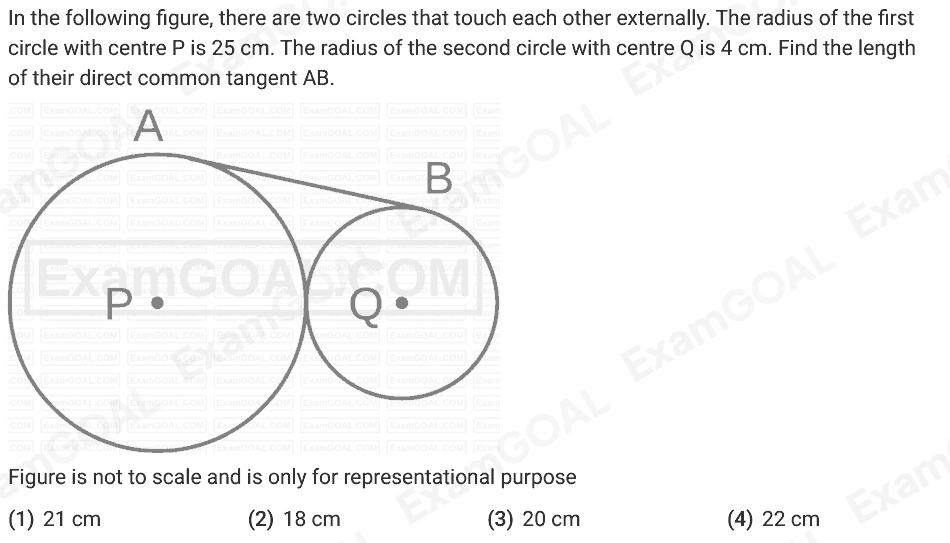
In the following figure, there are two circles that touch each other externally. The radius of the first circle with centre P is 25 cm. The radius of the second circle with centre Q is 4 cm. Find the length of their direct common tangent AB. Figure is not to scale and is only for representational purpose
Answer: C
A field is 150 m long and 80 wide. How many times (rounded off to 1 decimal place) is its perimeter to the length of its diagonal?
Answer: C
If RP and RQ are two tangents to a circle with centre O such that ∠POQ = 120°, where P and Q are the points on the circle and R is a point outside the circle then ∠PRQ is equal to:
Answer: C
The cube of the sum of two given numbers is 1728 , while the product of the two given numbers is 32. Find the positive difference between the cubes of the two given numbers.
Answer: A
What is the area of the sector of a circle of radius 8 cm and formed by an arc of length 12 cm?
Answer: C
The curved surface area of a solid circular cylinder of height 12 cm is 2640 cm2. What is the volume (in cm3) of the cylinder? (Take π = 22/7)
Answer: A
Two circles touch each other externally. The radius of the first circle with centre O is 6 cm. The radius of the second circle with centre P is 3 cm. Find the length of their common tangent AB.
Answer: D
The length of the longest diagonal of a cube is cm. Find its volume (in cm).
Answer: D
A cuboid with sides 4, 6 and 8 units is covered with paper. The paper is removed and a square is made from it. What is the side (in units) of the square?
Answer: C
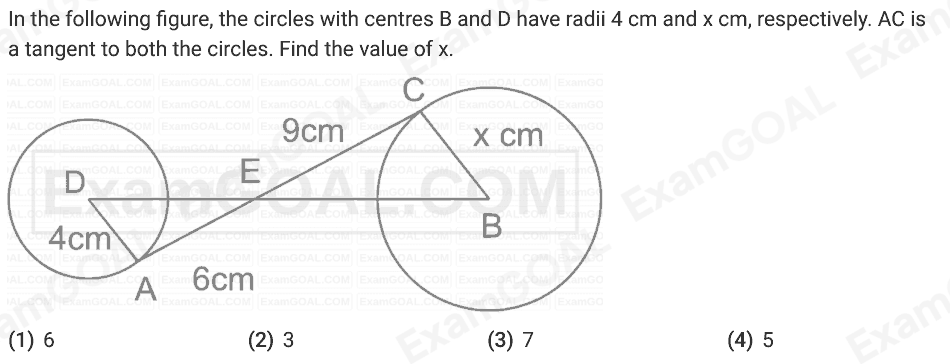
In the following figure, the circles with centres B and D have radii 4 cm and x cm, respectively. AC is a tangent to both the circles. Find the value of x.
Answer: A
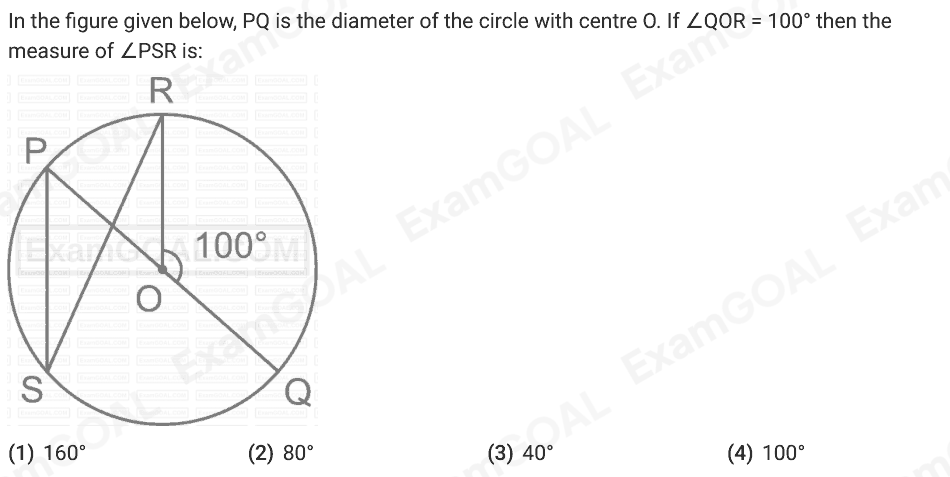
In the figure given below, PQ is the diameter of the circle with centre O. If ∠QOR = 100° then the measure of ∠PSR is:
Answer: C
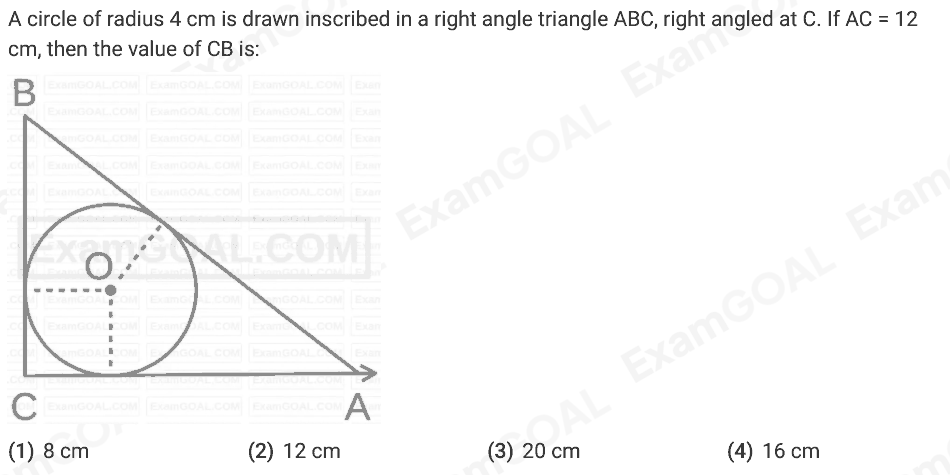
A circle of radius 4 cm is drawn inscribed in a right angle triangle ABC, right angled at C. If AC = 12 cm, then the value of CB is:
Answer: D
The length of each side of a triangle is 12 cm. What is the length of the circumradius of the triangle?
Answer: D
DE is a chord and KDE is a secant of a circle. If KD = 9 cm, DE = 7 cm and KH is a tangent to the circle at point H, then find KH.
Answer: A
Two circles with radii 22 cm and 16 cm touch each other externally. The length of the direct common tangent is:

Answer: D
The difference between the cubes of two given natural numbers is 6272, while the positive difference between the two given numbers is 8. What is the product of the two given numbers?
Answer: B
If the diameter of a sphere is 7 cm, then find the volume of the sphere. (use π = ) (Rounded up to two places of decimal).

Answer: D
