205 questions asked across 20 exam years, newest first
The X-Y plane be taken as the boundary between two transparent media and . in has a refractive index of and with has a refractive index of . A ray of light travelling in along the direction given by the vector , is incident on the plane of separation. The value of difference between the angle of incidence in and the angle of refraction in will be ____ degree.
Answer: 15
Light enters from air into a given medium at an angle of with interface of the air-medium surface. After refraction, the light ray is deviated through an angle of from its original direction. The refractive index of the medium is:
Answer: C
In normal adjustment, for a refracting telescope, the distance between objective and eye piece is . The focal length of the objective, when the angular magnification of the telescope is , will be :
Answer: A
The power of a lens (biconvex) is in particular medium. Refractive index of the lens is 1.5 and radii of curvature are and respectively. The refractive index of surrounding medium:
Answer: B
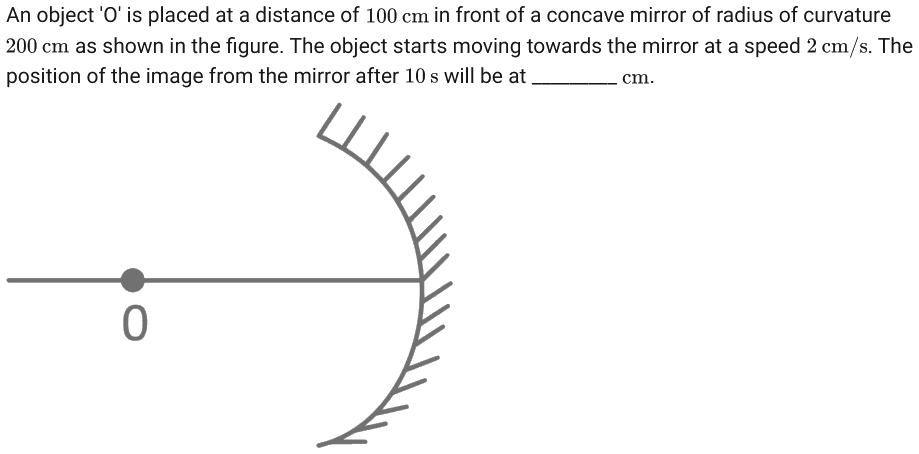
Answer: 400
In an experiment with a convex lens, The plot of the image distance () against the object distance () measured from the focus gives a curve . If all the distances are measured in cm. The magnitude of the focal length of the lens is _________ cm.
Answer: 15
A microscope was initially placed in air (refractive index 1). It is then immersed in oil (refractive index 2). For a light whose wavelength in air is , calculate the change of microscope's resolving power due to oil and choose the correct option.
Answer: B
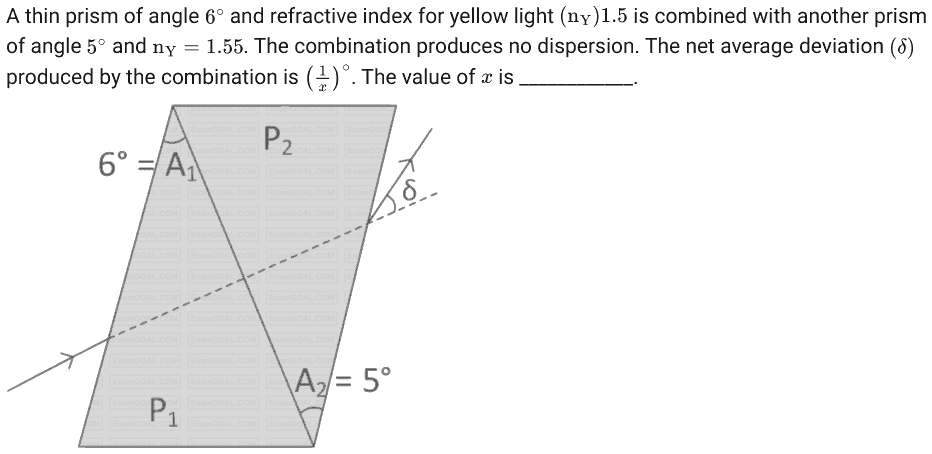
Answer: 4
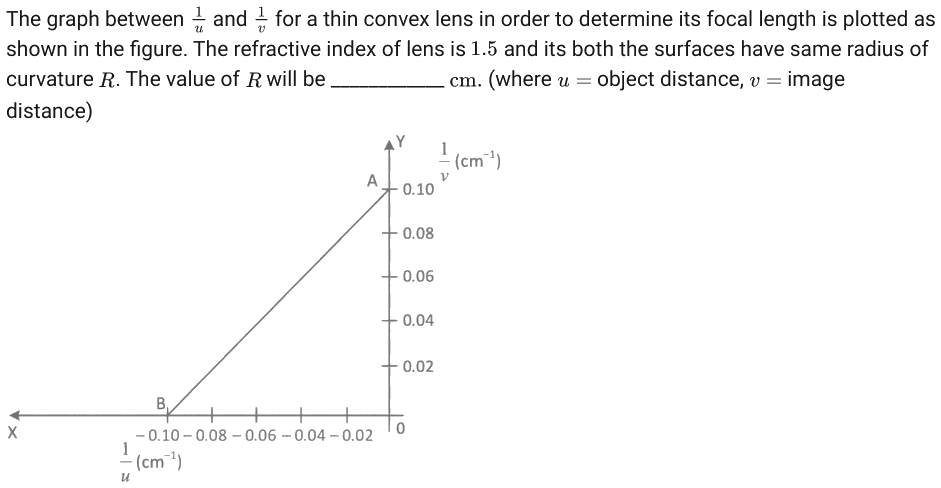
Answer: 10
For an object placed at a distance 2.4 m from a lens, a sharp focused image is observed on a screen placed at a distance 12 cm from the lens. A glass plate of refractive index 1.5 and thickness 1 cm is introduced between lens and screen such that the glass plate plane faces parallel to the screen. By what distance should the object be shifted so that a sharp focused image is observed again on the screen?
Answer: B
A convex lens of focal length 20 cm is placed in front of a convex mirror with principal axis coinciding each other. The distance between the lens and mirror is 10 cm. A point object is placed on principal axis at a distance of 60 cm from the convex lens. The image formed by combination coincides the object itself. The focal length of the convex mirror is ____________ cm.
Answer: 10
The refractive index of an equilateral prism is . The angle of emergence under minimum deviation position of prism, in degree, is ___________.
Answer: 45
Consider a light ray travelling in air is incident into a medium of refractive index . The incident angle is twice that of refracting angle. Then, the angle of incidence will be :
Answer: D
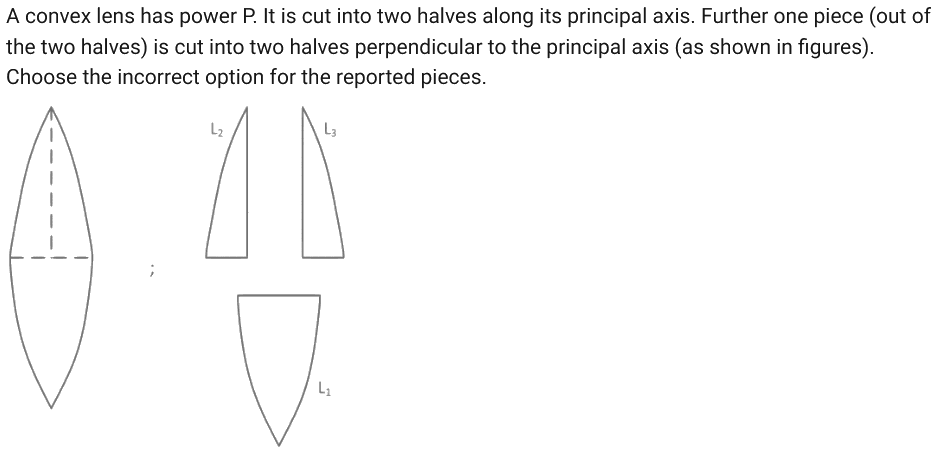
Answer: A
If a wave gets refracted into a denser medium, then which of the following is true?
Answer: C
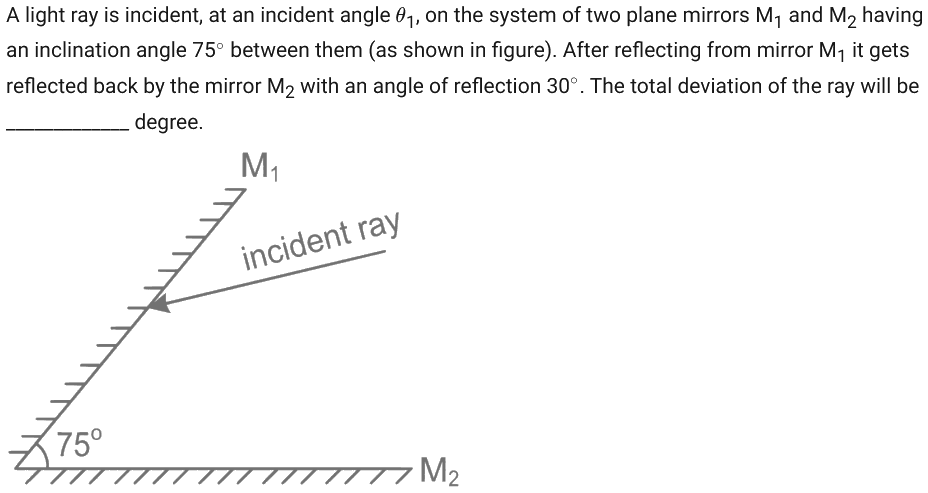
Answer: 210
A small bulb is placed at the bottom of a tank containing water to a depth of . The refractive index of water is . The area of the surface of water through which light from the bulb can emerge out is . The value of x is ________.
Answer: 9
The difference of speed of light in the two media A and B is . If the refractive index of medium B is , then the ratio of refractive index of medium B to medium A is : (Given : speed of light in vacuum )
Answer: C
A ray of light is incident at an angle of incidence on the glass slab of refractive index . After refraction, the light ray emerges out from other parallel faces and lateral shift between incident ray and emergent ray is . The thickness of the glass slab is ____ .
Answer: 12
