205 questions asked across 20 exam years, newest first
A thin biconvex lens is prepared from the glass () both curved surfaces of which have equal radii of each. Left side surface of the lens is silvered from outside to make it reflecting. To have the position of image and object at the same place, the object should be placed, from the lens at a distance of ____ .
Answer: A
Some distant star is to be observed by some telescope of diameter of objective lens , at an angular resolution of . If the wavelength of light from the star reaching the telescope is , the minimum diameter of the objective lens of the telescope is ____ . (nearest interger)
Answer: 203
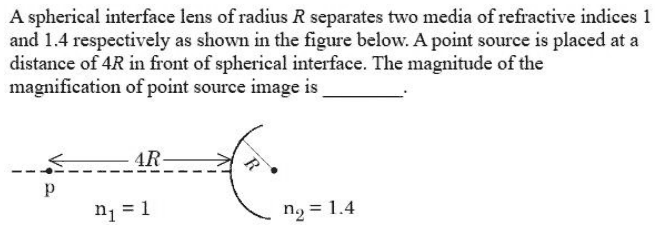
Answer: A
Angle of minimum deviation is equal to the half of the angle of prism in an equilateral prism. The refractive index of the prism is ________.
Answer: C
A concave mirror of focal length forms an image which is double the size of object when the object is placed at two different positions. The distance between the two positions of the object is ________ .
Answer: 10
A ray of light passing through an equilateral prism is having velocity in the prism material, then the minimum angle of deviation is ____ degrees.
Answer: B
A compound microscope is designed with two symmetric biconvex lenses. The objective lens is cut vertically, creating two identical plano-convex lenses. One of them is used in place of original objective lens. To retain same magnification keeping the object distance unchanged, the tube length has to be
Answer: A
A thin convex lens and a thin concave lens are kept in contact and are co-axial. Which of the following statements is correct for this combination of two lenses ?
Answer: A
An object is placed on the left of a convex lens of focal length . Another convex lens is now placed right of lens . If the focal length of lens is , the final image is ____.
Answer: B
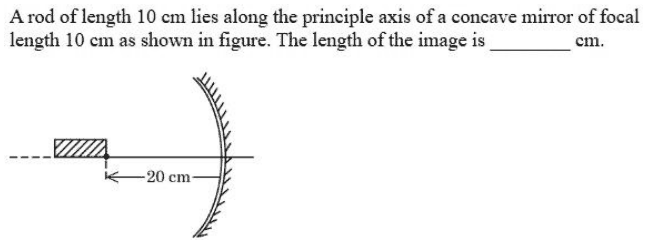
Answer: B
A telescope with objective diameter is used to observe a distant star emitting light of wavelength , at a resolution of . The value of is ________ .
Answer: B
A convex lens is made from glass material having refractive index of with same radius of curvature on both sides. The ratio of its focal length and radius of curvature is ____.
Answer: D
For a thin symmetric prism made of glass (refractive index ), the ratio of incident angle and minimum deviation will be ____
Answer: B
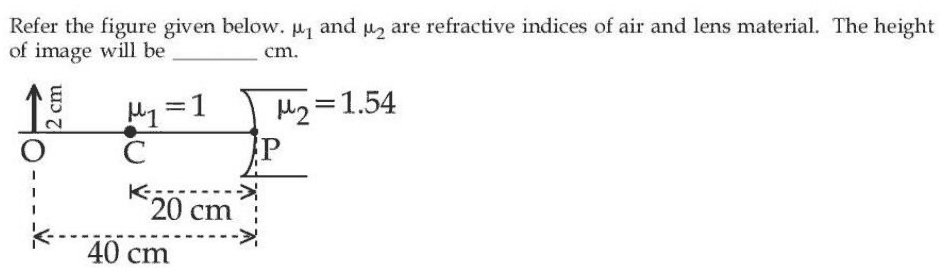
Answer: A
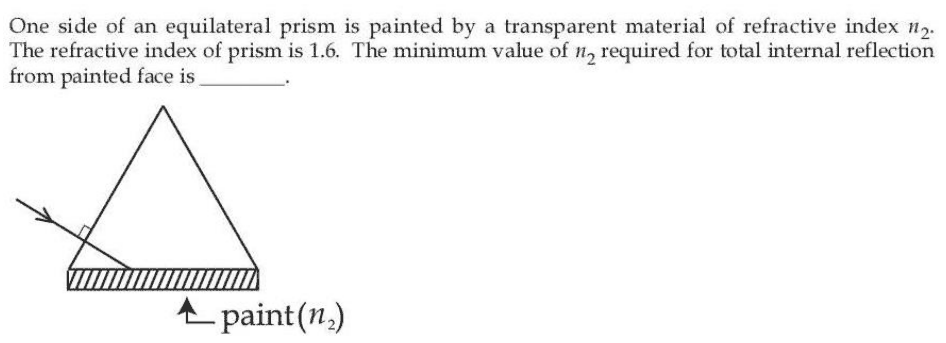
Answer: D
If sunlight is focused on a paper using convex lens, it starts burning the paper in shortest time when the lens is kept at above the paper. If the radius of curvature of the lens is then the refractive index of the lens material is . The value of is ____.
Answer: 20
The magnitudes of power of a biconvex lens (refractive index ) and that of a plano-concave lens (refractive ) are same. If the curvature of planoconcave lens exactly matches with the curvature of back surface of the biconvex lens, then ratio of radius of curvature of front and back surface of the biconvex lens is ____
Answer: B
Given below are two statements : Statement I : A plane wave after passing through prism remains as plane wave but passing through small pin hole may become spherical wave. Statement II : The curvature of a spherical wave emerging from a slit will increase for increasing slit width. In the light of the above statements, choose the correct answer from the options given below :
Answer: C
A convex lens of refractive index and focal length is immersed in water. The difference in focal lengths of the given lens when it is in water and in air is . The value of is ____ . (refractive index of water )
Answer: 3
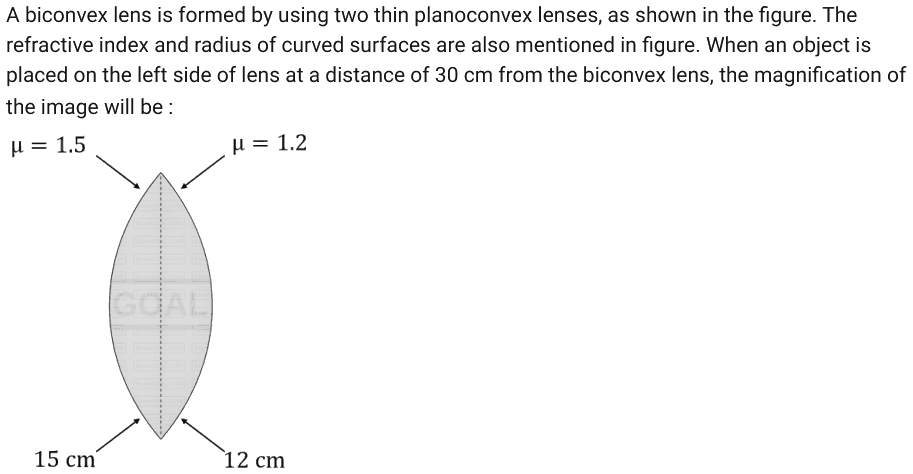
Answer: A
For a transparent prism, if the angle of minimum deviation is equal to its refracting angle, the refractive index of the prism satisfies.
Answer: B
The exit surface of a prism with refractive index is coated with a material having refractive index . When this prism is set for minimum angle of deviation, it exactly meets the condition of critical angle. The prism angle is ____ .
Answer: A
In a microscope of tube length two convex lenses are arranged with focal length of and . Total magnification obtained with this system for normal adjustment is . The value of is ____ .
Answer: C
A thin prism with angle of refractive index 1.72 is combined with another prism of refractive index 1.9 to produce dispersion without deviation. The angle of second prism is ____ .
Answer: B
Consider light travelling from a medium to medium separated by a plane interface. If the light undergoes total internal reflection during its travel from medium to and the speed of light in media and are and , respectively, then the value of critical angle is :
Answer: D
