205 questions asked across 20 exam years, newest first
A monochromatic light is incident at a certain angle on an equilateral triangular prism and suffers minimum deviation. If the refractive index of the material of the prism is , then the angle of incidence is:
Answer: A
A convex lens is put 10 cm from a light source and it makes a sharp image on a screen, kept 10 cm from the lens. Now a glass block (refractive index 1.5) of 1.5 cm thickness is placed in contact with the light source. To get the sharp image again, the screen is shifted by a distance d. Then d is :
Answer: D
A ray of light is incident at an angle of on one face of a prism of angle . The emergent ray of light makes an angle of with incident ray. The angle made by the emergent ray with second face of prism will be :
Answer: B
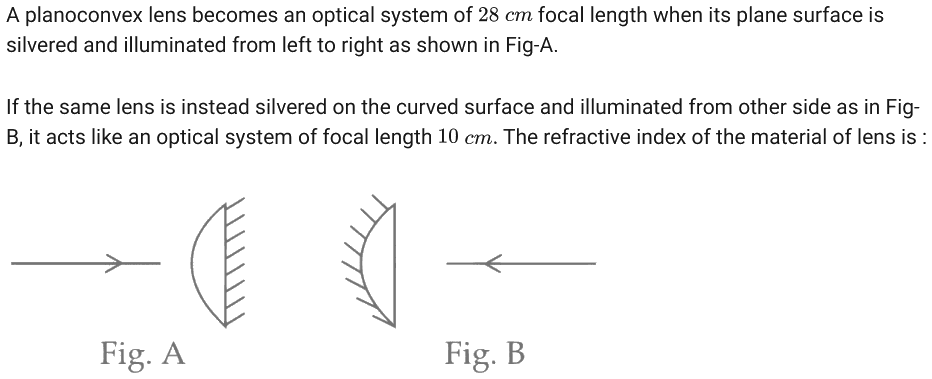
Answer: B
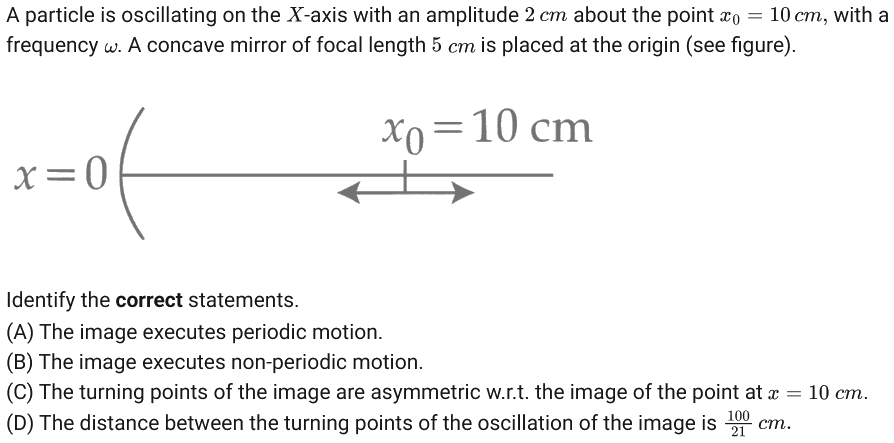
Answer: B
In an experiment a convex lens of focal length 15 cm is placed coaxially on an optical bench in front of a convex mirror at a distance of 5 cm from it. It is found that an object and its image coincide, if the object is placed at a distance of 20 cm from the lens. The focal length of the convex mirror is :
Answer: A
Let the refractive index of a denser medium with respect to a rarer medium be and its critical angle be . At an angle of incidence A when light is travelling from denser medium to rarer medium, a part of the light is reflected and the rest is refracted and the angle between reflected and refracted rays is . Angle A is given by :
Answer: D
An observer looks at a distant tree of height with a telescope of magnifying power of 20. To the observer the tree appears:
Answer: B
In an experiment for determination of refractive index of glass of a prism by plot, it was found that a ray incident at angle , suffers a deviation of and that it emerges at angle . In that case which of the following is closest to the maximum possible value of the refractive index?
Answer: C
On a hot summer night, the refractive index of air is smallest near the ground and increases with height from the ground. When a light beam is directed horizontally, the Huygens' principle leads us to conclude that as it travels, the light beam :
Answer: B
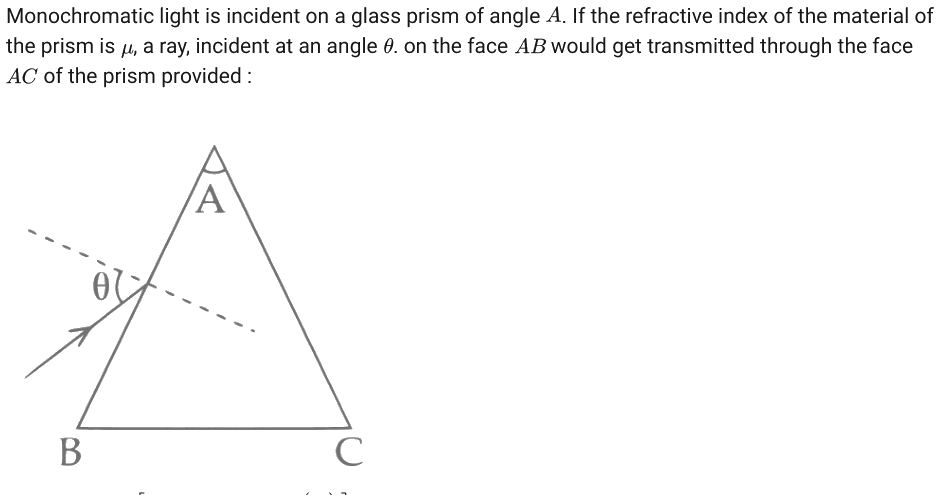
Answer: C
A thin convex lens made from crown glass () has focal length . When it is measured in two different liquids having refractive indices and , it has the focal lengths and respectively. The correct relation between the focal lengths is :
Answer: B
A green light is incident from the water to the air - water interface at the critical angle (). Select the correct statement.
Answer: B
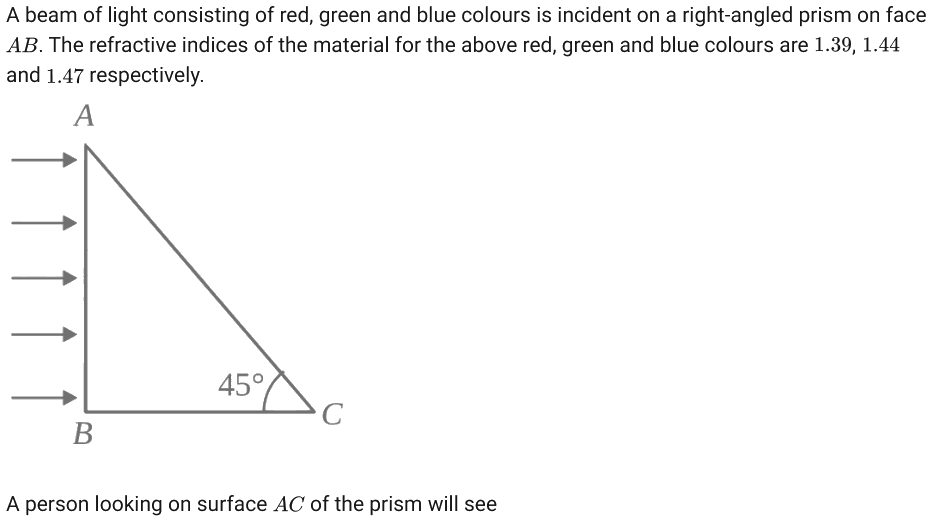
Answer: D
A telescope of aperture diameter is focused on a window at distance fitted with a wire mesh of spacing . Given: , which of the following is true for observing the mesh through the telescope?
Answer: A
We wish to make a microscope with the help of two positive lenses both with a focal length of each and the object is positioned from the objective lens. How far apart the lenses should be so that the final image is formed at infinity?
Answer: C
This question has Statement 1 and Statement 2. Of the four choices given after the Statements, choose the one that best describes the two Statements. Statement 1: Bats emitting ultrasonic waves can detect the location of a prey by hearing the waves reflected from it. Statement 2: When the source and the detector are moving, the frequency of reflected waves is changed.
Answer: C
Which of the following processes play a part in the formation of a rainbow? (i) Refraction (ii) Total internal reflection (iii) Dispersion (iv) Interference
Answer: A
An initially parallel cylindrical beam travels in a medium of refractive index , where and are positive constants and is the intensity of the light beam. The intensity of the beam is decreasing with increasing radius. As the beam enters the medium, it will
Answer: B
An initially parallel cylindrical beam travels in a medium of refractive index , where and are positive constants and is the intensity of the light beam. The intensity of the beam is decreasing with increasing radius. The initial shape of the wavefront of the beam is
Answer: D
An initially parallel cylindrical beam travels in a medium of refractive index , where and are positive constants and is the intensity of the light beam. The intensity of the beam is decreasing with increasing radius. The speed of light in the medium is
Answer: A
In an optics experiment, with the position of the object fixed, a student varies the position of a convex lens and for each position, the screen is adjusted to get a clear image of the object. A graph between the object distance and the image distance , from the lens, is plotted using the same scale for the two axes. A straight line passing through the origin and making an angle of with the -axis meets the experimental curve at . The coordinates of will be :
Answer: D
The refractive index of a glass is 1.520 for red light and 1.525 for blue light. Let and be angles of minimum deviation for red and blue light respectively in a prism of this glass. Then,
Answer: A
A fish looking up through the water sees the outside world contained in a circular horizon. If the refractive index of water is and the fish is below the surface, the radius of this circle in is
Answer: A
A thin glass (refractive index 1.5) lens has optical power of in air. Its optical power in a liquid medium with refractive index 1.6 will be
Answer: B
