205 questions asked across 20 exam years, newest first
A light ray enters a solid glass sphere of refractive index at an angle of incidence . The ray is both reflected and refracted at the farther surface of the sphere. The angle (in degrees) between the reflected and refracted rays at this surface is _______.
Answer: 90
A vessel of depth 2h is half filled with a liquid of refractive index and the upper half with another liquid of refractive index . The liquids are immiscible. The apparent depth of the inner surface of the bottom of vessel will be :
Answer: C
The aperture diameter of a telescope is 5m. The separation between the moon and the earth is . With light of wavelength of , the minimum separation between objects on the surface of moon, so that they are just resolved, is close to :
Answer: D
There is a small source of light at some depth below the surface of water (refractive index = ) in a tank of large cross sectional surface area. Neglecting any reflection from the bottom and absorption by water, percentage of light that emerges out of surface is (nearly) : [Use the fact that surface area of a spherical cap of height h and radius of curvature r is ]:
Answer: A
The magnifying power of a telescope with tube 60 cm is 5. What is the focal length of its eye piece ?
Answer: B
A point object in air is in front of the curved surface of a plano-convex lens. The radius of curvature of the curved surface is 30 cm and the refractive index of the lens material is 1.5, then the focal length of the lens (in cm) is ______.
Answer: 60

Answer: C
If we need a magnification of 375 from a compound microscope of tube length 150 mm and an objective of focal length 5 mm, the focal length of the eye-piece, should be close to :
Answer: A
A thin lens made of glass (refractive index = 1.5) of focal length f = 16 cm is immersed in a liquid of refractive index 1.42. If its focal length in liquid is , then the ratio is closest to the integer :
Answer: C
The value of numerical aperature of the objective lens of a microscope is 1.25. If light of wavelength is used, the minimum separation between two points, to be seen as distinct, will be :
Answer: C
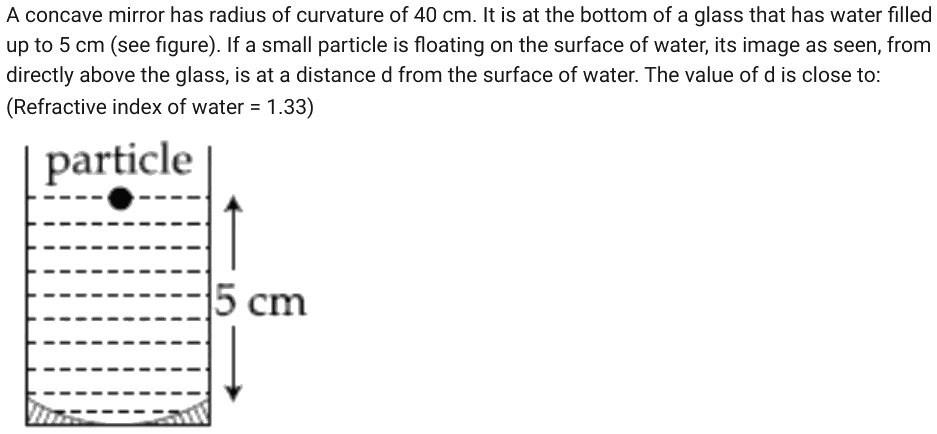
Answer: D
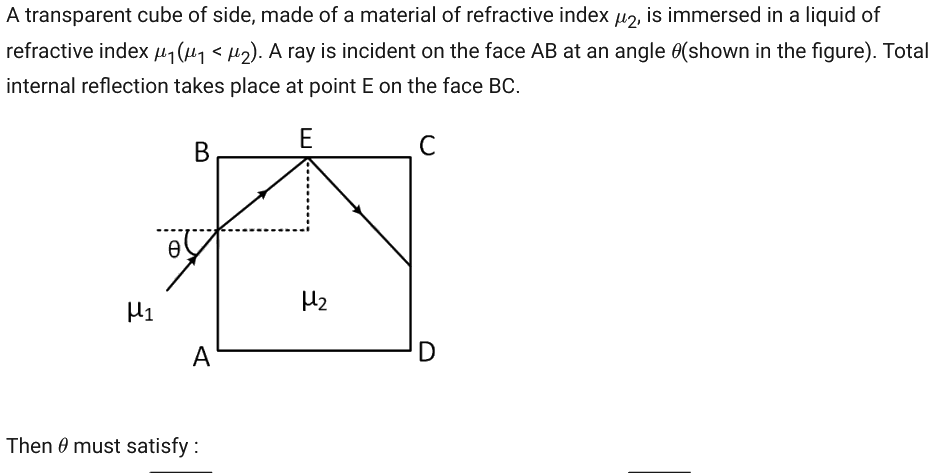
Answer: B
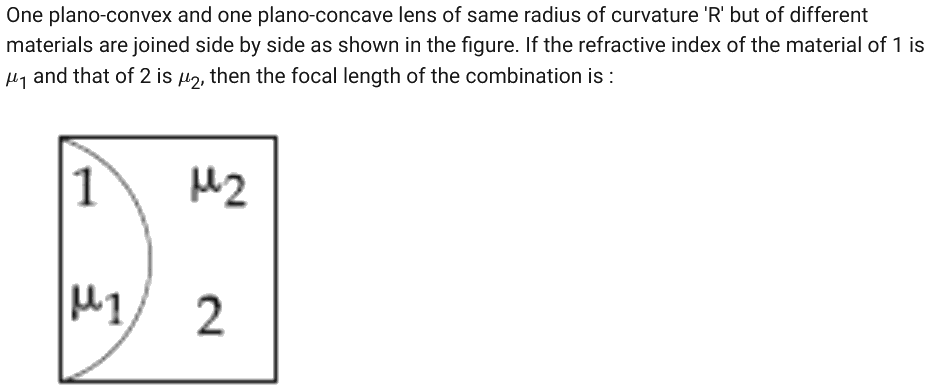
Answer: C
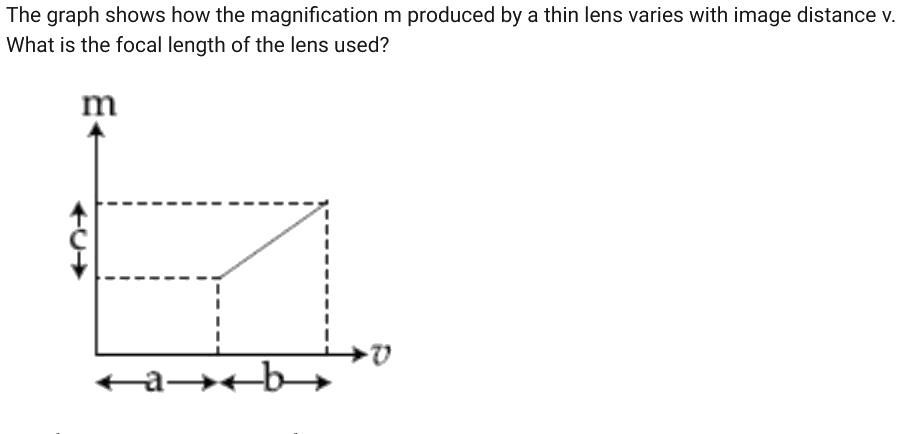
Answer: D
A concave mirror for face viewing has focal length of 0.4 m. The distance at which you hold the mirror from your face in order to see your image upright with a magnification of 5 is :
Answer: B
Answer: D
A convex lens of focal length 20 cm produces images of the same magnification 2 when an object is kept at two distances and from the lens. The ratio of and is :-
Answer: A
Diameter of the objective lens of a telescope is 250 cm. For light of wavelength 600nm. coming from a distant object, the limit of resolution of the telescope is close to :-
Answer: A
energy density of sunlight is normally incident on the surface of a solar panel. Some part of incident energy (25%) is reflected from the surface and the rest is absorbed. The force exerted on surface area will be close to :-
Answer: A
Calculate the limit of resolution of a telescope objective having a diameter of 200 cm, if it has to detect light of wavelength 500 nm coming from a star :-
Answer: C
A convex lens (of focal length 20 cm) and a concave mirror, having their principal axes along the same lines, are kept 80 cm apart from each other. The concave mirror is to the right of the convex lens. When an object is kept at a distance of 30 cm to the left of the convex lens, its image remains at the same position even if the concave mirror is removed. The maximum distance of the object for which this concave mirror, by itself would produce a virtual image would be :-
Answer: B
Answer: C
Answer: B
A plano-convex lens (focal length , refractive index , radius of curvature R) fits exactly into a plano-concave lens (focal length , refractive index , radius of curvature R). Their plane surfaces are parallel to each other. Then, the focal length of the combination will be :
Answer: C
Answer: A
