205 questions asked across 20 exam years, newest first
In an experiment for estimating the value of focal length of converging mirror, image of an object placed at from the pole of the mirror is formed at distance from the pole of the mirror. These distances are measured with a modified scale in which there are 20 small divisions in . The value of error in measurement of focal length of the mirror is . The value of K is __________.
Answer: 32
A point source of light is placed at the centre of curvature of a hemispherical surface. The source emits a power of . The radius of curvature of hemisphere is and the inner surface is completely reflecting. The force on the hemisphere due to the light falling on it is _________ .
Answer: 4
A scientist is observing a bacteria through a compound microscope. For better analysis and to improve its resolving power he should. (Select the best option)
Answer: C
A ray of light is incident from air on a glass plate having thickness cm and refractive index . The angle of incidence of a ray is equal to the critical angle for glass-air interface. The lateral displacement of the ray when it passes through the plate is ____ cm. (given )
Answer: 52
The light rays from an object have been reflected towards an observer from a standard flat mirror, the image observed by the observer is :- A. Real B. Erect C. Smaller in size than object D. Laterally inverted Choose the most appropriate answer from the options given below :
Answer: A
An object is placed on the principal axis of convex lens of focal length 10cm as shown. A plane mirror is placed on the other side of lens at a distance of 20 cm. The image produced by the plane mirror is 5cm inside the mirror. The distance of the object from the lens is ____ cm.
Answer: 30
Given below are two statements : Statement I : If the Brewster's angle for the light propagating from air to glass is , then the Brewster's angle for the light propagating from glass to air is Statement II : The Brewster's angle for the light propagating from glass to air is where is the refractive index of glass. In the light of the above statements, choose the correct answer from the options given below :
Answer: D
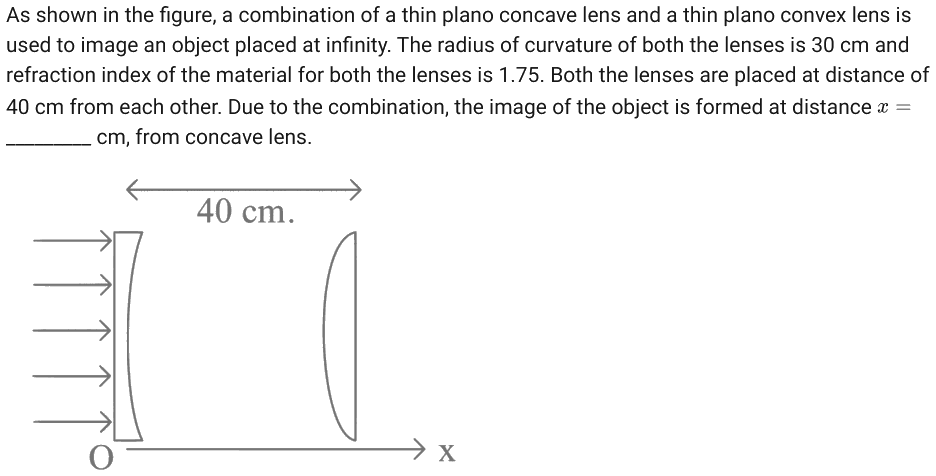
Answer: 120
When a beam of white light is allowed to pass through convex lens parallel to principal axis, the different colours of light converge at different points on the principal axis after refraction. This is called :
Answer: D
A convex lens of refractive index 1.5 and focal length 18cm in air is immersed in water. The change in focal length of the lens will be ________ cm. (Given refractive index of water )
Answer: 54
The X-Y plane be taken as the boundary between two transparent media and . in has a refractive index of and with has a refractive index of . A ray of light travelling in along the direction given by the vector , is incident on the plane of separation. The value of difference between the angle of incidence in and the angle of refraction in will be ____ degree.
Answer: 15
Light enters from air into a given medium at an angle of with interface of the air-medium surface. After refraction, the light ray is deviated through an angle of from its original direction. The refractive index of the medium is:
Answer: C
In normal adjustment, for a refracting telescope, the distance between objective and eye piece is . The focal length of the objective, when the angular magnification of the telescope is , will be :
Answer: A
The power of a lens (biconvex) is in particular medium. Refractive index of the lens is 1.5 and radii of curvature are and respectively. The refractive index of surrounding medium:
Answer: B
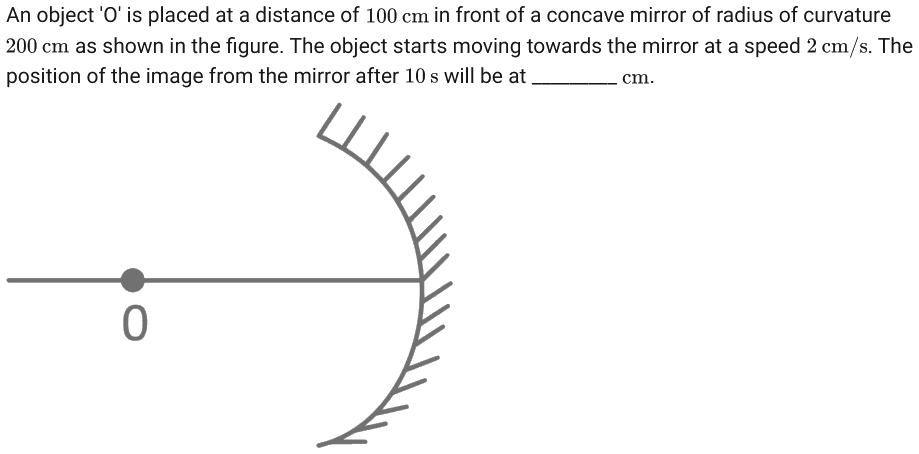
Answer: 400
In an experiment with a convex lens, The plot of the image distance () against the object distance () measured from the focus gives a curve . If all the distances are measured in cm. The magnitude of the focal length of the lens is _________ cm.
Answer: 15
A microscope was initially placed in air (refractive index 1). It is then immersed in oil (refractive index 2). For a light whose wavelength in air is , calculate the change of microscope's resolving power due to oil and choose the correct option.
Answer: B
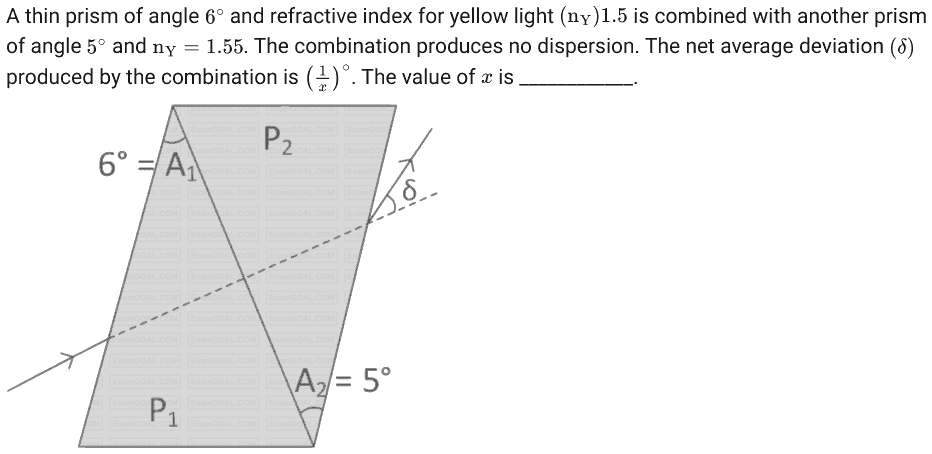
Answer: 4
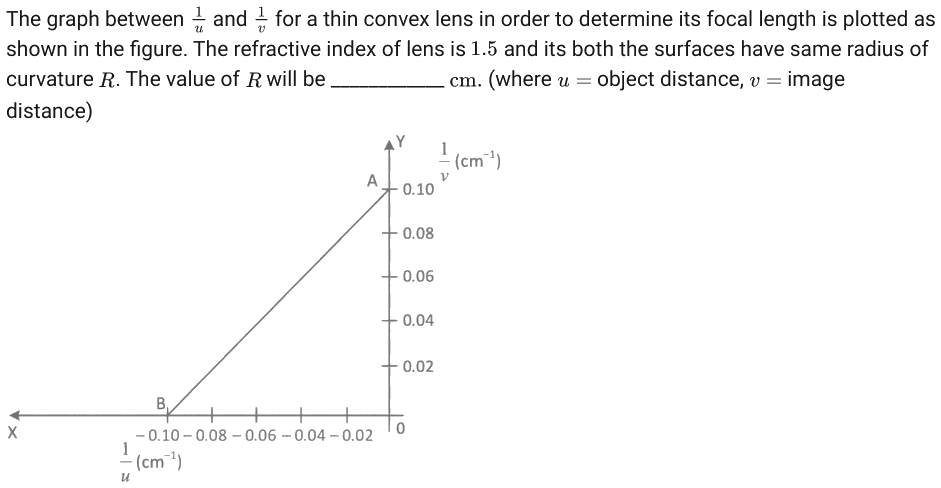
Answer: 10
For an object placed at a distance 2.4 m from a lens, a sharp focused image is observed on a screen placed at a distance 12 cm from the lens. A glass plate of refractive index 1.5 and thickness 1 cm is introduced between lens and screen such that the glass plate plane faces parallel to the screen. By what distance should the object be shifted so that a sharp focused image is observed again on the screen?
Answer: B
A convex lens of focal length 20 cm is placed in front of a convex mirror with principal axis coinciding each other. The distance between the lens and mirror is 10 cm. A point object is placed on principal axis at a distance of 60 cm from the convex lens. The image formed by combination coincides the object itself. The focal length of the convex mirror is ____________ cm.
Answer: 10
The refractive index of an equilateral prism is . The angle of emergence under minimum deviation position of prism, in degree, is ___________.
Answer: 45
Consider a light ray travelling in air is incident into a medium of refractive index . The incident angle is twice that of refracting angle. Then, the angle of incidence will be :
Answer: D
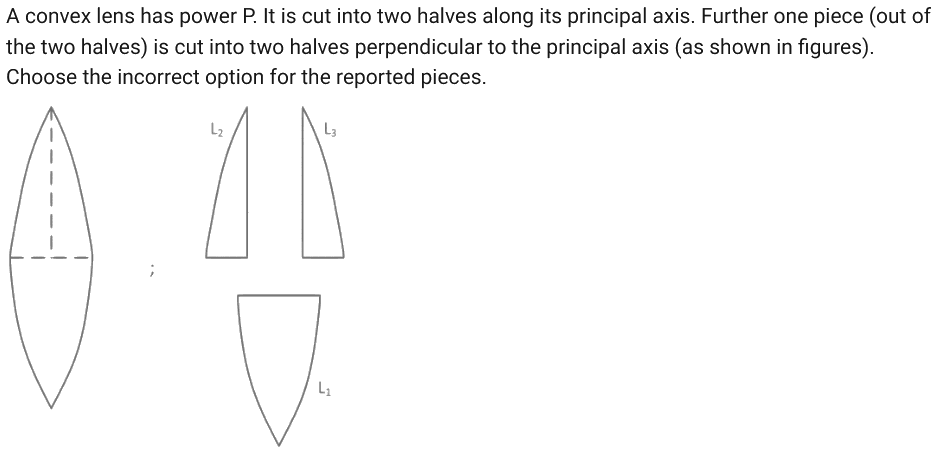
Answer: A
If a wave gets refracted into a denser medium, then which of the following is true?
Answer: C
