205 questions asked across 20 exam years, newest first
A prism of angle and refractive index is coated with thin film of refractive index 1.5 only at the back exit surface. To have total internal reflection at the back exit surface the incident angle must be _____
Answer: A, B, C
The size of the images of an object, formed by a thin lens are equal when the object is placed at two different positions 8 cm and 24 cm from the lens. The focal length of the lens is _____ cm.
Answer: 16
A thin convex lens of focal length 5 cm and a thin concave lens of focal length 4 cm are combined together (without any gap) and this combination has magnification when an object is placed 10 cm before the convex lens. Keeping the positions of convex lens and object undisturbed a gap of 1 cm is introduced between the lenses by moving the concave lens away, which lead to a change in magnification of total lens system to . The value of is ____.
Answer: B
Consider an equilateral prism (refractive index ). A ray of light is incident on its one surface at a certain angle . If the emergent ray is found to graze along the other surface then the angle of refraction at the incident surface is close to ____
Answer: D
A parallel beam of light travelling in air (refractive index 1.0) is incident on a convex spherical glass surface of radius of curvature 50 cm . Refractive index of glass is 1.5 . The rays converge to a point at a distance from the centre of the curvature of the spherical surface. The value of is ____ cm .
Answer: 100
In a microscope the objective is having focal length and eye-piece is having focal length . The tube length is 32 cm . The magnification produced by this microscope for normal adjustment is ____.
Answer: 100
A collimated beam of light of diameter 2 mm is propagating along -axis. The beam is required to be expanded in a collimated beam of diameter 14 mm using a system of two convex lenses. If first lens has focal length 40 mm , then the focal length of second lens is ____ mm.
Answer: 280
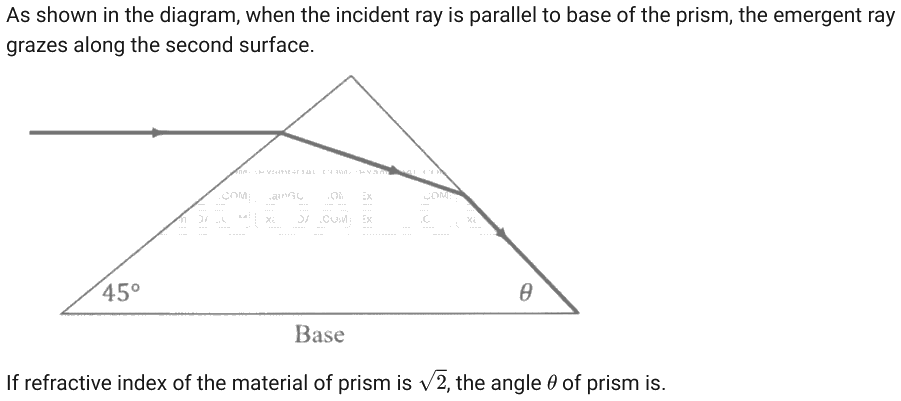
Answer: C
A convex lens of focal length is placed in contact with a concave lens of focal length . An object is placed at to the left of this lens system. The distance of the image from the lens in is .
Answer: B
A concave-convex lens of refractive index and the radii of curvature of its surfaces are and , respectively. The concave surface is upwards and is filled with a liquid of refractive index . The focal length of the liquid-glass combination will be
Answer: B
When an object is placed 40 cm away from a spherical mirror an image of magnification is produced. To obtain an image with magnification of , the object is to be moved :
Answer: D
A small mirror of mass is suspended by a massless thread of length . Then the small angle through which the thread will be deflected when a short pulse of laser of energy E falls normal on the mirror ( and )
Answer: D
Distance between object and its image (magnified by ) is 30 cm . The focal length of the mirror used is , where magnitude of value of is ____.
Answer: 45
A finite size object is placed normal to the principal axis at a distance of 30 cm from a convex mirror of focal length 30 cm . A plane mirror is now placed in such a way that the image produced by both the mirrors coincide with each other. The distance between the two mirrors is :
Answer: D
Consider following statements for refraction of light through prism, when angle of deviation is minimum. A. The refracted ray inside prism becomes parallel to the base. B. Larger angle prisms provide smaller angle of minimum deviation. C. Angle of incidence and angle of emergence becomes equal. D. There are always two sets of angle of incidence for which deviation will be same except at minimum deviation setting. E. Angle of refraction becomes double of prism angle. Choose the correct answer from the options given below :
Answer: D
The radii of curvature for a thin convex lens are 10 cm and 15 cm respectively. The focal length of the lens is 12 cm . The refractive index of the lens material is
Answer: C
A monochromatic light of frequency travelling through air, is incident on a medium of refractive index ' 2 '. Wavelength of the refracted light will be :
Answer: B
Light from a point source in air falls on a spherical glass surface (refractive index, and radius of curvature ). The image is formed at a distance of from the glass surface inside the glass. The magnitude of distance of the light source from the glass surface is __________.
Answer: 4
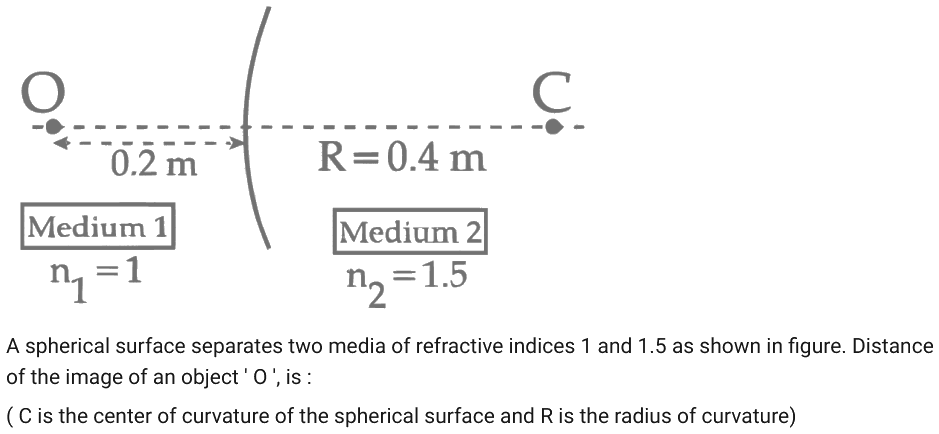
Answer: C
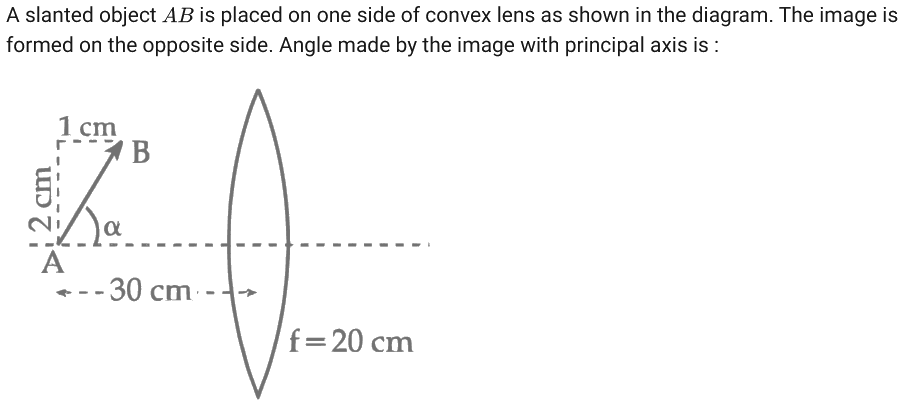
Answer: C
Two identical objects are placed in front of convex mirror and concave mirror having same radii of curvature of , at same distance of from the respective mirrors. The ratio of sizes of the images formed by convex mirror and by concave mirror is :
Answer: B
A bi-convex lens has radius of curvature of both the surfaces same as . If this lens is required to be replaced by another convex lens having different radii of curvatures on both sides , without any change in lens power then possible combination of and is :
Answer: B
A ray of light suffers minimum deviation when incident on a prism having angle of the prism equal to . The refractive index of the prism material is . The angle of incidence (in degrees) is ____.
Answer: 45
A convex lens made of glass (refractive index = 1.5) has focal length 24 cm in air. When it is totally immersed in water (refractive index = 1.33), its focal length changes to
Answer: A
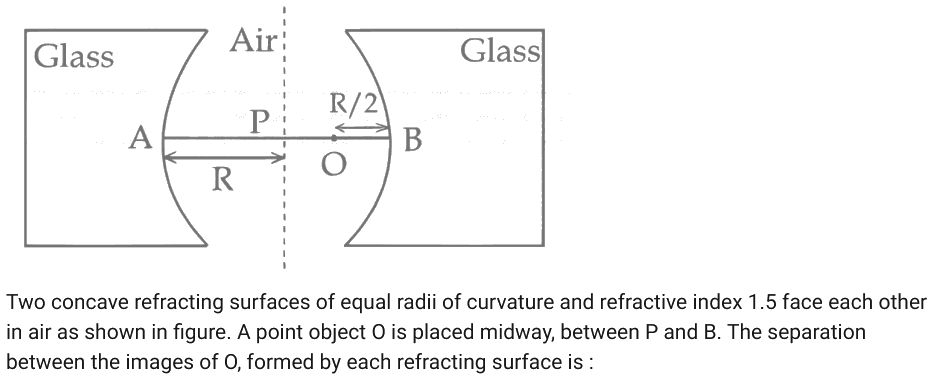
Answer: B
