429 questions asked across 20 exam years, newest first
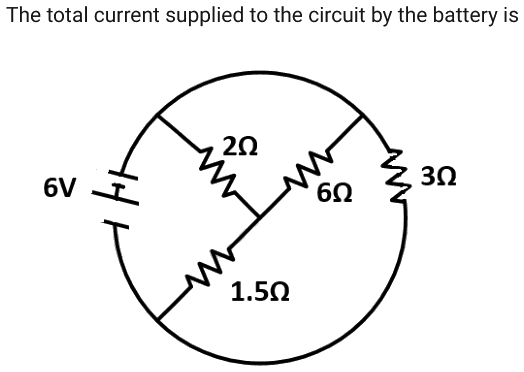
Answer: A
The resistance of the series combination of two resistances is . When they are joined in parallel the total resistance is . If then the minimum possible value of is
Answer: C
An electric current is passed through a circuit containing two wires of the same material, connected in parallel. If the lengths and radii are in the ratio of and , then the ratio of the current passing through the wires will be
Answer: B
In a meter bridge experiment null point is obtained at , from one end of the wire when resistance is balanced against another resistance . If , then where will be the new position of the null point from the same end, if one decides to balance a resistance of against
Answer: C
The Kirchhoff's first law and second law , where the symbols have their usual meanings, are respectively based on
Answer: D
A material has twice the specific resistance of . A circular wire made of has twice the diameter of a wire made of . Then for the two wires to have the same resistance, the ratio of their respective lengths must be
Answer: D
In an series circuit, the voltage across each of the components, and is . The voltage across the combination will be :
Answer: D
A coil having turns and resistance is connected with a galvanometer of resistance . This combination is moved in time seconds from a magnetic field weber to weber. The induced current in the circuit is
Answer: B
In a uniform magnetic field of induction a wire in the form of a semicircle of radius rotates about the diameter of the circle with an angular frequency . The axis of rotation is perpendicular to the field. If the total resistance of the circuit is , the mean power generated per period of rotation is
Answer: B
A piece of copper and another of germanium are cooled from room temperature to , the resistance of
Answer: D
