PaperYodha

Prepare

Mock TestsLive TestsPrevious Year PapersPractice
PaperYodha
Previous Year Papers· Real papers, shift-wise

PaperYodha

One platform for SSC, Defence and Engineering entrance exams: mocks in each exam's official pattern, weekly all-India live tests, real previous-year papers and topic-wise practice.

Coming soon: IBPS PO · SBI Clerk · MPPSC · CAT

SSC

  • SSC CGL
  • SSC CHSL
  • SSC MTS
  • SSC GD Constable

Defence & Engineering

  • NDA
  • JEE Main
  • JEE Advanced

Platform

  • Mock tests
  • Live tests
  • Previous year papers
  • Practice

AboutContactPrivacy noticeTerms of usePricingRefunds & cancellationYour data

PaperYodha is an independent preparation platform and is not affiliated with the Staff Selection Commission, UPSC, the National Testing Agency or the IITs. Mock questions are original. Exam patterns are taken from published sources; always confirm details in the official notification.

MocksLivePYQsPractice
Mock TestsLive TestsPrevious Year PapersPractice
MocksLivePYQsPractice
← JEE Main topics

Other Chemistry · JEE Main previous year questions

650 questions asked across 20 exam years, newest first

Other Chemistry has appeared 650 times in JEE Main papers between 2002 and 2026, about 4.7 questions per paper, from 25 per paper in 2002 to 2.6 per paper in 2026. Every question is listed below with its answer and the paper it came from. Use Practise this topic to attempt them as a timed set.

Year-wise papersTopic-wise questions
Practise this topic
All years 6502026 442025 342024 852023 962022 742021 582020 542019 552018 142017 142016 92015 62014 62012 282010 72009 52006 92005 132004 142002 25

2012 28 questions

  1. Q842012 · 7 May 2012 · Shift 1

    Which of the oxide groups among the following cannot be reduced by carbon?

    1. A.Cu2​O,SnO2​
    2. B.CaO,K2​O
    3. C.PbO,Fe3​O4​
    4. D.Fe2​O3​,ZnO
    Show answer

    Answer: B

  2. Q862012 · 7 May 2012 · Shift 1

    Among the following which is the best description of water in the solid phase?

    1. A.Covalent solid
    2. B.Molecular solid
    3. C.Ionic solid
    4. D.Network solid
    Show answer

    Answer: B

2010 7 questions

  1. Q622010 · 25 Apr 2010 · Shift 1

    Ionisation energy of He+ is 19.6×10⁻¹⁸ J atom−1. The energy of the first stationary state (n=1) of Li2+ is

    1. A.4.41×10−16 J atom−1
    2. B.−4.41×10⁻¹⁷ J atom−1
    3. C.−2.2×10⁻¹⁵ J atom−1
    4. D.8.82×10−17 J atom−1
    Show answer

    Answer: B

  2. Q662010 · 25 Apr 2010 · Shift 1

    Three reactions involving H2​PO4−​ are given below : (i) H3​PO4​+H2​O→H3​O++H2​PO4−​ (ii) H2​PO4−​+H2​O→HPO42−​+H3​O+ (iii) H2​PO4−​+OH−→H3​PO4​+O2− In which of the above does H2​PO4−​ act as an acid?

    1. A.(ii) only
    2. B.(i) and (ii)
    3. C.(iii) only
    4. D.(i) only
    Show answer

    Answer: A

  3. Q672010 · 25 Apr 2010 · Shift 1

    In aqueous solution the ionization constants for carbonic acid are K1​=4.2×10⁻⁷ and K2​=4.8×10⁻¹¹ Select the correct statement for a saturated 0.034 M solution of the carbonic acid.

    1. A.The concentration of CO32−​ is 0.034 M.
    2. B.The concentration of CO32−​ is greater than that of HCO3−​
    3. C.The concentration of H+ and HCO3−​ are approximately equal.
    4. D.The concentration of H+ is double that of CO32−​.
    Show answer

    Answer: C

  4. Q762010 · 25 Apr 2010 · Shift 1

    The correct order of EM2+/Mo​ values with negative sign for the four successive elements Cr, Mn, Fe and Co is :

    1. A.Mn>Cr>Fe>Co
    2. B.Cr>Fe>Mn>Co
    3. C.Fe>Mn>Cr>Co
    4. D.Cr>Mn>Fe>Co
    Show answer

    Answer: A

  5. Q832010 · 25 Apr 2010 · Shift 1

    Biuret test is not given by

    1. A.carbohydrates
    2. B.polypeptides
    3. C.urea
    4. D.proteins
    Show answer

    Answer: A

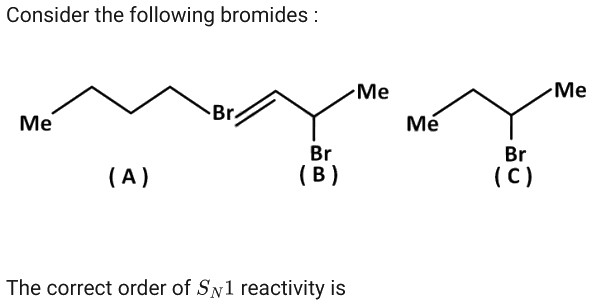
  6. Q842010 · 25 Apr 2010 · Shift 1
    Chemistry question 24 as printed in the paper
    1. A.B>C>A
    2. B.B>A>C
    3. C.C>B>A
    4. D.A>B>C
    Show answer

    Answer: A

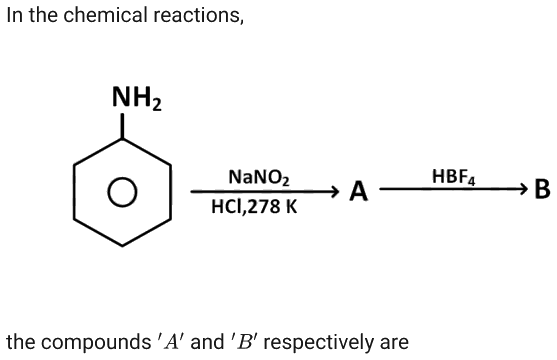
  7. Q862010 · 25 Apr 2010 · Shift 1
    Chemistry question 26 as printed in the paper
    1. A.nitrobenzene and fluorobenzene
    2. B.phenol and benzene
    3. C.benzene diazonium chloride and fluorobenzene
    4. D.nitrobenzene and chlorobenzene
    Show answer

    Answer: C

2009 5 questions

  1. Q612009 · 27 Apr 2009 · Shift 1

    Calculate the wavelength (in nanometer) associated with a proton moving at 1.0×10³ ms−1 (Mass of proton=1.67×10⁻²⁷ kg and h=6.63×10⁻³⁴ Js) :

    1. A.0.40 nm
    2. B.2.5 nm
    3. C.14.0 nm
    4. D.0.032 nm
    Show answer

    Answer: A

  2. Q622009 · 27 Apr 2009 · Shift 1

    In an atom, an electron is moving with a speed of 600 m/s with an accuracy of 0.005%. Certainity with which the position of the electron can be located is (h=6.6×10⁻³⁴ kg m2s−1, mass of electron, em​=9.1×10⁻³¹ kg)

    1. A.5.10×10−3 m
    2. B.1.92×10−3 m
    3. C.3.84×10−3 m
    4. D.1.52×10−4 m
    Show answer

    Answer: B

  3. Q632009 · 27 Apr 2009 · Shift 1

    In which of the following arrangements, the sequence is not strictly according to the property written against it

    1. A.CO2​<SiO2​<SnO2​<PbO2​ : increasing oxidising power
    2. B.HF<HCl<HBr<HI : increasing acid strength
    3. C.NH3​<PH3​<AsH3​<SbH3​ : increasing basic strength
    4. D.B<C<O<N : increasing first ionization enthalpy
    Show answer

    Answer: C

  4. Q752009 · 27 Apr 2009 · Shift 1

    The half life period of a first order chemical reaction is 6.93 minutes. The time required for the completion of 99% of the chemical reaction will be (log 2=0.301) :

    1. A.230.3 minutes
    2. B.23.03 minutes
    3. C.46.06 minutes
    4. D.460.6 minutes
    Show answer

    Answer: C

  5. Q872009 · 27 Apr 2009 · Shift 1

    Which of the following statements is incorrect regarding physisorption ?

    1. A.It occurs because of van der Waals forces.
    2. B.More easily liquefiable gases are adsorbed readily.
    3. C.Under high pressure it results into multi molecular layer on adsorbent surface.
    4. D.Enthalpy of adsorption (ΔHadsorption​ ) is low and positive
    Show answer

    Answer: D

2006 9 questions

  1. Q1022006 · 29 Apr 2006 · Shift 1

    Which of the following molecules/ions does not contain unpaired electrons?

    1. A.O22−​
    2. B.B2​
    3. C.N2+​
    4. D.O2​
    Show answer

    Answer: A

  2. Q1032006 · 29 Apr 2006 · Shift 1

    In which of the following molecules/ions are all the bonds not equal?

    1. A.XeF4​
    2. B.BF4−​
    3. C.SF4​
    4. D.SiF4​
    Show answer

    Answer: C

  3. Q1152006 · 29 Apr 2006 · Shift 1

    Among the following mixtures, dipole-dipole as the major interaction, is present in

    1. A.benzene and ethanol
    2. B.acetonitrile and acetone
    3. C.KCl and water
    4. D.benzene and carbon tetrachloride
    Show answer

    Answer: B

  4. Q1172006 · 29 Apr 2006 · Shift 1

    Which of the following chemical reactions depicts the oxidizing behaviour of H2​SO4​?

    1. A.NaCl+H2​SO4​→NaHSO4​+HCl
    2. B.2PCl5​+H2​SO4​→2POCl3​+2HCl+SO2​Cl2​
    3. C.2HI+H2​SO4​→I2​+SO2​+2H2​O
    4. D.Ca(OH)2​+H2​SO4​→CaSO4​+2H2​O
    Show answer

    Answer: C

  5. Q1182006 · 29 Apr 2006 · Shift 1

    The molar conductivities ∧NaOAc∘​ and ∧HCl∘​ and at infinite dilution in water at 25∘C are 91.0 and 426.2 Scm2/mol respectively. To calculate ∧HOAc∘​, the additional value required is

    1. A.∧H2​O∘​
    2. B.∧KCl∘​
    3. C.∧NaOH∘​
    4. D.∧NaCl∘​
    Show answer

    Answer: D

  6. Q1242006 · 29 Apr 2006 · Shift 1

    Which of the following statements is true?

    1. A.H3​PO3​ is a stronger acid than H2​SO3​
    2. B.In aqueous medium HF is a stronger acid than HCl
    3. C.HClO4​ is a weaker acid than HClO3​
    4. D.HNO3​ is a stronger acid than HNO2​
    Show answer

    Answer: D

  7. Q1302006 · 29 Apr 2006 · Shift 1

    In Fe(CO)5​, the Fe−C bond possesses :

    1. A.π-character only
    2. B.both σ and π characters
    3. C.ionic character
    4. D.σ-character
    Show answer

    Answer: B

  8. Q1352006 · 29 Apr 2006 · Shift 1

    HBr reacts with CH2​=CH−OCH3​ under anhydrous conditions at room temperature to give

    1. A.CH3​CHO and CH3​Br
    2. B.BrCH2​CHO and CH3​OH
    3. C.BrCH2​−CH2​−OCH3​
    4. D.H3​C−CHBr−OCH3​
    Show answer

    Answer: D

  9. Q1362006 · 29 Apr 2006 · Shift 1

    The increasing order of the rate of HCN addition to compounds A – D is (A) HCHO (B) CH3​COCH3​ (C) PhCOCH3​ (D) PhCOPh

    1. A.A<B<C<D
    2. B.D<B<C<A
    3. C.D<C<B<A
    4. D.C<D<B<A
    Show answer

    Answer: C

2005 13 questions

  1. Q1552005 · 28 Apr 2005 · Shift 1

    Which of the following oxides is amphoteric in character?

    1. A.CaO
    2. B.CO2​
    3. C.SiO2​
    4. D.SnO2​
    Show answer

    Answer: D

  2. Q1562005 · 28 Apr 2005 · Shift 1

    In which of the following arrangements the order is NOT according to the property indicated against it?

    1. A.Li<Na<K<Rb Increasing metallic radius
    2. B.I<Br<F<Cl Increasing electron gain enthalpy (with negative sign)
    3. C.B<C<N<O Increasing first ionization enthalpy
    4. D.Al3+<Mg2+<Na+<F− Increasing ionic size
    Show answer

    Answer: C

More Chemistry topics in JEE Main

  • Chemical & Ionic Equilibrium (277)
  • Organic Reactions & Conversions (262)
  • General Organic Chemistry & Isomerism (235)
  • p-Block Elements (193)
  • Mole Concept & Stoichiometry (179)
  • Atomic Structure (177)
  • Chemical Bonding (174)
  • Coordination Compounds (169)
← PreviousPage 24 of 26Next →