650 questions asked across 20 exam years, newest first
Other Chemistry has appeared 650 times in JEE Main papers between 2002 and 2026, about 4.7 questions per paper, from 25 per paper in 2002 to 2.6 per paper in 2026. Every question is listed below with its answer and the paper it came from. Use Practise this topic to attempt them as a timed set.
Which of the oxide groups among the following cannot be reduced by carbon?
Answer: B
Among the following which is the best description of water in the solid phase?
Answer: B
Ionisation energy of is . The energy of the first stationary state () of is
Answer: B
Three reactions involving are given below : (i) (ii) (iii) In which of the above does act as an acid?
Answer: A
In aqueous solution the ionization constants for carbonic acid are and Select the correct statement for a saturated 0.034 M solution of the carbonic acid.
Answer: C
The correct order of values with negative sign for the four successive elements Cr, Mn, Fe and Co is :
Answer: A
Biuret test is not given by
Answer: A
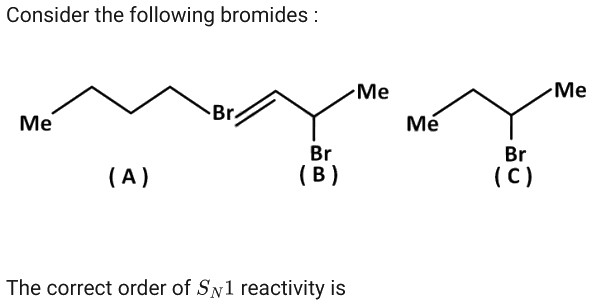
Answer: A
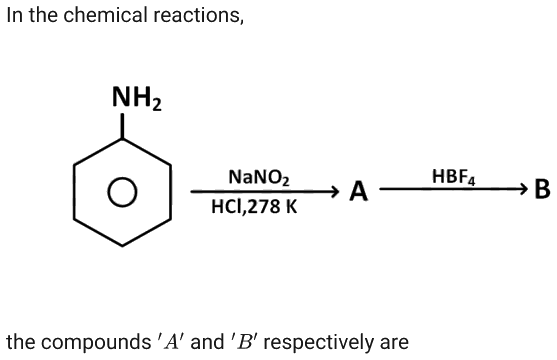
Answer: C
Calculate the wavelength (in nanometer) associated with a proton moving at (Mass of and ) :
Answer: A
In an atom, an electron is moving with a speed of with an accuracy of . Certainity with which the position of the electron can be located is (, mass of electron, )
Answer: B
In which of the following arrangements, the sequence is not strictly according to the property written against it
Answer: C
The half life period of a first order chemical reaction is 6.93 minutes. The time required for the completion of 99% of the chemical reaction will be (log 2=0.301) :
Answer: C
Which of the following statements is incorrect regarding physisorption ?
Answer: D
Which of the following molecules/ions does not contain unpaired electrons?
Answer: A
In which of the following molecules/ions are all the bonds not equal?
Answer: C
Among the following mixtures, dipole-dipole as the major interaction, is present in
Answer: B
Which of the following chemical reactions depicts the oxidizing behaviour of ?
Answer: C
The molar conductivities and and at infinite dilution in water at are 91.0 and respectively. To calculate , the additional value required is
Answer: D
Which of the following statements is true?
Answer: D
In , the bond possesses :
Answer: B
HBr reacts with under anhydrous conditions at room temperature to give
Answer: D
The increasing order of the rate of HCN addition to compounds A – D is (A) HCHO (B) (C) (D) PhCOPh
Answer: C
Which of the following oxides is amphoteric in character?
Answer: D
In which of the following arrangements the order is NOT according to the property indicated against it?
Answer: C
