349 questions asked across 4 exam years, newest first
Select the correct combination of mathematical signs to sequentially replace the * signs and balance the given equation. 45 * 86 * 23 * 36 * 18 * 2021
Answer: D
Select the correct combination of mathematical signs that can sequentially replace the * signs and balance the given equation. 12 * 70 * 5 * 5 * 5 * 11 * 2
Answer: A
Select the correct combination of mathematical signs to sequentially replace the * signs and balance the given equation. 76 * 4 * 26 * 13 * 9 * 62
Answer: C
Which of the following interchanges of signs would make the given equation correct? 1000 - 448 + 14 ÷ 15 × 2 = 998
Answer: A
Which two signs and two numbers should be interchanged in the following equation to make it correct? 15 ÷ 80 - 34 + 10 × 8 = 102
Answer: C
Which of the following interchanges of signs would make the given equation correct? 50 - 25 ÷ 5 × 3 + 6 = 59
Answer: D
Which two signs and two numbers should be interchanged to make the following equation correct? 784 ÷ 6 × 9 - 30 + 14 = 528
Answer: A
Study the given pattern carefully and select the number that can replace the question mark (?) in it. First row: 16, 15, 35 Second row: 12, 18, 33 Third row: 8, 17, ? (NOTE: Operations should be performed on the whole numbers, without breaking down the number into its constituent digits. For example, 13 - Operations on 13 such as adding/subtracting/multiplying etc. to 13 can be performed. Breaking down 13 into 1 and 3 and then performing mathematical operations on 1 and 3 is not allowed.)
Answer: B
Which two signs should be interchanged to make the given equation correct? 3 × 12 - 6 ÷ 2 + 12 = 16
Answer: C
Study the given pattern carefully and select the number that can replace the question mark (?) in it. (6, 1, 18) (5, 4, 60) (6, 2, ?) (NOTE: Operations should be performed on the whole numbers, without breaking down the numbers into its constituent digits. E.g. 13 – Operations on 13 such as adding/subtracting/multiplying etc. to 13 can be performed. Breaking down 13 into 1 and 3 and then performing mathematical operations on 1 and 3 is not allowed)
Answer: A
Select the correct combination of mathematical signs to sequentially replace the * signs and to balance the given equation. 18 * 3 * 12 * 9 * 3 * 111
Answer: A
Which two signs and two numbers should be interchanged to make the following equation correct? 840 ÷ 38 - 7 + 10 × 12 = 462
Answer: B
Select the correct combination of mathematical signs to sequentially replace the * signs and balance the given equation. 9 * 16 * 64 * 8 * 2 * 9
Answer: C
Which of the following interchanges of signs would make the given equation correct? 162 ÷ 3 + 5 × 6 - 2 = 274
Answer: D
Select the correct combination of mathematical signs to sequentially fill in the boxes and to balance the given equation.
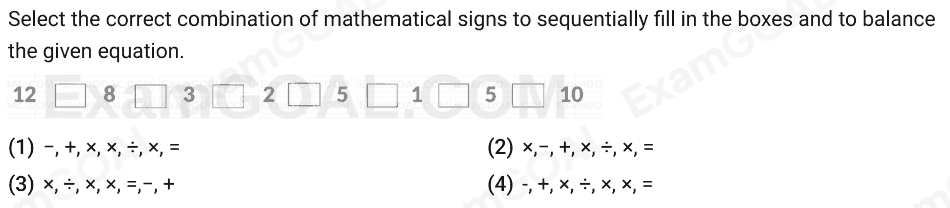
Answer: D
Study the given pattern carefully and select the number that can replace the question mark (?) in it. (2, 2, 4) (1, 6, 6) (7, 2, ?) (NOTE: Operations should be performed on the whole numbers, without breaking down the numbers into its constituent digits. E.g. 13 - Operations on 13 such as adding/subtracting/multiplying etc. to 13 can be performed. Breaking down 13 into 1 and 3 and then performing mathematical operations on 1 and 3 is not allowed)
Answer: A
Which two numbers and two signs should be interchanged in the following equation to make it correct? 3 − 17 + 3 + 16 × 8 = 60
Answer: D
Select the correct combination of mathematical signs to sequentially replace the @ signs and to balance the given equation. 72 @ 9 @3 @ 6 @ 6 @ 6 @ 6
Answer: B
Study the given pattern carefully and select the number that can replace the question mark (?) in it. (6, 8, 11) (2, 1, 2) (6, 7, ?) (NOTE: Operations should be performed on the whole numbers, without breaking down the numbers into its constituent digits. E.g. 13 - Operations on 13 such as adding/subtracting/multiplying etc. to 13 can be performed. Breaking down 13 into 1 and 3 and then performing mathematical operations on 1 and 3 is not allowed)
Answer: B
Which two signs and numbers need to be interchanged to make the following equation correct? (31 × 3) - (27 × 4) + (81 ÷ 9) = 126
Answer: D
Which of the following interchange of numbers would make the given equation correct? 5 × 15 ÷ 3 + 20 - 9 = 4
Answer: D
Select the correct combination of mathematical signs that can sequentially replace the * signs and balance the given equation. 96 * 3 * 7 * 4 * 11 = 15
Answer: D
Study the given pattern carefully and select the number that can replace the question mark (?) in it. (3, 5, 6) (5, 12, 15) (9, 4, ?) (NOTE: Operations should be performed on the whole numbers, without breaking down the numbers into its constituent digits. E.g. 13 - Operations on 13 such as adding/subtracting/multiplying etc. to 13 can be performed. Breaking down 13 into 1 and 3 and then performing mathematical operations on 1 and 3 is not allowed)
Answer: C
Which two signs should be interchanged to make the given equation correct? 459 + 17 × 12 ÷ 72 - 47 = 349
Answer: A
Study the given pattern carefully and select the number that can replace the question mark (?) in it. (5, 14, 3) (3, 24, 7) (9, 30, ?) (NOTE: Operations should be performed on the whole numbers, without breaking down the numbers into its constituent digits. E.g. 13 — Operations on 13 such as adding/subtracting/multiplying etc. to 13 can be performed. Breaking down 13 into 1 and 3 and then performing mathematical operations on 1 and 3 is not allowed)
Answer: A
