349 questions asked across 4 exam years, newest first
Which two signs should be interchanged to make the given equation correct? 2 × 236 − 2 + 36 ÷ 72 = 200
Answer: A
Study the given pattern carefully and select the number that can replace the question mark (?) in it. (16, 4, 4) (30, 5, 15) (8, 2, ?) (NOTE: Operations should be performed on the whole numbers, without breaking down the numbers into its constituent digits. E.g. 13-Operations on 13 such as adding/subtracting/multiplying etc. to 13 can be performed. Breaking down 13 into 1 and 3 and then performing mathematical operations on 1 and 3 is not allowed)
Answer: A
Which of the following interchange of numbers and signs would make the given equation correct? 512 × 64 ÷ 5 + 30 − 50 = 20
Answer: C
Which of the following interchange of numbers and signs would make the given equation correct? 24 × 9 + 6 ÷ 24 - 18 = 22
Answer: C
Which of the following interchanges of signs and numbers would make the given equation correct? 25 - 10 ÷ 5 + 15 × 30 = 55
Answer: C
Which two signs should be interchanged to make the given equation correct? 10 - 4 + 13 ÷ 15 × 3 = 71
Answer: C
Choose one of the following correct combination of mathematical signs which can be filled sequentially to balance the following equation.

Answer: C
Select the correct combination of mathematical signs that can sequentially replace the * signs and balance the given equation. 55 * 63 * 9 * 8 * 3 = 38
Answer: D
Study the given pattern carefully and select the number that can replace the question mark (?) in it. (5, 19, 4) (1, 7, 4) (6, ?, 1) (NOTE: Operations should be performed on the whole numbers, without breaking down the numbers into its constituent digits. E.g. 13 - Operations on 13 such as adding/subtracting/multiplying etc. to 13 can be performed. Breaking down 13 into 1 and 3 and then performing mathematical operations on 1 and 3 is not allowed)
Answer: C
Study the given pattern carefully and select the number that can replace the question mark (?) in it. (7, 5, 10) (2, 1, 5) (16, 6, ?) (NOTE: Operations should be performed on the whole numbers, without breaking down the numbers into its constituent digits. E.g. 13 - Operations on 13 such as adding/subtracting/multiplying etc. to 13 can be performed. Breaking down 13 into 1 and 3 and then performing mathematical operations on 1 and 3 is not allowed)
Answer: B
Which two signs should be interchanged to make the given equation correct? 1664 ÷ 4 × 2 + 712 - 316 = 436
Answer: C
Select the correct combination of mathematical signs to sequentially replace the * signs and to balance the given equation. 17 * 21 * 7 * 5 * 4 * 34
Answer: B
Select the option that represents the correct order of the given words as they would appear in an English dictionary. 1. Significant 2. Sinful 3. Signed 4. Singing 5. Simplify
Answer: A
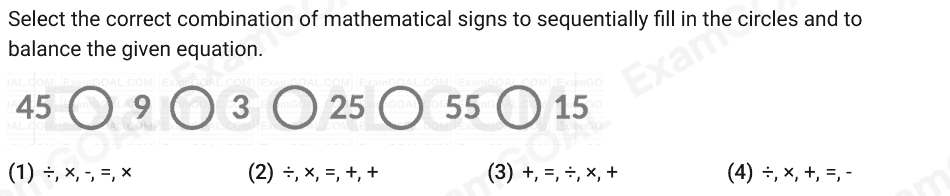
Select the correct combination of mathematical signs to sequentially fill in the circles and to balance the given equation.
Answer: D
Which two numbers and two signs should be interchanged in the following equation to make it correct? 18 - 6 + 11 × 5 + 18 = 113
Answer: C
Select the correct combination of mathematical signs to sequentially replace the * signs and balance the given equation. 76 * 34 * 23 * 12 * 6 * 21
Answer: D
Which two signs should be Interchanged to make the given equation correct? 912 - 456 × 28 + 390 ÷ 2 = 444
Answer: A
Study the given pattern carefully and select the number that can replace the question mark (?) in it. (6, 4, 6) (18, 9, 13) (8, 6, ?) (NOTE: Operations should be performed on the whole numbers, without breaking down the numbers into its constituent digits. E.g. 13 - Operations on 13 such as adding/subtracting/multiplying etc. to 13 can be performed. Breaking down 13 into 1 and 3 and then performing mathematical operations on 1 and 3 is not allowed)
Answer: D
Which two signs should be interchanged to make the given equation correct? 625 ÷ 25 + 7 × 318 - 112 = 381
Answer: D
Study the given pattern carefully and select the number that can replace the question mark (?) in it. (6, 2, 34) (1, 5, 13) (9, 1, ?) (NOTE: Operations should be performed on the whole numbers, without breaking down the numbers into its constituent digits. E.g. 13 - Operations on 13 such as adding/subtracting/multiplying etc. to 13 can be performed. Breaking down 13 into 1 and 3 and then performing mathematical operations on 1 and 3 is not allowed)
Answer: A
Select the correct combination of mathematical signs to sequentially replace the * signs and to balance the given equation. 5 * 23 * 24 * 4 * 10 * 111
Answer: C
Select the correct combination of mathematical signs that can sequentially replace the * signs and balance the given equation. 32 * 42 * 7 * 7 * 17 = 202
Answer: A
Study the given pattern carefully and select the number that can replace the question mark (?) in it. (2, 1, 5) (5, 12, 22) (6, 2, ?) (NOTE: Operations should be performed on the whole numbers, without breaking down the numbers into its constituent digits. E.g. 13 — Operations on 13 such as adding/subtracting/multiplying etc. to 13 can be performed. Breaking down 13 into 1 and 3 and then performing mathematical operations on 1 and 3 is not allowed)
Answer: B
Which of the following interchanges of signs would make the given equation correct? 100 + 100 × 50 - 2 ÷ 3 = 51
Answer: A
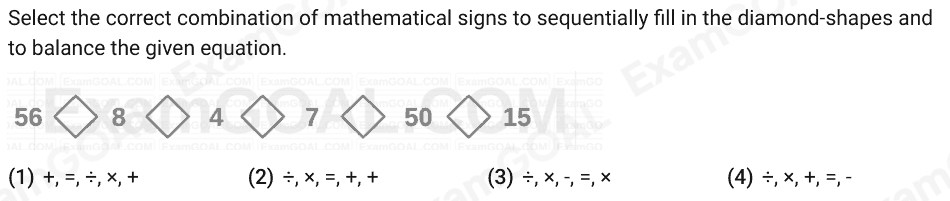
Select the correct combination of mathematical signs to sequentially fill in the diamond-shapes and to balance the given equation.
Answer: D
