218 questions asked across 4 exam years, newest first
A tank can be filled by pipe A in 4 hours and pipe B in 6 hours. At 8:00 a.m., pipe A was opened. At what time will the tank be filled if pipe B is opened at 9:00 a.m.?
Answer: C
Two pipes A and B can fill a tank in 20 and 30 hours, respectively. Both pipes are opened to fill the tank, but when the tank is one-third full, a leak develops through which one-fourth of the water supplied by both pipes goes out. Find the total time (in hours) taken to fill the tank.

Answer: B
Pipe X can fill a tank in 9 hours and Pipe Y can fill it in 21 hours. If they are opened on alternate hours and Pipe X is opened first, in how many hours shall the tank be full?

Answer: D
At a school building, there is an overhead tank. To fill this tank 50 buckets of water are required. Assume that the capacity of the bucket is reduced to two-fifth of the present. How many buckets of water are required to fill the same tank?
Answer: C
A and B can do a work in 12 days and 16 days, respectively. If they work together for 6 days, then the fraction of the work left is ________.
Answer: D
Two inlet pipes, P1 and P2, can fill a cistern in 20 hours and 30 hours, respectively. They were opened at the same time, but pipe P1 had to be closed 5 hours before the cistern was full. How many hours in total did it take for the two pipes to fill the cistern?
Answer: A
Pipe X can fill a tank in 60 hours while pipe Y can fill the tank in 72 hours. Both pipes are opened together for 20 hours. How much of the tank is left empty?

Answer: D
Pipes A and B can fill a tank in 6 hours and 8 hours, respectively. Both pipes are opened together for 3 hours. After that pipe A is closed, and B continues to fill the tank. In how many hours will the tank be filled?
Answer: A
Pipe Q can fill the tank in 60 hours while pipe R may fill in 45 hours. Q and R pipes are opened together for 6 hours after which pipe W is also opened to empty the tank. All three pipes are opened simultaneously for 24 hours to reach the half-level mark. How much time (in hours) will pipe W alone take to empty the entire tank?
Answer: A
Pipes A and B can fill a tank in 15 hours and 25 hours, respectively, whereas pipe C can empty the full tank in 40 hours. All three pipes are opened together, but pipe A is closed after 5 hours. After how many hours will the remaining part of the tank be filled?

Answer: B
A cistern can be filled by two pipes in 8 minutes and 10 minutes, separately. Both the pipes are opened together for a certain time, but due to an obstruction, only of the full quantity of water flowed through the former pipe and through the latter pipe. However, the obstruction was suddenly removed, and the cistern was filled in 3 minutes from that moment. How long did it take before the full flow began?
Answer: C
Two pipes can fill a tank in 12 hours and 18 hours, respectively, while a third pipe can empty it in 8 hours. How long (in hours) will it take to fill the empty tank if all three pipes are opened simultaneously?
Answer: C
There are two pipes used to fill a tank and when operated together, they can fill the tank in 20 minutes. If one pipe can fill the tank two and a half times as quickly as the other, then the faster pipe alone can fill the tank in:
Answer: D
What is the height (in m) of a conical water tank having radius of 70 m and volume of 46,200 m³? (Take π = 22/7)
Answer: D
A pipe can fill an empty tank in 5 minutes, and another pipe can empty it in 6 minutes. If both pipes are opened simultaneously, how long will it take to fill the tank?
Answer: D
Two pipes P and Q can fill a tank in 36 minutes and 45 minutes, respectively. If both pipes are opened together, the time taken to fill the tank is:
Answer: C
Two pipes, A and B, can fill a tank in 10 minutes and 20 minutes, respectively. The pipe C can empty the tank in 30 minutes. All the three pipes are opened at a time in the beginning. However, pipe C is closed 2 minutes before the tank is filled. In what time, will the tank be full (in minutes)?
Answer: B
Two pipes A and B can fill a tank in 48 minutes and 66 minutes, respectively. If both the pipes are opened simultaneously, then after how many minutes should pipe B be closed so that the tank gets filled in 32 minutes?
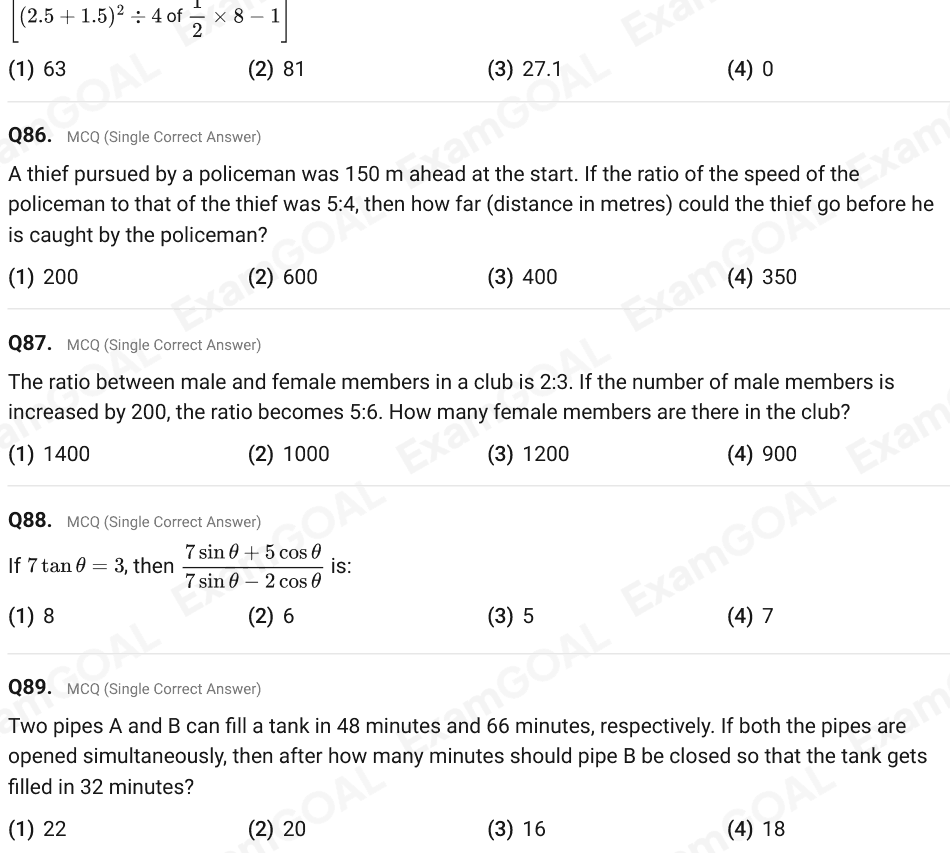
Answer: A
Two pipes A and B can fill a tank in 1⅓ hours and 2 hours, respectively. If both the pipes are opened simultaneously, then in how much time will the tank be filled?
Answer: C
There are two pipes to fill a tank. Together, they can fill the tank in 15 minutes. If one pipe can fill the tank in one and a half times as fast as the other, the faster pipe alone can fill the tank in:

Answer: C
Pipe A usually fills a tank in 6 hours. But due to a leak at the bottom of the tank, it takes extra 2 hours to fill the tank. If the tank is full, then how much time will it take to get emptied due to the leak?
Answer: C
Three pipes P, Q, and R can fill a cistern in 40 minutes, 80 minutes, and 120 minutes, respectively. Initially, all the pipes are opened. After how much time (in minutes) should the pipes Q and R be turned off so that the cistern will be completely filled in just half an hour?
Answer: A
Pipe L can fill a pool in 30 hours and pipe M in 45 hours. If both the pipes are opened in an empty pool, how much time will they take to fill it?
Answer: B
Pipes P and Q can completely fill a water tank in 10 hours and 15 hours, respectively. A pipe R can empty a tank filled completely with water in 12 hours. Initially, the tank is empty, and only pipes P and Q are opened at 6 a.m., and pipe R is also opened at 9 a.m. By what time will the tank be completely filled?
Answer: A
A pipe can fill an overhead tank in 12 hours. But due to a leak at the bottom, it is filled in 18 hours. If the tank is full, how much time will the leak take to empty it?
Answer: A
