352 questions asked across 4 exam years, newest first
To conceive of gender as ontologically prior or naturally originary is to misrecognize its status as a [1] _______, a semiotic and performative topology whose coherence is secured only through its reiteration across spatial, legal, and psychic apparatuses. Within this regime, embodiment is not merely lived but mediated—filtered through hermeneutic technologies that valorize some corporealities while rendering others abject, deviant, or structurally unintelligible. The state, in tandem with biomedical epistemes and juridico-political grammars, exercises a necropolitical calibration of life itself—where recognition is not a right but a [2] _______, allocated via matrices of intelligibility that are historically contingent and politically fungible. This disposit if renders gender a function of discursive legility rather than biological inevitability. Resistance, when funneled through these grammars, risks becoming complicit in the very structures it seeks to subvert. Hence, the radical task is not merely to "expand" recognition but to effect a [3] _______ of recognition's ontological architecture. This entails refusing the dialectics of inclusion and exclusion that liberal frameworks offer and instead exposing their constitutive foreclosure of alterity. Such a politics necessitates the [4] _______ of normativity as a structuring logic of embodiment. Only through its unmaking can a post-identitarian ethics of becoming be envisioned—one that privileges contingency over coherence, opacity over transparency, and relational indeterminacy over categorical fixity. In this schema, freedom is not recuperative but [5] _______—a rupture from taxonomic legibility, a departure from the logocentric compulsion to be known. What should come in the place of blank number [1]?
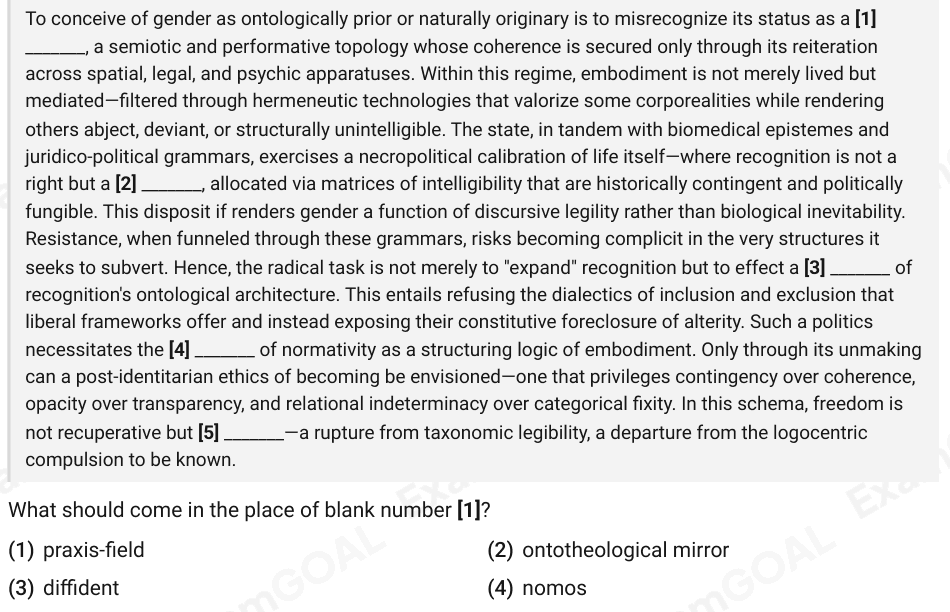
Answer: A
What should come in the place of blank number [2]?
Answer: A
What should come in the place of blank number [3]?
Answer: B
What should come in the place of blank number [4]?
Answer: A
What should come in the place of blank number [5]?
Answer: B
In the following passage, some words have been deleted. Read the passage intently and choose the most appropriate option to fill in each blank: To speak of the political as an abstract structure is, perhaps, already to concede to the logic of the archive: that which preserves through containment, and [1] _____ through its very naming. The subject here is neither born nor made\u2014but suspended, deferred in the machinic interplay of signifiers. One becomes governable only to the extent that one appears, and to appear is already to capitulate to the syntax of recognition. Power, then, does not suppress but surfaces\u2014it emerges in the folds of citation, in the gentle violence of classification. The biometric gaze is not ocular but computational; not what it sees, but what it does not allow to vanish. Resistance, if it resists at all, cannot be found in opposition, but in [2] _____\u2014in the refusal to be coherent, in the grammarless whisper. The body, meanwhile, becomes a ledger: inscribed, decoded, re-encoded. What justice can exist in such a system? Not that of law, but of rupture. A justice that unbinds, that refuses the terms of its own invocation. It is not reparation that is sought, but [3] _____\u2014the unworking of systems, the destitution of legibility. To enter this mode is to abandon appeal, to relinquish the comfort of meaning. One must instead submit to the possibility of a justice that never arrives, that remains [4] _____, excessive and unlocatable. Only then can we imagine a politics not of representation, but of presence without capture, of subjectivity without scaffolding. What remains, finally, is not identity but [5] _____\u2014a presence that eludes, that persists in the absence of affirmation. What should come in the place of blank number [1]?
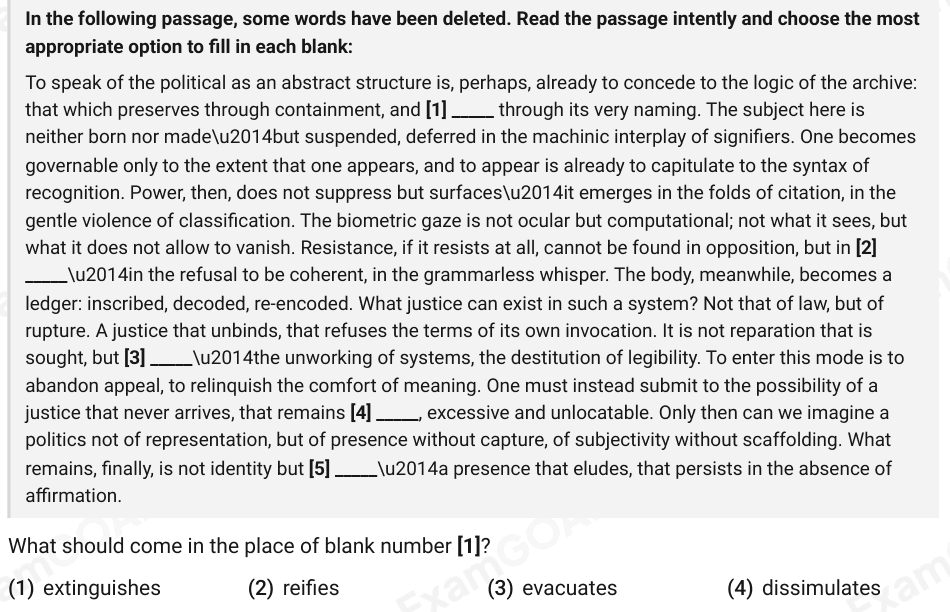
Answer: B
What should come in the place of blank number [2]?
Answer: D
What should come in the place of blank number [3]?
Answer: C
What should come in the place of blank number [4]?
Answer: B
What should come in the place of blank number [5]?
Answer: A
The pursuit of global equity in the anthropocene is less a matter of distributive justice and more a theatre of ontological misrecognition. While the Global North presents technocratic solutions as universally applicable, such solutions often encode assumptions of temporal supremacy and civilizational [1] _______. Climate finance, for instance, masquerades as benevolence while entrenching hierarchies of surveillance and dependence. The epistemes of the South, rather than being engaged on their own terms, are often reconfigured through extractive logics of "capacity building," a term whose etymology betrays its colonial [2] _______. Embedded within these discourses is the idea that certain populations must be "readied" for modernity—thus reproducing a pedagogical asymmetry that masks itself as aid. Meanwhile, planetary imaginaries are increasingly framed through cartographies of emergency. The language of "tipping points" and "irreversible loss" evokes a moral urgency that, paradoxically, facilitates a form of ecological [3] _______, wherein radical structural reform is substituted by incremental techno-fixes. Carbon offsets, biodiversity credits, and green financialization proliferate not as correctives, but as symptoms of an underlying refusal to dislodge anthropocentric capitalism. In such a milieu, protest is not silence-breaking but often met with strategic [4] _______, where rhetorical accommodation obscures institutional inertia. Civil society is co-opted, not crushed. The subaltern voice is archived, not amplified. Thus, to reclaim ecological justice is not merely to demand inclusion, but to interrogate the ontologies that define inclusion itself. Absent this, the dream of planetary stewardship will remain a ceremonial [5] _______, rich in symbolism, barren in substance. What should come in the place of blank number [1]?
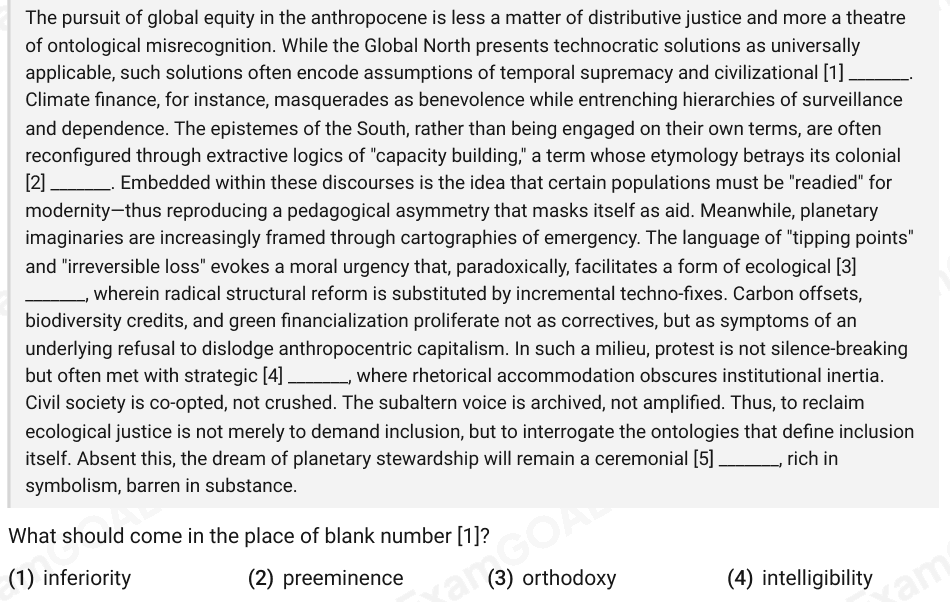
Answer: B
What should come in the place of blank number [2]?
Answer: A
What should come in the place of blank number [3]?
Answer: D
What should come in the place of blank number [4]?
Answer: A
What should come in the place of blank number [5]?
Answer: A
In the given passage, some words have been deleted. Read the passage intently and choose the most appropriate option to fill in each blank: Global sustainability discourse has not so much evolved as ossified into a lexicon of managerial (1) ____— terms engineered more for reputational lubrication than ecological redress. What was once a moral reckoning with planetary precarity now traffics in dashboards and metrics, calibrated less to redistribute power than to launder it. Words like “resilience,” “stakeholder engagement,” and “net-zero” populate position papers, their meanings stretched until they acquire the elasticity of (2) ____. In this semantic economy, language ceases to be revelatory and becomes performative. Reports teeter on euphemism; declarations bristle with procedural piety. Crises are not named; they are (3) ____ into ‘developmental challenges.’ The grammar of suffering is bleached, even as the facts remain uncompromising. What emerges is not truth, but a choreography of credibility—an affective simulation of care. Meanwhile, epistemic asymmetries persist: indigenous knowledge is (4) ____ as “local insight,” offered just enough space to decorate, never to reorient. Environmental justice, once confrontational, now wears a diplomatic smile, folded neatly into intergovernmental communiqués. If sustainability is to escape the orbit of self- congratulation, it must surrender its obsession with optics and inhabit the discomfort of history. Anything less is not stewardship—it is semantic (5) ____ masquerading as progress.
What should come in the place of blank number (1)?
Answer: B
In the given passage, some words have been deleted. Read the passage intently and choose the most appropriate option to fill in each blank: Global sustainability discourse has not so much evolved as ossified into a lexicon of managerial (1) ____— terms engineered more for reputational lubrication than ecological redress. What was once a moral reckoning with planetary precarity now traffics in dashboards and metrics, calibrated less to redistribute power than to launder it. Words like “resilience,” “stakeholder engagement,” and “net-zero” populate position papers, their meanings stretched until they acquire the elasticity of (2) ____. In this semantic economy, language ceases to be revelatory and becomes performative. Reports teeter on euphemism; declarations bristle with procedural piety. Crises are not named; they are (3) ____ into ‘developmental challenges.’ The grammar of suffering is bleached, even as the facts remain uncompromising. What emerges is not truth, but a choreography of credibility—an affective simulation of care. Meanwhile, epistemic asymmetries persist: indigenous knowledge is (4) ____ as “local insight,” offered just enough space to decorate, never to reorient. Environmental justice, once confrontational, now wears a diplomatic smile, folded neatly into intergovernmental communiqués. If sustainability is to escape the orbit of self- congratulation, it must surrender its obsession with optics and inhabit the discomfort of history. Anything less is not stewardship—it is semantic (5) ____ masquerading as progress.
What should come in the place of blank number (2)?
Answer: A
In the given passage, some words have been deleted. Read the passage intently and choose the most appropriate option to fill in each blank: Global sustainability discourse has not so much evolved as ossified into a lexicon of managerial (1) ____— terms engineered more for reputational lubrication than ecological redress. What was once a moral reckoning with planetary precarity now traffics in dashboards and metrics, calibrated less to redistribute power than to launder it. Words like “resilience,” “stakeholder engagement,” and “net-zero” populate position papers, their meanings stretched until they acquire the elasticity of (2) ____. In this semantic economy, language ceases to be revelatory and becomes performative. Reports teeter on euphemism; declarations bristle with procedural piety. Crises are not named; they are (3) ____ into ‘developmental challenges.’ The grammar of suffering is bleached, even as the facts remain uncompromising. What emerges is not truth, but a choreography of credibility—an affective simulation of care. Meanwhile, epistemic asymmetries persist: indigenous knowledge is (4) ____ as “local insight,” offered just enough space to decorate, never to reorient. Environmental justice, once confrontational, now wears a diplomatic smile, folded neatly into intergovernmental communiqués. If sustainability is to escape the orbit of self- congratulation, it must surrender its obsession with optics and inhabit the discomfort of history. Anything less is not stewardship—it is semantic (5) ____ masquerading as progress.
What should come in the place of blank number (3)?
Answer: B
In the given passage, some words have been deleted. Read the passage intently and choose the most appropriate option to fill in each blank: Global sustainability discourse has not so much evolved as ossified into a lexicon of managerial (1) ____— terms engineered more for reputational lubrication than ecological redress. What was once a moral reckoning with planetary precarity now traffics in dashboards and metrics, calibrated less to redistribute power than to launder it. Words like “resilience,” “stakeholder engagement,” and “net-zero” populate position papers, their meanings stretched until they acquire the elasticity of (2) ____. In this semantic economy, language ceases to be revelatory and becomes performative. Reports teeter on euphemism; declarations bristle with procedural piety. Crises are not named; they are (3) ____ into ‘developmental challenges.’ The grammar of suffering is bleached, even as the facts remain uncompromising. What emerges is not truth, but a choreography of credibility—an affective simulation of care. Meanwhile, epistemic asymmetries persist: indigenous knowledge is (4) ____ as “local insight,” offered just enough space to decorate, never to reorient. Environmental justice, once confrontational, now wears a diplomatic smile, folded neatly into intergovernmental communiqués. If sustainability is to escape the orbit of self- congratulation, it must surrender its obsession with optics and inhabit the discomfort of history. Anything less is not stewardship—it is semantic (5) ____ masquerading as progress.
What should come in the place of blank number (4)?
Answer: C
In the given passage, some words have been deleted. Read the passage intently and choose the most appropriate option to fill in each blank: Global sustainability discourse has not so much evolved as ossified into a lexicon of managerial (1) ____— terms engineered more for reputational lubrication than ecological redress. What was once a moral reckoning with planetary precarity now traffics in dashboards and metrics, calibrated less to redistribute power than to launder it. Words like “resilience,” “stakeholder engagement,” and “net-zero” populate position papers, their meanings stretched until they acquire the elasticity of (2) ____. In this semantic economy, language ceases to be revelatory and becomes performative. Reports teeter on euphemism; declarations bristle with procedural piety. Crises are not named; they are (3) ____ into ‘developmental challenges.’ The grammar of suffering is bleached, even as the facts remain uncompromising. What emerges is not truth, but a choreography of credibility—an affective simulation of care. Meanwhile, epistemic asymmetries persist: indigenous knowledge is (4) ____ as “local insight,” offered just enough space to decorate, never to reorient. Environmental justice, once confrontational, now wears a diplomatic smile, folded neatly into intergovernmental communiqués. If sustainability is to escape the orbit of self- congratulation, it must surrender its obsession with optics and inhabit the discomfort of history. Anything less is not stewardship—it is semantic (5) ____ masquerading as progress.
What should come in the place of blank number (5)?
Answer: B
In the given passage, some words have been deleted. Read the passage intently and choose the most appropriate option to fill in each blank: Literature, far from being a static repository of aesthetic delight, is a restless medium through which cultures interrogate themselves. The novel, the poem, the play—all are not merely forms but fields wherein ideologies (1) ___, mutate, and sometimes dissolve. To read deeply is to risk disorientation, for every interpretation implies an act of displacement: of authorial intent, of reader expectation, of historical certainty. The literary canon itself is less a monument than a (2) ___—a site of contestation shaped by inclusion, exclusion, and reinvention. A Shakespearean soliloquy may bear universal resonance, yet it also emerges from a matrix of Elizabethan anxieties and power structures. The illusion of timelessness is, more often than not, a function of critical emphasis rather than intrinsic merit. Postcolonial and feminist critiques have challenged this apparent neutrality, foregrounding the voices that were once peripheral. Such interventions have not diminished literature’s prestige but instead (3) ___ its moral and political stakes. Texts once considered apolitical are now read as cultural artifacts entangled in empire, patriarchy, and resistance. In this light, literary criticism becomes an act not of judgment but of (4) ___—an excavation of silences as much as meanings. The reader, then, is not a passive consumer but a co-creator, whose insights must be (5) ___ with humility and historical awareness.
What should come in the place of blank number (1)?
Answer: B
In the given passage, some words have been deleted. Read the passage intently and choose the most appropriate option to fill in each blank: Literature, far from being a static repository of aesthetic delight, is a restless medium through which cultures interrogate themselves. The novel, the poem, the play—all are not merely forms but fields wherein ideologies (1) ___, mutate, and sometimes dissolve. To read deeply is to risk disorientation, for every interpretation implies an act of displacement: of authorial intent, of reader expectation, of historical certainty. The literary canon itself is less a monument than a (2) ___—a site of contestation shaped by inclusion, exclusion, and reinvention. A Shakespearean soliloquy may bear universal resonance, yet it also emerges from a matrix of Elizabethan anxieties and power structures. The illusion of timelessness is, more often than not, a function of critical emphasis rather than intrinsic merit. Postcolonial and feminist critiques have challenged this apparent neutrality, foregrounding the voices that were once peripheral. Such interventions have not diminished literature’s prestige but instead (3) ___ its moral and political stakes. Texts once considered apolitical are now read as cultural artifacts entangled in empire, patriarchy, and resistance. In this light, literary criticism becomes an act not of judgment but of (4) ___—an excavation of silences as much as meanings. The reader, then, is not a passive consumer but a co-creator, whose insights must be (5) ___ with humility and historical awareness.
What should come in the place of blank number (2)?
Answer: B
In the given passage, some words have been deleted. Read the passage intently and choose the most appropriate option to fill in each blank: Literature, far from being a static repository of aesthetic delight, is a restless medium through which cultures interrogate themselves. The novel, the poem, the play—all are not merely forms but fields wherein ideologies (1) ___, mutate, and sometimes dissolve. To read deeply is to risk disorientation, for every interpretation implies an act of displacement: of authorial intent, of reader expectation, of historical certainty. The literary canon itself is less a monument than a (2) ___—a site of contestation shaped by inclusion, exclusion, and reinvention. A Shakespearean soliloquy may bear universal resonance, yet it also emerges from a matrix of Elizabethan anxieties and power structures. The illusion of timelessness is, more often than not, a function of critical emphasis rather than intrinsic merit. Postcolonial and feminist critiques have challenged this apparent neutrality, foregrounding the voices that were once peripheral. Such interventions have not diminished literature’s prestige but instead (3) ___ its moral and political stakes. Texts once considered apolitical are now read as cultural artifacts entangled in empire, patriarchy, and resistance. In this light, literary criticism becomes an act not of judgment but of (4) ___—an excavation of silences as much as meanings. The reader, then, is not a passive consumer but a co-creator, whose insights must be (5) ___ with humility and historical awareness.
What should come in the place of blank number (3)?
Answer: B
In the given passage, some words have been deleted. Read the passage intently and choose the most appropriate option to fill in each blank: Literature, far from being a static repository of aesthetic delight, is a restless medium through which cultures interrogate themselves. The novel, the poem, the play—all are not merely forms but fields wherein ideologies (1) ___, mutate, and sometimes dissolve. To read deeply is to risk disorientation, for every interpretation implies an act of displacement: of authorial intent, of reader expectation, of historical certainty. The literary canon itself is less a monument than a (2) ___—a site of contestation shaped by inclusion, exclusion, and reinvention. A Shakespearean soliloquy may bear universal resonance, yet it also emerges from a matrix of Elizabethan anxieties and power structures. The illusion of timelessness is, more often than not, a function of critical emphasis rather than intrinsic merit. Postcolonial and feminist critiques have challenged this apparent neutrality, foregrounding the voices that were once peripheral. Such interventions have not diminished literature’s prestige but instead (3) ___ its moral and political stakes. Texts once considered apolitical are now read as cultural artifacts entangled in empire, patriarchy, and resistance. In this light, literary criticism becomes an act not of judgment but of (4) ___—an excavation of silences as much as meanings. The reader, then, is not a passive consumer but a co-creator, whose insights must be (5) ___ with humility and historical awareness.
What should come in the place of blank number (4)?
Answer: C
In the given passage, some words have been deleted. Read the passage intently and choose the most appropriate option to fill in each blank: Literature, far from being a static repository of aesthetic delight, is a restless medium through which cultures interrogate themselves. The novel, the poem, the play—all are not merely forms but fields wherein ideologies (1) ___, mutate, and sometimes dissolve. To read deeply is to risk disorientation, for every interpretation implies an act of displacement: of authorial intent, of reader expectation, of historical certainty. The literary canon itself is less a monument than a (2) ___—a site of contestation shaped by inclusion, exclusion, and reinvention. A Shakespearean soliloquy may bear universal resonance, yet it also emerges from a matrix of Elizabethan anxieties and power structures. The illusion of timelessness is, more often than not, a function of critical emphasis rather than intrinsic merit. Postcolonial and feminist critiques have challenged this apparent neutrality, foregrounding the voices that were once peripheral. Such interventions have not diminished literature’s prestige but instead (3) ___ its moral and political stakes. Texts once considered apolitical are now read as cultural artifacts entangled in empire, patriarchy, and resistance. In this light, literary criticism becomes an act not of judgment but of (4) ___—an excavation of silences as much as meanings. The reader, then, is not a passive consumer but a co-creator, whose insights must be (5) ___ with humility and historical awareness.
What should come in the place of blank number (5)?
Answer: D
