352 questions asked across 4 exam years, newest first
In the given passage, some words have been deleted. Read the passage intently and choose the most appropriate option to fill in each blank: Postcolonial infrastructures often inhabit a schizochronic condition—a simultaneity of obsolescence and futurity. Flyovers half-finished, railway stations calcified mid-renovation, and electric grids oscillating between blackout and surplus do not signify simple malfunction. Rather, they manifest a (1) _____ temporality in which the present is neither a continuity of the past nor a stable projection of the future. These infrastructures function not as inert utilities but as affective indexes of temporal rupture. Modernity, once telegraphed through asphalt and concrete, now flickers within these arrested developments— gestures of progress suspended in bureaucratic amber. Here, functionality is beside the point. What matters is the performative (2) _____ of development: roads that signify mobility even when impassable, metros that symbolize futurity even when immobile. In this schema, infrastructure ceases to be an engineering problem and becomes a narrative technology—a spatial discourse that (3) _____ the nation- state’s promises into sedimented form. Bridges-to-be and always-rebuilding airports constitute not failure, but continuity: the continual renewal of unfinished intention. Such spatial artifacts require a recalibrated hermeneutics. To read them literally is to miss their symbolic resonance. Their disrepair is not decay but (4) _____: a visual vocabulary of state temporality, in which incompletion is the political idiom of continuity. This is the temporal grammar of anticipation without arrival. Thus, the postcolonial built environment articulates not stasis, but (5) _____—a condition where motion exists without direction, and progress is simulated through perpetual incompletion.
What should come in the place of blank number (1)?
Answer: C
In the given passage, some words have been deleted. Read the passage intently and choose the most appropriate option to fill in each blank: Postcolonial infrastructures often inhabit a schizochronic condition—a simultaneity of obsolescence and futurity. Flyovers half-finished, railway stations calcified mid-renovation, and electric grids oscillating between blackout and surplus do not signify simple malfunction. Rather, they manifest a (1) _____ temporality in which the present is neither a continuity of the past nor a stable projection of the future. These infrastructures function not as inert utilities but as affective indexes of temporal rupture. Modernity, once telegraphed through asphalt and concrete, now flickers within these arrested developments— gestures of progress suspended in bureaucratic amber. Here, functionality is beside the point. What matters is the performative (2) _____ of development: roads that signify mobility even when impassable, metros that symbolize futurity even when immobile. In this schema, infrastructure ceases to be an engineering problem and becomes a narrative technology—a spatial discourse that (3) _____ the nation- state’s promises into sedimented form. Bridges-to-be and always-rebuilding airports constitute not failure, but continuity: the continual renewal of unfinished intention. Such spatial artifacts require a recalibrated hermeneutics. To read them literally is to miss their symbolic resonance. Their disrepair is not decay but (4) _____: a visual vocabulary of state temporality, in which incompletion is the political idiom of continuity. This is the temporal grammar of anticipation without arrival. Thus, the postcolonial built environment articulates not stasis, but (5) _____—a condition where motion exists without direction, and progress is simulated through perpetual incompletion.
What should come in the place of blank number (2)?
Answer: B
In the given passage, some words have been deleted. Read the passage intently and choose the most appropriate option to fill in each blank: Postcolonial infrastructures often inhabit a schizochronic condition—a simultaneity of obsolescence and futurity. Flyovers half-finished, railway stations calcified mid-renovation, and electric grids oscillating between blackout and surplus do not signify simple malfunction. Rather, they manifest a (1) _____ temporality in which the present is neither a continuity of the past nor a stable projection of the future. These infrastructures function not as inert utilities but as affective indexes of temporal rupture. Modernity, once telegraphed through asphalt and concrete, now flickers within these arrested developments— gestures of progress suspended in bureaucratic amber. Here, functionality is beside the point. What matters is the performative (2) _____ of development: roads that signify mobility even when impassable, metros that symbolize futurity even when immobile. In this schema, infrastructure ceases to be an engineering problem and becomes a narrative technology—a spatial discourse that (3) _____ the nation- state’s promises into sedimented form. Bridges-to-be and always-rebuilding airports constitute not failure, but continuity: the continual renewal of unfinished intention. Such spatial artifacts require a recalibrated hermeneutics. To read them literally is to miss their symbolic resonance. Their disrepair is not decay but (4) _____: a visual vocabulary of state temporality, in which incompletion is the political idiom of continuity. This is the temporal grammar of anticipation without arrival. Thus, the postcolonial built environment articulates not stasis, but (5) _____—a condition where motion exists without direction, and progress is simulated through perpetual incompletion.
What should come in the place of blank number (3)?
Answer: D
In the given passage, some words have been deleted. Read the passage intently and choose the most appropriate option to fill in each blank: Postcolonial infrastructures often inhabit a schizochronic condition—a simultaneity of obsolescence and futurity. Flyovers half-finished, railway stations calcified mid-renovation, and electric grids oscillating between blackout and surplus do not signify simple malfunction. Rather, they manifest a (1) _____ temporality in which the present is neither a continuity of the past nor a stable projection of the future. These infrastructures function not as inert utilities but as affective indexes of temporal rupture. Modernity, once telegraphed through asphalt and concrete, now flickers within these arrested developments— gestures of progress suspended in bureaucratic amber. Here, functionality is beside the point. What matters is the performative (2) _____ of development: roads that signify mobility even when impassable, metros that symbolize futurity even when immobile. In this schema, infrastructure ceases to be an engineering problem and becomes a narrative technology—a spatial discourse that (3) _____ the nation- state’s promises into sedimented form. Bridges-to-be and always-rebuilding airports constitute not failure, but continuity: the continual renewal of unfinished intention. Such spatial artifacts require a recalibrated hermeneutics. To read them literally is to miss their symbolic resonance. Their disrepair is not decay but (4) _____: a visual vocabulary of state temporality, in which incompletion is the political idiom of continuity. This is the temporal grammar of anticipation without arrival. Thus, the postcolonial built environment articulates not stasis, but (5) _____—a condition where motion exists without direction, and progress is simulated through perpetual incompletion.
What should come in the place of blank number (4)?
Answer: A
In the given passage, some words have been deleted. Read the passage intently and choose the most appropriate option to fill in each blank: Postcolonial infrastructures often inhabit a schizochronic condition—a simultaneity of obsolescence and futurity. Flyovers half-finished, railway stations calcified mid-renovation, and electric grids oscillating between blackout and surplus do not signify simple malfunction. Rather, they manifest a (1) _____ temporality in which the present is neither a continuity of the past nor a stable projection of the future. These infrastructures function not as inert utilities but as affective indexes of temporal rupture. Modernity, once telegraphed through asphalt and concrete, now flickers within these arrested developments— gestures of progress suspended in bureaucratic amber. Here, functionality is beside the point. What matters is the performative (2) _____ of development: roads that signify mobility even when impassable, metros that symbolize futurity even when immobile. In this schema, infrastructure ceases to be an engineering problem and becomes a narrative technology—a spatial discourse that (3) _____ the nation- state’s promises into sedimented form. Bridges-to-be and always-rebuilding airports constitute not failure, but continuity: the continual renewal of unfinished intention. Such spatial artifacts require a recalibrated hermeneutics. To read them literally is to miss their symbolic resonance. Their disrepair is not decay but (4) _____: a visual vocabulary of state temporality, in which incompletion is the political idiom of continuity. This is the temporal grammar of anticipation without arrival. Thus, the postcolonial built environment articulates not stasis, but (5) _____—a condition where motion exists without direction, and progress is simulated through perpetual incompletion.
What should come in the place of blank number (5)?
Answer: B
In the given passage, some words have been deleted. Read the passage intently and choose the most appropriate option to fill in each blank: Urban decay is not merely a symptom of infrastructural attrition, but a semantic artifact—where stone and steel become archives of deferred modernities. Cracks, corrosion, and spectral scaffolds do not degrade meaning; they transmute it, encoding absence as presence and entropy as (1) _____. These architectural residues defy the chronological hygiene of masterplans, offering instead a fugitive temporality—unruly, sedimented, and unresolved. The ruin, in this schema, is not a failure of design, but an overdetermined syntax of collapse. Its grammar speaks through spalling concrete and oxidized signage, refusing the gloss of civic optimism. To aestheticize such decay without critique is to partake in ontological (2) _____— rendering disorder decorative and suffering sublime. What masquerades as renewal often constitutes spatial evisceration, where memory is evacuated in favor of speculative capital and “heritage” becomes a euphemism for curatorial sanitization. To read ruins poetically is to displace utility with (3) _____: to allow detritus to articulate that which infrastructure occludes. These spaces demand not beautification, but semiotic excavation—where rusted balustrades and defunct corridors become sites of interpretive insurgency. Yet decay resists even romanticization. It is not allegory, but ontic excess—a surplus that confounds enclosure. Gentrification cannot domesticate it; nostalgia cannot vitrify it. It lingers, mutinous and mnemonic, as a (4) _____ syntax etched across municipal forgetting. The city's ruins are not relics. They are discursive glitches—interruptions in the urban script that demand to be read not as loss, but as infrastructural (5) _____.
What should come in the place of blank number (1)?
Answer: B
In the given passage, some words have been deleted. Read the passage intently and choose the most appropriate option to fill in each blank: Urban decay is not merely a symptom of infrastructural attrition, but a semantic artifact—where stone and steel become archives of deferred modernities. Cracks, corrosion, and spectral scaffolds do not degrade meaning; they transmute it, encoding absence as presence and entropy as (1) _____. These architectural residues defy the chronological hygiene of masterplans, offering instead a fugitive temporality—unruly, sedimented, and unresolved. The ruin, in this schema, is not a failure of design, but an overdetermined syntax of collapse. Its grammar speaks through spalling concrete and oxidized signage, refusing the gloss of civic optimism. To aestheticize such decay without critique is to partake in ontological (2) _____— rendering disorder decorative and suffering sublime. What masquerades as renewal often constitutes spatial evisceration, where memory is evacuated in favor of speculative capital and “heritage” becomes a euphemism for curatorial sanitization. To read ruins poetically is to displace utility with (3) _____: to allow detritus to articulate that which infrastructure occludes. These spaces demand not beautification, but semiotic excavation—where rusted balustrades and defunct corridors become sites of interpretive insurgency. Yet decay resists even romanticization. It is not allegory, but ontic excess—a surplus that confounds enclosure. Gentrification cannot domesticate it; nostalgia cannot vitrify it. It lingers, mutinous and mnemonic, as a (4) _____ syntax etched across municipal forgetting. The city's ruins are not relics. They are discursive glitches—interruptions in the urban script that demand to be read not as loss, but as infrastructural (5) _____.
What should come in the place of blank number (2)?
Answer: B
In the given passage, some words have been deleted. Read the passage intently and choose the most appropriate option to fill in each blank: Urban decay is not merely a symptom of infrastructural attrition, but a semantic artifact—where stone and steel become archives of deferred modernities. Cracks, corrosion, and spectral scaffolds do not degrade meaning; they transmute it, encoding absence as presence and entropy as (1) _____. These architectural residues defy the chronological hygiene of masterplans, offering instead a fugitive temporality—unruly, sedimented, and unresolved. The ruin, in this schema, is not a failure of design, but an overdetermined syntax of collapse. Its grammar speaks through spalling concrete and oxidized signage, refusing the gloss of civic optimism. To aestheticize such decay without critique is to partake in ontological (2) _____— rendering disorder decorative and suffering sublime. What masquerades as renewal often constitutes spatial evisceration, where memory is evacuated in favor of speculative capital and “heritage” becomes a euphemism for curatorial sanitization. To read ruins poetically is to displace utility with (3) _____: to allow detritus to articulate that which infrastructure occludes. These spaces demand not beautification, but semiotic excavation—where rusted balustrades and defunct corridors become sites of interpretive insurgency. Yet decay resists even romanticization. It is not allegory, but ontic excess—a surplus that confounds enclosure. Gentrification cannot domesticate it; nostalgia cannot vitrify it. It lingers, mutinous and mnemonic, as a (4) _____ syntax etched across municipal forgetting. The city's ruins are not relics. They are discursive glitches—interruptions in the urban script that demand to be read not as loss, but as infrastructural (5) _____.
What should come in the place of blank number (3)?
Answer: A
In the given passage, some words have been deleted. Read the passage intently and choose the most appropriate option to fill in each blank: Urban decay is not merely a symptom of infrastructural attrition, but a semantic artifact—where stone and steel become archives of deferred modernities. Cracks, corrosion, and spectral scaffolds do not degrade meaning; they transmute it, encoding absence as presence and entropy as (1) _____. These architectural residues defy the chronological hygiene of masterplans, offering instead a fugitive temporality—unruly, sedimented, and unresolved. The ruin, in this schema, is not a failure of design, but an overdetermined syntax of collapse. Its grammar speaks through spalling concrete and oxidized signage, refusing the gloss of civic optimism. To aestheticize such decay without critique is to partake in ontological (2) _____— rendering disorder decorative and suffering sublime. What masquerades as renewal often constitutes spatial evisceration, where memory is evacuated in favor of speculative capital and “heritage” becomes a euphemism for curatorial sanitization. To read ruins poetically is to displace utility with (3) _____: to allow detritus to articulate that which infrastructure occludes. These spaces demand not beautification, but semiotic excavation—where rusted balustrades and defunct corridors become sites of interpretive insurgency. Yet decay resists even romanticization. It is not allegory, but ontic excess—a surplus that confounds enclosure. Gentrification cannot domesticate it; nostalgia cannot vitrify it. It lingers, mutinous and mnemonic, as a (4) _____ syntax etched across municipal forgetting. The city's ruins are not relics. They are discursive glitches—interruptions in the urban script that demand to be read not as loss, but as infrastructural (5) _____.
What should come in the place of blank number (4)?
Answer: B
In the given passage, some words have been deleted. Read the passage intently and choose the most appropriate option to fill in each blank: Urban decay is not merely a symptom of infrastructural attrition, but a semantic artifact—where stone and steel become archives of deferred modernities. Cracks, corrosion, and spectral scaffolds do not degrade meaning; they transmute it, encoding absence as presence and entropy as (1) _____. These architectural residues defy the chronological hygiene of masterplans, offering instead a fugitive temporality—unruly, sedimented, and unresolved. The ruin, in this schema, is not a failure of design, but an overdetermined syntax of collapse. Its grammar speaks through spalling concrete and oxidized signage, refusing the gloss of civic optimism. To aestheticize such decay without critique is to partake in ontological (2) _____— rendering disorder decorative and suffering sublime. What masquerades as renewal often constitutes spatial evisceration, where memory is evacuated in favor of speculative capital and “heritage” becomes a euphemism for curatorial sanitization. To read ruins poetically is to displace utility with (3) _____: to allow detritus to articulate that which infrastructure occludes. These spaces demand not beautification, but semiotic excavation—where rusted balustrades and defunct corridors become sites of interpretive insurgency. Yet decay resists even romanticization. It is not allegory, but ontic excess—a surplus that confounds enclosure. Gentrification cannot domesticate it; nostalgia cannot vitrify it. It lingers, mutinous and mnemonic, as a (4) _____ syntax etched across municipal forgetting. The city's ruins are not relics. They are discursive glitches—interruptions in the urban script that demand to be read not as loss, but as infrastructural (5) _____.
What should come in the place of blank number (5)?
Answer: B
In the following passage, some words have been deleted. Read the passage carefully and select the most appropriate option to fill in each blank. Global warming is a major problem. The result will be the problems created by the rising temperatures of the Arctic region. As a result of global warming, (1)_________ in rainfall and plant distribution affect the migration patterns, feeding behaviour, and breeding preferences of numerous bird species. The increase in the temperature may also alter ocean currents, which may alter the (2)__________ ecology as a whole. Greenhouse gas emissions are responsible for the ongoing melting of the Arctic. This will result in a (3)__________loop since greenhouse gases trap the heat in the atmosphere and the additional emissions may (4)__________ the global warming process. Now, the only way to reverse the harm is for every person to be environmentally sensitive. This may offer us hope that we will be able to leave a green planet to our future generations, who presently appear to face (5)__________. Select the most appropriate option to fill in blank number 1.
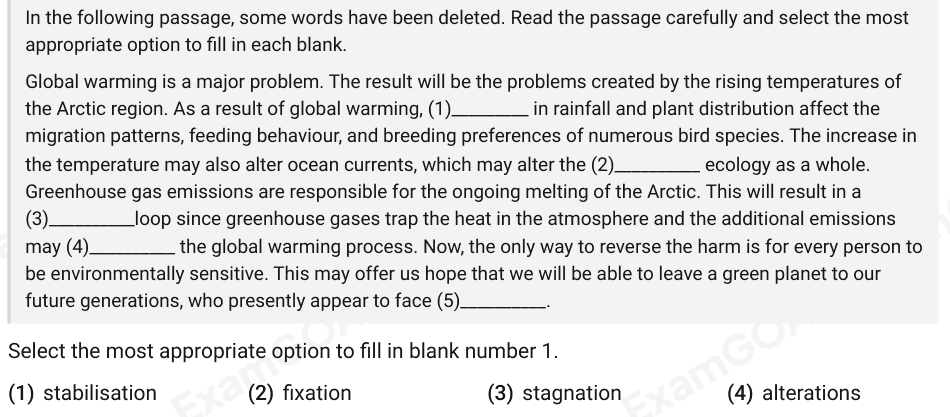
Answer: D
Select the most appropriate option to fill in blank number 2.
Answer: D
Select the most appropriate option to fill in blank number 3.
Answer: A
Select the most appropriate option to fill in blank number 4.
Answer: D
Select the most appropriate option to fill in blank number 5.
Answer: A
In the following passage, some words have been deleted. Read the passage carefully and select the most appropriate option to fill in each blank. The Kuno Palpur National Park, located in Madhya Pradesh's Chambal (1)__________, has an area of 750 square kilometres. It now has leopards, jackals, spotted deer, sambhar, neelgai, chinkara, wild boar, and four-horned antelope, making it a perfect (2)_________ base for felids. Despite strong objections from Gujarat, which (3)_________ that lions were part of the state's heritage, that MP had a poor (4)________ in wildlife management, and that Kuno Palpur had other big cat species that would (5)___________ lion relocation, the sanctuary was chosen for the lion reintroduction project in 2013. Select the most appropriate option to fill in blank number 1.
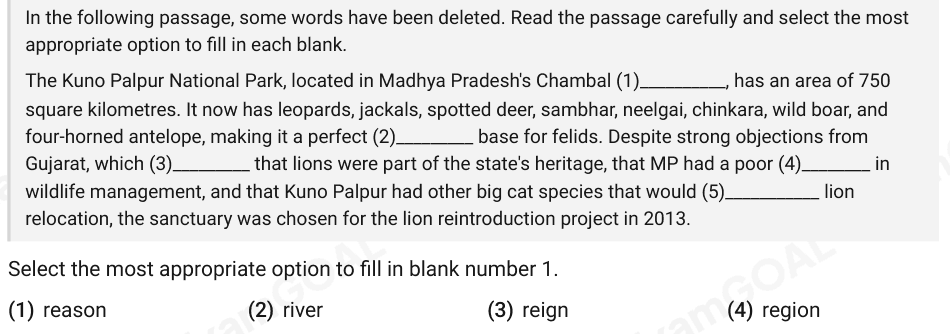
Answer: D
Select the most appropriate option to fill in blank number 2.
Answer: D
Select the most appropriate option to fill in blank number 3.
Answer: D
Select the most appropriate option to fill in blank number 4.
Answer: C
Select the most appropriate option to fill in blank number 5.
Answer: A
In the following passage, some words have been deleted. Read the passage carefully and select the most appropriate option to fill in each blank. We naturally seek the company of those whose (1) _________ are the same as our own. Fools do not like the (2) _________ of wise men, and wise men avoid fools. Serious-minded people do not find much in common with (3) _________ folk, and vice versa. Sinners feel uncomfortable with (4) _________ and do not seek their company. We can, therefore, as a rule, judge a man’s (5) _________ by the company he keeps. Select the most appropriate option to fill in blank number 1.

Answer: D
Select the most appropriate option to fill in blank number 2.
Answer: D
Select the most appropriate option to fill in blank number 3.
Answer: A
Select the most appropriate option to fill in blank number 4.
Answer: C
Select the most appropriate option to fill in blank number 5.
Answer: D
