172 questions asked across 18 exam years, newest first
If the highest degree coefficient is equal to 1, then what is the total number of quadratic equations which are unchanged on squaring their roots ?
Answer: B
For the following two (02) items: Let and be the roots of the quadratic equation where and Further, What is equal to?
Answer: B
For the following two (02) items: Let and be the roots of the quadratic equation where and Further, What is the relation between and ?
Answer: A
For the following two (02) items: Let If p + q = 66 then which one of the following is correct?
Answer: C
For the following two (02) items: Let If p + q = 15 then what is equal to? q - p
Answer: D
For the following two (02) items: Consider the equation abx² + bcx + ca = cax² + abx + bc
If the roots of the equation are equal, then which one of the following is correct?
Answer: D
For the following two (02) items: Let be a quadratic polynomial such that f(1) = f(4) = 2 Further, 2 is a root of f(x) = 0 What is the other root of f(x) = 0
Answer: C
For the following two (02) items: Let be a quadratic polynomial such that f(1) = f(4) = 2 Further, 2 is a root of f(x) = 0 What is (a + b + c) equal to?
Answer: C
If one root of the equation exceeds the other by then which one of the following is a value of k?
Answer: B
If , and , then what is (x + y) equal to?
Answer: A
If is a root of the equation and is a root of the equation , where , then what is the value of ?
Answer: C
What is the number of real roots of the equation ?
Answer: A
In a class of 240 students, 180 passed in English, 130 passed in Hindi and 150 passed in Sanskrit. Further, 60 passed in only one subject, 110 passed in only two subjects and 10 passed in none of the subjects. How many passed in all three subjects?
Answer: A
Direction : Consider the following for the items that follow : The roots of the quadratic equation are equal .
Which one of the following is a root of the equation?
Answer: C
Direction : Consider the following for the items that follow : What is A(adj A) equal to?
Answer: D
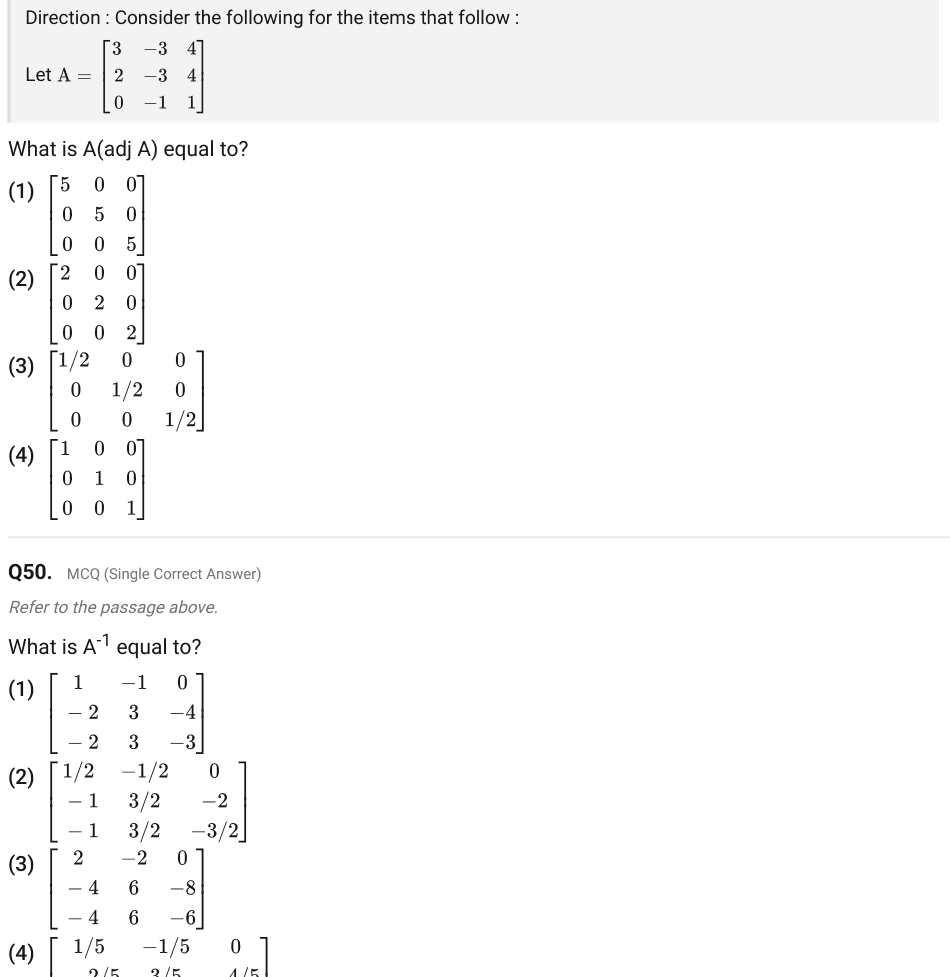
Answer: A
If and are roots of the equation where are integers, then which one of the following is correct?
Answer: C
If and are the roots of the equation , then what is the value of ?
Answer: B
What is the value of ?
Answer: C
Consider the following statements: 1. In a triangle , if , then the triangle is an acute-angled triangle. 2. In a triangle , if , then the triangle is an obtuse-angled triangle. Which of the statements given above is/are correct?
Answer: A
Consider the following for the next items that follow: A quadratic equation is given by , where a, b, c are real. If , , then the roots of the equation are : If , then the roots of the equation are:
Answer: C
Consider the following for the next items that follow: Let . What is equal to ?
Answer: D
What is equal to ?
Answer: D
Consider the following for the next items that follow: Let . What is equal to ?
Answer: B
Consider the following for the next items that follow: Let and . Which one of the following is a possible expression for g(x)?
Answer: B
