509 questions asked across 18 exam years, newest first
What is the maximum number of points of intersection of 10 circles?
Answer: C
Consider the following for the next items that follow: Let a function f be defined on and . If f is differentiable, then what is f'(0.5) equal to?
Answer: C
Consider the following for the next items that follow: A function is defined by . The function is decreasing on :
Answer: A
Consider the following for the next items that follow: A function is defined by . The function attains local minimum value at :
Answer: C
Consider the following for the next items that follow: Given that . What is the maximum value of y?
Answer: B
Consider the following for the next items that follow: Given that . What is the maximum value of xy ?
Answer: A
Consider the following for the next items that follow: Let and f(x) be continuous at x = 3. What is the value of a ?
Answer: D
Consider the following for the next items that follow: Let and f(x) be continuous at x = 3. What is the value of b?
Answer: B
Consider the following for the next items that follow: Let What is equal to?
Answer: B
Consider the following for the next items that follow: Let What is I equal to?
Answer: C
Consider the following for the next items that follow: Let If the function f(x) is differentiable at x = 1, then what is the value of (a + b)?
Answer: A
Consider the following for the next items that follow: Let What is equal to ?
Answer: B
If f(x) = |ln|x|| where 0 < x < 1, then what is f'(0.5) equal to ?
Answer: A
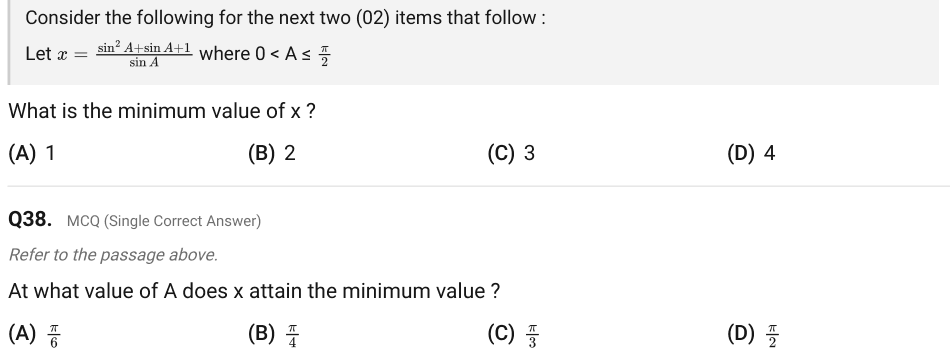
Consider the following for the next two (02) items that follow : Let where What is the minimum value of x ?
Answer: C
Answer: D
Consider the following for the next two (02) items that follow : Consider the function f(x) = |x - 2| + |3 - x| + |4 - x|, where x ∈ R.
At what value of x does the function attain minimum value ?
Answer: B
Consider the following for the next two (02) items that follow : Consider the function f(x) = |x - 2| + |3 - x| + |4 - x|, where x ∈ R.
What is the minimum value of the function ?
Answer: A
Consider the following for the next two (02) items that follow : Consider the sum S = 0! + 1! + 2! + 3! + 4! +... .+ 100!
If the sum S is divided by 8, what is the remainder ?
Answer: C
Consider the following for the next two (02) items that follow : Consider the sum S = 0! + 1! + 2! + 3! + 4! +... .+ 100!
If the sum S is divided by 60, what is the remainder ?
Answer: D
Consider the following for the next three (03) items that follow : Let f(x) = |ln x|, x ≠ 1
What is the derivative of f(x) at x = 0.5 ?
Answer: A
Consider the following for the next three (03) items that follow : Let f(x) = |ln x|, x ≠ 1
What is the derivative of f(x) at x = 2 ?
Answer: C
Consider the following for the next three (03) items that follow : Let f(x) = |ln x|, x ≠ 1
What is the derivative of fof(x), where 1 < x < 2 ?
Answer: D
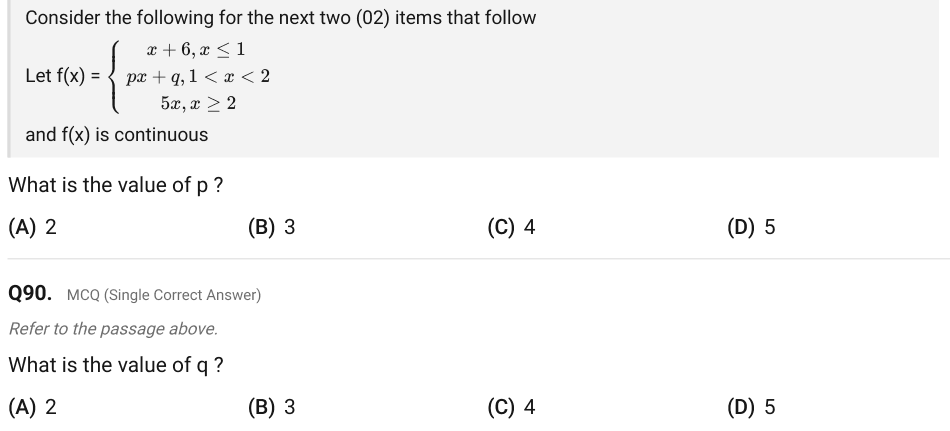
Consider the following for the next two (02) items that follow Let and f(x) is continuous What is the value of p ?
Answer: B
Answer: C
Consider the following statements : 1. is increasing in 2. is decreasing in Which of the statements given above is/are correct ?
Answer: A
