509 questions asked across 18 exam years, newest first
What is the derivative of with respect to ?
Answer: A
What is the derivative of cosec(x°) ?
Answer: B
What is equal to ?
Answer: D
What is equal to ?
Answer: C
Let P be the sum of first n positive terms of an increasing arithmetic progression A. Let Q be the sum of first n positive terms of another increasing arithmetic progression B. Let P ∶ Q = (5n + 4) ∶ (9n + 6)
What is the ratio of the first term of A to that of B ?
Answer: D
Let P be the sum of first n positive terms of an increasing arithmetic progression A. Let Q be the sum of first n positive terms of another increasing arithmetic progression B. Let P ∶ Q = (5n + 4) ∶ (9n + 6)

Answer: C
Let P be the sum of first n positive terms of an increasing arithmetic progression A. Let Q be the sum of first n positive terms of another increasing arithmetic progression B. Let P ∶ Q = (5n + 4) ∶ (9n + 6)
If d is the common difference of A, and D is the common difference of B, then which one of the following is always correct ?
Answer: A
What is the minimum value of the function ?
Answer: B
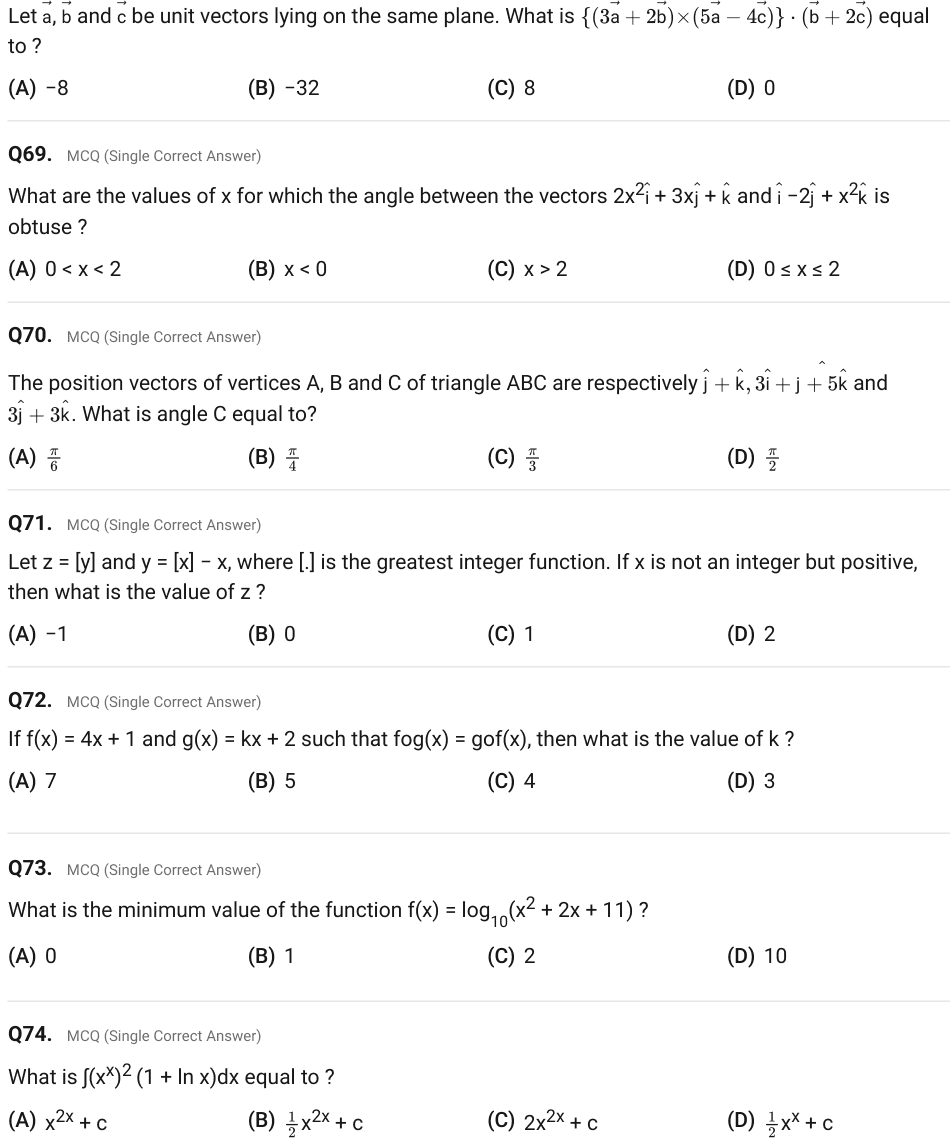
Answer: B
What is equal to ?
Answer: A
What is equal to ?
Answer: C
If , then what is equal to ?
Answer: C
If , then which one of the following is correct ?
Answer: B
What is the maximum value of ?
Answer: B
What is equal to ?
Answer: D
What is equal to ?
Answer: A
If , then what is equal to ?
Answer: D
Under which one of the following conditions does the function attain minimum value ?
Answer: A
Where does the function attain its minimum value ?
Answer: B
Consider the following statements in respect of the function : 1. The function attains maximum value only at 2. The function attains local minimum only at Which of the statements given above is/are correct ?
Answer: B
What is equal to ?
Answer: B
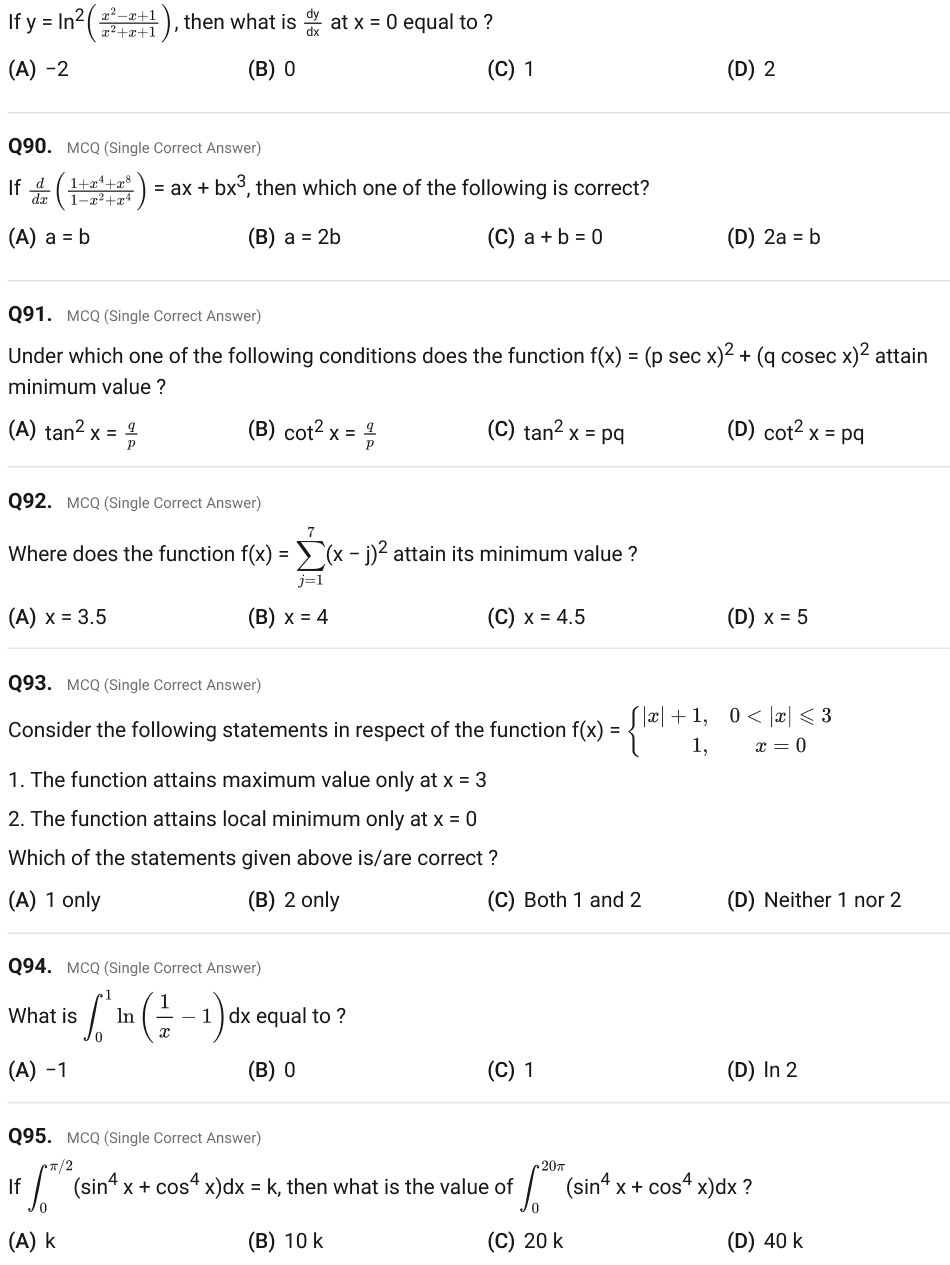
Answer: D
What is the maximum value of n such that divides , where n is a natural number?
Answer: C
What is the value of 2(2 × 1) + 3(3 × 2 × 1) + 4(4 × 3 × 2 × 1) + 5(5 × 4 × 3 × 2 × 1) + .................. + 9(9 × 8 × 7 × 6 × 5 × 4 × 3 × 2 × 1) + 2 ?
Answer: B
Consider the following statements in respect of the function y = [x], x ∈ (-1, 1) where [.] is the greatest integer function: 1. Its derivative is 0 at x = 0.5 2. It is continuous at x = 0 Which of the above statements is/are correct?
Answer: A
