If z − z 4 = 2 ∣ z ∣
A. 1 + 3 B. 1 + 5 C. 1 − 5 D. 5 − 1 Show answer Answer: B
It is given that the roots of the equation
x 2 − 4 x − log 3 P = 0 P
A. 27 1 B. 64 1 C. 81 1 D. 1 Show answer Answer: C
Match List-I with List-II and select the correct answer using the code given below the lists :
| List-I (Function) | List-II (Maximum value) |
| :--- | :--- |
| A. sin x + cos x 10 3 sin x + 4 cos x 2 2 sin x + cos x 5 sin x + 3 cos x 5
A. A 2, B 3, C 1, D 4 B. A 2, B 3, C 4, D 1 C. A 3, B 2, C 1, D 4 D. A 3, B 2, C 4, D 1 Show answer Answer: B
The value of sin − 1 ( 5 3 ) + tan − 1 ( 7 1 )
A. 0 B. 4 π C. 3 π D. 2 π Show answer Answer: B
The principal value of sin − 1 x
A. ( − 2 π , 2 π ) B. [ − 2 π , 2 π ] C. [ 0 , 2 π ] D. [ 0 , π ] Show answer Answer: B
If f ( x ) = 2 x − 1 [ 0 , π ]
A. tan [ f ( x )] [ ⋅ ] f ( x ) 1 B. tan [ f ( x )] [ ⋅ ] f − 1 ( x ) C. tan [ f ( x )] [ ⋅ ] f ( x ) 1 D. tan [ f ( x )] [ ⋅ ] f ( x ) 1 Show answer Answer: C
A function is defined as follows :
f ( x ) = { − x 2 x , 0 , x = 0 x = 0
A. f ( x ) x = 0 x = 0 B. f ( x ) x = 0 C. f ( x ) x = 0 D. None of the above Show answer Answer: C
Consider the following :
1. x + x 2 x = 0 x + cos x 1 x = 0 x 2 + cos x 1 x = 0
A. 1 and 2 only B. 2 and 3 only C. 1 and 3 only D. 1, 2 and 3 Show answer Answer: A
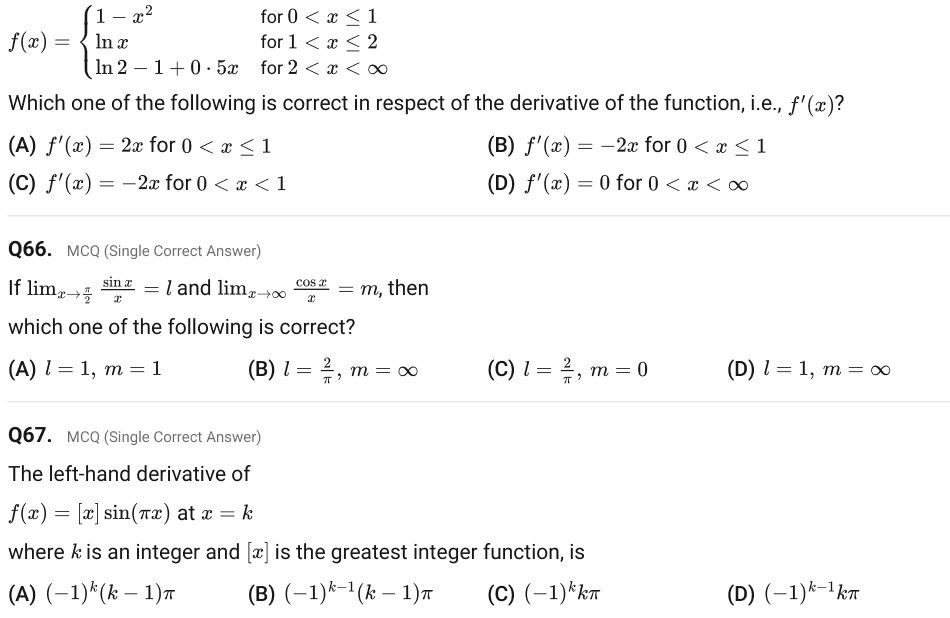
A function is defined in ( 0 , ∞ ) f ( x ) = ⎩ ⎨ ⎧ 1 − x 2 ln x ln 2 − 1 + 0 ⋅ 5 x for 0 < x ≤ 1 for 1 < x ≤ 2 for 2 < x < ∞ f ′ ( x )
A. f ′ ( x ) = 2 x 0 < x ≤ 1 B. f ′ ( x ) = − 2 x 0 < x ≤ 1 C. f ′ ( x ) = − 2 x 0 < x < 1 D. f ′ ( x ) = 0 0 < x < ∞ Show answer Answer: C
If lim x → 2 π x s i n x = l lim x → ∞ x c o s x = m
A. l = 1 , m = 1 B. l = π 2 , m = ∞ C. l = π 2 , m = 0 D. l = 1 , m = ∞ Show answer Answer: C
A. ( − 1 ) k ( k − 1 ) π B. ( − 1 ) k − 1 ( k − 1 ) π C. ( − 1 ) k k π D. ( − 1 ) k − 1 k π Show answer Answer: A
The set of all points, where the function f ( x ) = 1 − e − x 2
A. ( 0 , ∞ ) B. ( − ∞ , ∞ ) C. ( − ∞ , 0 ) ∪ ( 0 , ∞ ) D. ( − 1 , ∞ ) Show answer Answer: C
If f ( x ) = x ( x − x + 1 ) f ( x )
A. continuous but not differentiable at x = 0 B. differentiable at x = 0 C. not continuous at x = 0 D. None of the above Show answer Answer: B
Let g f ( x ) = ( g ( x ) ) 2 − g ( x 2 )
A. all integers B. all integers except 0 and 1 C. all integers except 0 D. all integers except 1 Show answer Answer: D
If y = ( cos x ) ( c o s x ) ( c o s x ) ⋅ ⋅ ⋅ d x d y
A. − 1 − y l n ( c o s x ) y 2 t a n x B. 1 + y l n ( c o s x ) y 2 t a n x C. 1 − y l n ( s i n x ) y 2 t a n x D. 1 + y l n ( s i n x ) y 2 s i n x Show answer Answer: A
Consider the following statements :
1. Derivative of f ( x ) f ( x ) f ( x )
A. 1 and 2 only B. 2 and 3 only C. 1 and 3 only D. 1, 2 and 3 Show answer Answer: D
If y = cos − 1 ( 1 + x 2 2 x ) d x d y
A. − 1 + x 2 2 ∣ x ∣ < 1 B. − 1 + x 2 2 ∣ x ∣ > 1 C. 1 + x 2 2 ∣ x ∣ < 1 D. None of the above Show answer Answer: A
Which one of the following is correct in respect of the function
f ( x ) = x ( x − 1 ) ( x + 1 )
A. The local maximum value is larger than local minimum value B. The local maximum value is smaller than local minimum value C. The function has no local maximum D. The function has no local minimum Show answer Answer: A
The maximum value of x l n x
A. e B. e 1 C. e 2 D. 1 Show answer Answer: B
A cylindrical jar without a lid has to be constructed using a given surface area of a metal sheet. If the capacity of the jar is to be maximum, then the diameter of the jar must be k k
A. 1 B. 2 C. 3 D. 4 Show answer Answer: B
What is ∫ tan − 1 ( sec x + tan x ) d x
A. 4 π x + 4 x 2 + c B. 2 π x + 4 x 2 + c C. 4 π x + 4 π x 2 + c D. 4 π x − 4 x 2 + c Show answer Answer: A
∫ ( ln x ) − 1 d x − ∫ ( ln x ) − 2 d x
A. x ( ln x ) − 1 + c B. x ( ln x ) − 2 + c C. x ( ln x ) + c D. x ( ln x ) 2 + c Show answer Answer: A
What is ∫ 0 2 π 1 + sin 2 x d x
A. 8 B. 4 C. 2 D. 0 Show answer Answer: A
The value of ∫ 0 4 π tan x d x + ∫ 0 4 π cot x d x
A. 4 π B. 2 π C. 2 2 π D. 2 π Show answer Answer: D