172 questions asked across 17 exam years, newest first
Answer: A
In an amplitude modulator circuit, the carrier wave is given by, while modulating signal is given by, . The values of modulation index and lower side band frequency are :
Answer: D
A message signal of frequency 100 MHz and peak voltage 100 V is used to execute amplitude modulation on a carrier wave of frequency 300 GHz and peak voltage 400 V. The modulation index and difference between the two side band frequencies are :
Answer: D
An n-p-n transistor operates as a common emitter amplifier, with a power gain of 60 dB. The input circuit resistance is and the output load resistance is . The common emitter current gain is :
Answer: B
An NPN transistor is used in common emitter configuration as an amplifier with load resistance. Signal voltage of 10 mV is applied across the base-emitter. This produces a 3 mA change in the collector current and change in the base current of the amplifier. The input resistance and voltage gain are :
Answer: C
A signal is transmitted using as carrier wave. The correct amplitude modulated (AM) signal is
Answer: D
Answer: D
The physical sizes of the transmitter and receiver antenna in a communication system are :-
Answer: B
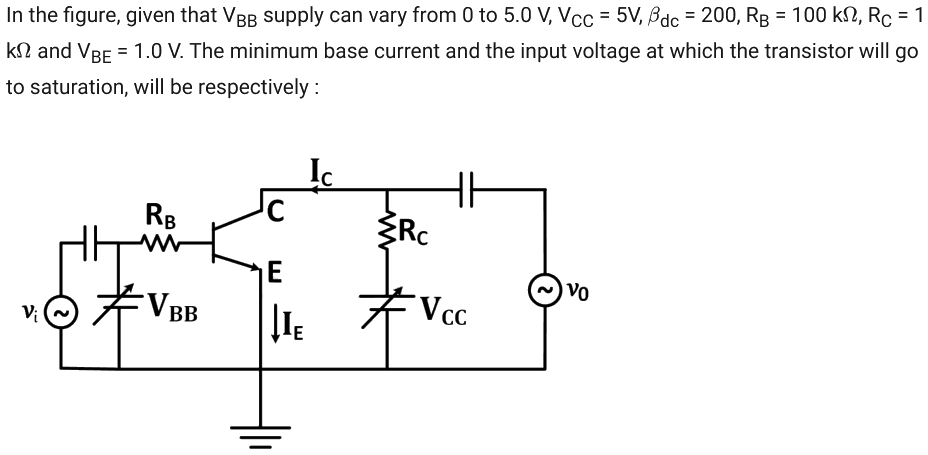
A common emitter amplifier circuit, built using an npn transistor, is shown in the figure. Its dc current gain is 250, and . What is the minimum base current for to reach saturation ?
Answer: D
In a line of sight radio communication, a distance of about 50 km is kept between the transmitting and receiving antennas. If the height of the receiving antenna is 70m, then the minimum height of the transmitting antenna should be : (Radius of the Earth = ).
Answer: D
A 100 V carrier wave is made to vary between 160 V and 40 V by a modulating signal. What is the modulation index ?
Answer: B
Answer: D
Mobility of electrons in a semiconductor is defined as the ratio of their drift velocity to the applied electric field. If, for an n-type semiconductor, the density of electrons is and their mobility is then the resistivity of the semiconductor (since it is an n-type semiconductor contribution of holes is ignored) is close to :
Answer: C
