295 questions asked across 20 exam years, newest first
The half life period of radioactive element x is same as the mean life time of another radioactive element y. Initially they have the same number of atoms. Then :
Answer: B
The de-Broglie wavelength of a particle having kinetic energy E is . How much extra energy must be given to this particle so that the de-Broglie wavelength reduces to of the initial value?
Answer: B
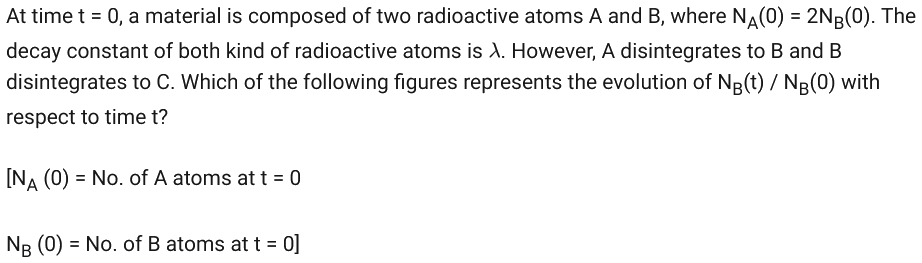
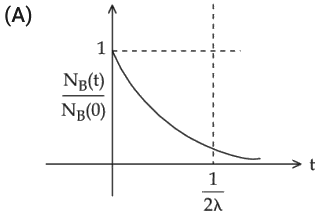
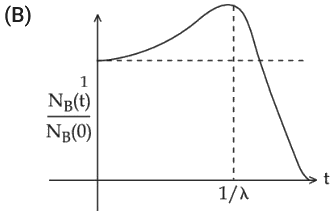
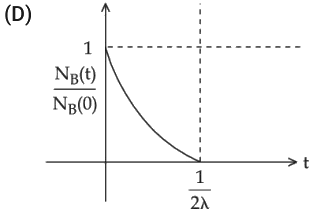
Answer: C
An electron and proton are separated by a large distance. The electron starts approaching the proton with energy 3 eV. The proton captures the electron and forms a hydrogen atom in second excited state. The resulting photon is incident on a photosensitive metal of threshold wavelength . What is the maximum kinetic energy of the emitted photoelectron?
Answer: B
Consider the following statements : A. Atoms of each element emit characteristics spectrum. B. According to Bohr's Postulate, an electron in a hydrogen atom, revolves in a certain stationary orbit. C. The density of nuclear matter depends on the size of the nucleus. D. A free neutron is stable but a free proton decay is possible. E. Radioactivity is an indication of the instability of nuclei. Choose the correct answer from the options given below :
Answer: B
The X-ray of molybdenum has wavelength 0.071 nm. If the energy of a molybdenum atom with a K electron knocked out is 27.5 keV, the energy of this atom when an L electron is knocked out will be __________ keV. (Round off to the nearest integer) [, ]
Answer: 10
A particle of mass 4M at rest disintegrates into two particles of mass M and 3M respectively having non zero velocities. The ratio of de-Broglie wavelength of particle of mass M to that of mass 3M will be :
Answer: D
Some nuclei of a radioactive material are undergoing radioactive decay. The time gap between the instances when a quarter of the nuclei have decayed and when half of the nuclei have decayed is given as : (where is the decay constant)
Answer: D
The half-life of is 3 days. If atomic weight of is 198 g/mol then the activity of 2 mg of is [in disintegration/second] :
Answer: D
An electron moving with speed v and a photon moving with speed c, have same de-Broglie wavelength. The ratio of kinetic energy of electron to that of photon is :
Answer: C
When radiation of wavelength is incident on a metallic surface, the stopping potential of ejected photoelectrons is 4.8 V. If the same surface is illuminated by radiation of double the previous wavelength, then the stopping potential becomes 1.6 V. The threshold wavelength of the metal is :
Answer: B
From the given data, the amount of energy required to break the nucleus of aluminium is ____ J. Mass of neutron = 1.00866 u Mass of proton = 1.00726 u Mass of Aluminium nucleus = 27.18846 u (Assume 1 u corresponds to x J of energy) (Round off to the nearest integer)
Answer: 27
The nuclear activity of a radioactive element becomes of its initial value in 30 years. The half-life of radioactive element is ____ years.
Answer: 10
A nucleus with mass number 184 initially at rest emits an -particle. If the Q value of the reaction is , calculate the kinetic energy of the -particle.
Answer: C
An electron of mass and a proton of mass are accelerated through the same potential difference. The ratio of the de-Broglie wavelength associated with the electron to that with the proton is
Answer: D
A nucleus of mass M emits -ray photon of frequency ''. The loss of internal energy by the nucleus is : [Take 'c' as the speed of electromagnetic wave]
Answer: B
A radioactive material decays by simultaneous emissions of two particles with half lives of 1400 years and 700 years respectively. What will be the time after which one third of the material remains ? (Take ln 3 = 1.1)
Answer: A
A particle is travelling 4 time as fast as an electron. Assuming the ratio of de-Broglie wavelength of a particle to that of electron is , the mass of the particle is :
Answer: D
A radioactive sample disintegrates via two independent decay processes having half lives and respectively. The effective half-life of the nuclei is :
Answer: C
The decay of a proton to neutron is :
Answer: B
The stopping potential in the context of photoelectric effect depends on the following property of incident electromagnetic radiation :
Answer: B
The first three spectral lines of H-atom in the Balmer series are given considering the Bohr atomic model, the wave lengths of first and third spectral lines are related by a factor of approximately '' . The value of x, to the nearest integer, is _______.
Answer: 15
Given below are two statements : one is labeled as Assertion A and the other is labelled as Reason R. Assertion A : An electron microscope can achieve better resolving power than an optical microscope. Reason R : The de Broglie's wavelength of the electrons emitted from an electron gun is much less than wavelength of visible light. In the light of the above statements, choose the correct answer from the options given below :
Answer: C
If and are the wavelengths of the third member of Lyman and first member of the Paschen series respectively, then the value of is :
Answer: A
The recoil speed of a hydrogen atom after it emits a photon in going from n = 5 state to n = 1 state will be :
Answer: D
