295 questions asked across 20 exam years, newest first
The mass of proton, neutron and helium nucleus are respectively , and . The binding energy of helium nucleus is :
Answer: A
A free neutron decays into a proton but a free proton does not decay into neutron. This is because
Answer: B
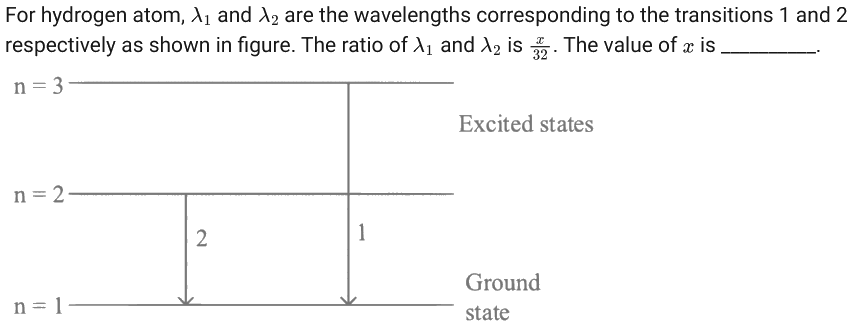
Answer: 27
The radius of electron's second stationary orbit in Bohr's atom is R. The radius of 3rd orbit will be
Answer: A
If the binding energy of ground state electron in a hydrogen atom is , then, the energy required to remove the electron from the second excited state of will be : . The value of is ___________.
Answer: 136
Speed of an electron in Bohr's orbit for Hydrogen atom is . The corresponding speed of the electron in orbit, in is :
Answer: C
The threshold wavelength for photoelectric emission from a material is 5500 . Photoelectrons will be emitted, when this material is illuminated with monochromatic radiation from a A. 75 W infra-red lamp B. 10 W infra-red lamp C. 75 W ultra-violet lamp D. 10 W ultra-violet lamp Choose the correct answer from the options given below :
Answer: C
If a radioactive element having half-life of is undergoing beta decay, the fraction of radioactive element remains undecayed after . will be
Answer: C
A radioactive element emits two -particles, one electron and two positrons. The product nucleus is represented by . The value of P is ____.
Answer: 87
The ratio of de-Broglie wavelength of an particle and a proton accelerated from rest by the same potential is , the value of m is -
Answer: C
Substance A has atomic mass number 16 and half life of 1 day. Another substance B has atomic mass number 32 and half life of day. If both A and B simultaneously start undergo radio activity at the same time with initial mass 320 g each, how many total atoms of A and B combined would be left after 2 days.
Answer: B
Electron beam used in an electron microscope, when accelerated by a voltage of 20 kV, has a de-Broglie wavelength of . IF the voltage is increased to 40 kV, then the de-Broglie wavelength associated with the electron beam would be :
Answer: C
The ratio of the density of oxygen nucleus and helium nucleus is
Answer: B
The wavelength of the radiation emitted is when an electron jumps from the second excited state to the first excited state of hydrogen atom. If the electron jumps from the third excited state to the second orbit of the hydrogen atom, the wavelength of the radiation emitted will be . The value of is ____.
Answer: 27
Given below are two statements : Statement I : Stopping potential in photoelectric effect does not depend on the power of the light source. Statement II : For a given metal, the maximum kinetic energy of the photoelectron depends on the wavelength of the incident light. In the light of above statements, choose the most appropriate answer from the options given below
Answer: C
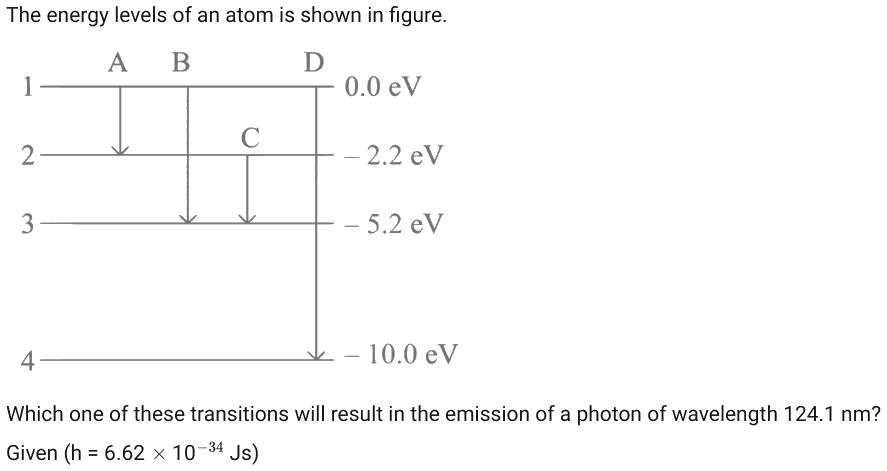
Answer: D
A nucleus disintegrates into two smaller parts, which have their velocities in the ratio 3 : 2. The ratio of their nuclear sizes will be . The value of '' is :-
Answer: 2
From the photoelectric effect experiment, following observations are made. Identify which of these are correct. A. The stopping potential depends only on the work function of the metal. B. The saturation current increases as the intensity of incident light increases. C. The maximum kinetic energy of a photo electron depends on the intensity of the incident light. D. Photoelectric effect can be explained using wave theory of light. Choose the correct answer from the options given below :
Answer: D
Match List I with List II Choose the correct answer from the options given below :
Answer: B
Consider the following radioactive decay process The mass number and the atomic number of are given by :
Answer: B
Assume that protons and neutrons have equal masses. Mass of a nucleon is and radius of nucleus is . The approximate ratio of the nuclear density and water density is . The value of is ____.
Answer: 11
An -particle, a proton and an electron have the same kinetic energy. Which one of the following is correct in case of their de-Broglie wavelength:
Answer: D
A photon is emitted in transition from n = 4 to n = 1 level in hydrogen atom. The corresponding wavelength for this transition is (given, ) :
Answer: B
The energy released per fission of nucleus of is 200 MeV. The energy released if all the atoms in 120g of pure undergo fission is _________ . (Given )
Answer: 6
Find the ratio of energies of photons produced due to transition of an electron of hydrogen atom from its (i) second permitted energy level to the first level, and (ii) the highest permitted energy level to the first permitted level.
Answer: A
