295 questions asked across 20 exam years, newest first
A electron beam is used to bombard gaseous hydrogen at room temperature. The number of spectral lines emitted will be:
Answer: C
A common example of alpha decay is Given : , , and The energy released () during the alpha decay of is _________
Answer: 4
A metallic surface is illuminated with radiation of wavelength , the stopping potential is . If the same surface is illuminated with radiation of wavelength . the stopping potential becomes . The threshold wavelength for this metallic surface will be
Answer: A
Two radioactive elements A and B initially have same number of atoms. The half life of A is same as the average life of B. If and are decay constants of A and B respectively, then choose the correct relation from the given options.
Answer: A
A monochromatic light is incident on a hydrogen sample in ground state. Hydrogen atoms absorb a fraction of light and subsequently emit radiation of six different wavelengths. The frequency of incident light is . The value of is _________. (Given )
Answer: 3
The energy of ion in its first excited state is, (The ground state energy for the Hydrogen atom is ) :
Answer: A
The ratio of the de-Broglie wavelengths of proton and electron having same Kinetic energy : (Assume )
Answer: A
A nucleus disintegrates into two nuclear parts, in such a way that ratio of their nuclear sizes is . Their respective speeds have a ratio of . The value of is _________.
Answer: 2
The de Broglie wavelength of a molecule in a gas at room temperature (300 K) is . If the temperature of the gas is increased to 600 K, then the de Broglie wavelength of the same gas molecule becomes
Answer: C
The angular momentum for the electron in the first Bohr orbit is L. If the electron is assumed to revolve in second orbit of hydrogen atom, then the change in angular momentum will be
Answer: A
The decay constant for a radioactive nuclide is . Atomic weight of the substance is , (). The activity of of the substance is _________ .
Answer: 15
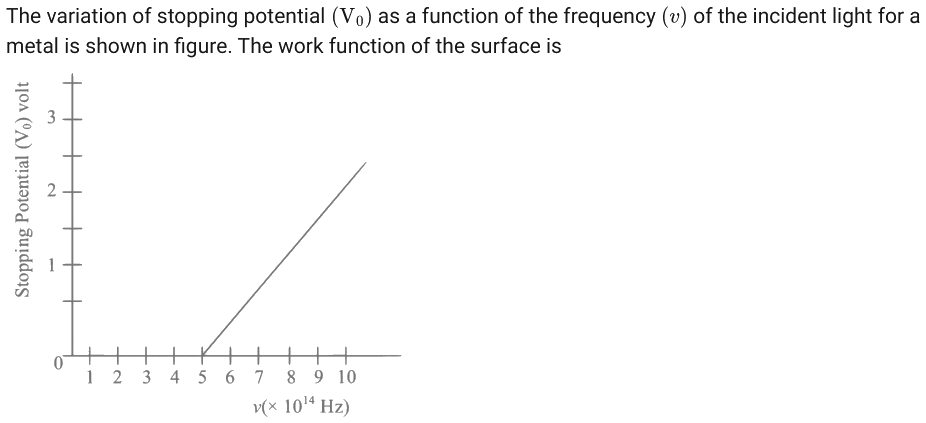
Answer: D
The half life of a radioactive substance is T. The time taken, for disintegrating part of its original mass will be:
Answer: B
If be the lowest wavelength of Lyman series then the lowest wavelength of Balmer series will be _________ .
Answer: 3668
For a nucleus having mass number and atomic number A. The surface energy per nucleon . B. The Coulomb contribution to the binding energy C. The volume energy D. Decrease in the binding energy is proportional to surface area. E. While estimating the surface energy, it is assumed that each nucleon interacts with 12 nucleons. ( and are constants) Choose the most appropriate answer from the options given below:
Answer: A
Proton () and electron () will have same de-Broglie wavelength when the ratio of their momentum is (assume, ):
Answer: A
A nucleus with mass number and binding energy per nucleon as breaks into two fragment each with mass number . If each fragment nucleus has binding energy per nucleon as , the total gain in binding energy is ___________ .
Answer: 121
The ratio of wavelength of spectral lines and in the Balmer series is . The value of is ____.
Answer: 27
The kinetic energy of an electron, -particle and a proton are given as and K respectively. The de-Broglie wavelength associated with electron (), -particle () and the proton () are as follows:
Answer: A
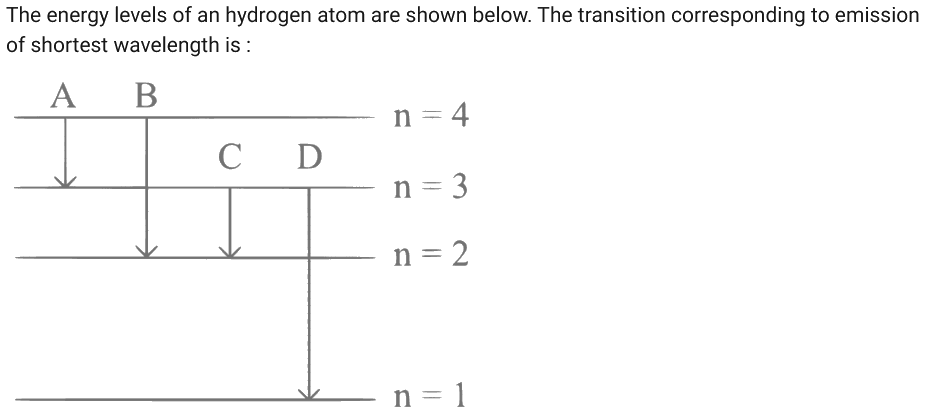
Answer: D
The radius of fifth orbit of the is ________ . Take: radius of hydrogen atom
Answer: 425
The work functions of Aluminium and Gold are and respectively. The ratio of the slope of the stopping potential versus frequency plot for Gold to that of Aluminium is
Answer: C
A small particle of mass moves in such a way that its potential energy where is constant and is the distance of the particle from origin. Assuming Bohr's quantization of momentum and circular orbit, the radius of orbit will be proportional to,
Answer: A
A proton moving with one tenth of velocity of light has a certain de Broglie wavelength of . An alpha particle having certain kinetic energy has the same de-Broglie wavelength . The ratio of kinetic energy of proton and that of alpha particle is:
Answer: C
Match List I with List II : | List I | List II | | :--- | :--- | | A. Microwaves | I. Radioactive decay of the nucleus | | B. Gamma rays | II. Rapid acceleration and deceleration of electron in aerials | | C. Radio waves | III. Inner shell electrons | | D. X-rays | IV. Klystron valve | Choose the correct answer from the options given below :
Answer: C
