295 questions asked across 20 exam years, newest first
Given below are two statements. One is labelled as Assertion (A) and the other is labelled as Reason (R). Assertion (A) : The binding energy per nucleon is found to be practically independent of the atomic number A , for nuclei with mass numbers between 30 and 170 . Reason (R) : Nuclear force is long range. In the light of the above statements, choose the correct answer from the options given below :
Answer: A
In photoelectric effect an em-wave is incident on a metal surface and electrons are ejected from the surface. If the work function of the metal is and stopping potential is , what is the wavelength of the em-wave? (Given where is the Planck's constant and is the speed of light in vacuum.)
Answer: C
The work functions of cesium (Cs) and lithium (Li) metals are 1.9 eV and 2.5 eV , respectively. If we incident a light of wavelength 550 nm on these two metal surfaces, then photo-electric effect is possible for the case of
Answer: D
An electron in the ground state of the hydrogen atom has the orbital radius of while that for the electron in third excited state is . The ratio of the de Broglie wavelengths of electron in the excited state to that in the ground state is
Answer: A
A proton, an electron and an alpha particle have the same energies. Their de-Broglie wavelengths will be compared as :
Answer: B
A nucleus at rest disintegrates into two smaller nuclei with their masses in the ratio of . After disintegration they will move :
Answer: A
The energy released in the fusion of of hydrogen deep in the sun is and the energy released in the fission of of is . The ratio is approximately: (Consider the fusion reaction as , energy released in the fission reaction of is per fission nucleus and )
Answer: A
A hydrogen atom in ground state is given an energy of . How many spectral lines will be emitted due to transition of electrons?
Answer: D
A proton and an electron are associated with same de-Broglie wavelength. The ratio of their kinetic energies is: (Assume and )
Answer: C
Binding energy of a certain nucleus is . How much is the difference between total mass of all the nucleons and nuclear mass of the given nucleus:
Answer: A
In an alpha particle scattering experiment distance of closest approach for the particle is . If target nucleus has atomic number 80 , then maximum velocity of -particle is ________ approximately. (, mass of particle )
Answer: 156
If is the mass of isotope , and are the masses of proton and neutron, then nuclear binding energy of isotope is:
Answer: A
A proton and an electron have the same de Broglie wavelength. If and be the kinetic energies of proton and electron respectively, then choose the correct relation :
Answer: C
In a hypothetical fission reaction The identity of emitted particles (R) is :
Answer: B
When UV light of wavelength is incident on the metal surface having work function , electron emission takes place. The stopping potential is : (Given )
Answer: B
In Franck-Hertz experiment, the first dip in the current-voltage graph for hydrogen is observed at . The wavelength of light emitted by hydrogen atom when excited to the first excitation level is ________ . (Given ).
Answer: 122
Which of the following statement is not true about stopping potential ?
Answer: C
The shortest wavelength of the spectral lines in the Lyman series of hydrogen spectrum is . The longest wavelength of spectral lines in the Balmer series will be ____ .
Answer: 6588
Which of the following nuclear fragments corresponding to nuclear fission between neutron () and uranium isotope () is correct :
Answer: D

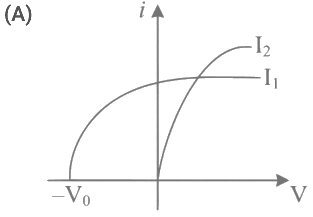
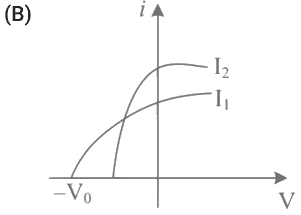
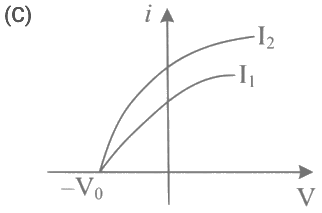
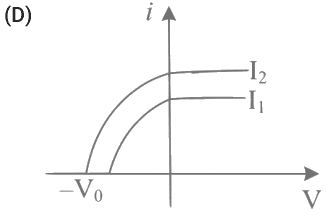
Answer: C
A hydrogen atom changes its state from to . Due to recoil, the percentage change in the wavelength of emitted light is approximately . The value of is ____. [Given mass of the hydrogen atom ]
Answer: 7
According to Bohr's theory, the moment of momentum of an electron revolving in orbit of hydrogen atom is:
Answer: A
The disintegration energy for the nuclear fission of is ________ . Given atomic masses of ; , ; , Value of .
Answer: 208
The minimum energy required by a hydrogen atom in ground state to emit radiation in Balmer series is nearly :
Answer: C
The de Broglie wavelengths of a proton and an particle are and respectively. The ratio of the velocities of proton and particle will be :
Answer: A
