295 questions asked across 20 exam years, newest first
The average energy released per fission for the nucleus of is 190 MeV . When all the atoms of 47 g pure undergo fission process, the energy released is . The value of is _____. (Avogadro Number per mole)
Answer: 228
The minimum frequency of photon required to break a particle of mass 15.348 amu into particles is ____ kHz . [mass of He nucleus = and ]
Answer: D
-particle scatters from a target material of atomic number 79 . From the given data the estimated diameter of nuclei of the target material is (approximately) ____ m.
Answer: B
If an alpha particle with energy 7.7 MeV is bombarded on a thin gold foil, the closest distance from nucleus it can reach is ____ m. (Atomic number of gold and in SI units)
Answer: C
The energy of an electron in an orbit of the Bohr's atom is eV where is the ground state energy. If is the angular momentum of the electron in this orbit and is the Planck's constant, then is ____ :
Answer: C
For a nucleus of mass number and radius , the mass density of nucleus can be represented as
Answer: B
An electron is released from rest near an infinite non-conducting sheet of uniform charge density ''. The rate of change of de-Broglie wave length associated with the electron varies inversely as power of time. The numerical value of is .
Answer: 2
Considering the Bohr model of hydrogen like atoms, the ratio of the radius of orbit of the electron in and is
Answer: B
Given below are two statements: one is labelled as Assertion A and the other is labelled as Reason R Assertion A : In photoelectric effect, on increasing the intensity of incident light the stopping potential increases. Reason R : Increase in intensity of light increases the rate of photoelectrons emitted, provided the frequency of incident light is greater than threshold frequency. In the light of the above statements, choose the correct answer from the options given below
Answer: B

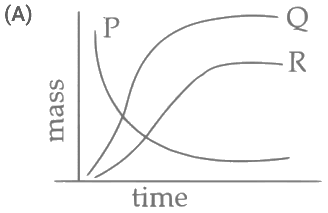
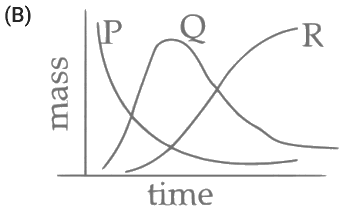
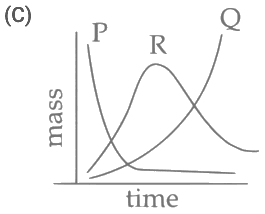
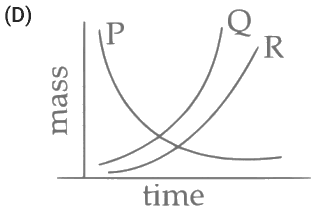
Answer: B
Given below are two statements : Statement (I) : The dimensions of Planck's constant and angular momentum are same. Statement (II) : In Bohr's model electron revolve around the nucleus only in those orbits for which angular momentum is integral multiple of Planck's constant. In the light of the above statements, choose the most appropriate answer from the options given below :
Answer: B
The work function of a metal is 3 eV . The color of the visible light that is required to cause emission of photoelectrons is
Answer: C
Match the LIST-I with LIST-II Choose the correct answer from the options given below:
Answer: B
Given below are two statements: one is labelled as Assertion A and the other is labelled as Reason R Assertion A : The Bohr model is applicable to hydrogen and hydrogen-like atoms only. Reason R : The formulation of Bohr model does not include repulsive force between electrons. In the light of the above statements, choose the correct answer from the options given below
Answer: B
An electron in the hydrogen atom initially in the fourth excited state makes a transition to energy state by emitting a photon of energy . The integer value of will be__________.
Answer: 2
Considering Bohr's atomic model for hydrogen atom : (A) the energy of H atom in ground state is same as energy of ion in its first excited state. (B) the energy of H atom in ground state is same as that for ion in its second excited state. (C) the energy of H atom in its ground state is same as that of ion for its ground state. (D) the energy of ion in its first excited state is same as that for ion in its ground state. Choose the correct answer from the options given below :
Answer: A
Energy released when two deuterons () fuse to form a helium nucleus () is : (Given : Binding energy per nucleon of and binding energy per nucleon of )
Answer: C
Assuming the validity of Bohr's atomic model for hydrogen like ions the radius of ion in its ground state is given by , where ____ (Where is the first Bohr's radius.)
Answer: D
In an experiment with photoelectric effect, the stopping potential,
Answer: A
The number of spectral lines emitted by atomic hydrogen that is in the 4th energy level, is
Answer: B
A proton of mass ' ' has same energy ' ' as that of a photon of wavelength ' '. If the proton is moving at non-relativistic speed, then ratio of its de Broglie wavelength to the wavelength of photon is.
Answer: D
Choose the correct nuclear process from the below options [ : proton, : neutron, : electron, : positron, : neutrino, : antineutrino]
Answer: B
During the transition of electron from state A to state C of a Bohr atom, the wavelength of emitted radiation is and it becomes when the electron jumps from state B to state C. Then the wavelength of the radiation emitted during the transition of electrons from state A to state B is
Answer: D
In photoelectric effect, the stopping potential () v/s frequency () curve is plotted. ( h is the Planck's constant and is work function of metal ) (A) is linear. (B) The slope of curve (C) h constant is related to the slope of line. (D) The value of electric charge of electron is not required to determine h using the curve. (E) The work function can be estimated without knowing the value of . Choose the correct answer from the options given below :
Answer: A
The ratio of the power of a light source to that of the light source is 2. is emitting photons per second at 600 nm . If the wavelength of the source is 300 nm , then the number of photons per second emitted by is ________ .
Answer: 5
