295 questions asked across 20 exam years, newest first
Both the nucleus and the atom of some element are in their respective first excited states. They get de-excited by emitting photons of wavelengths respectively. The ratio is closest to :
Answer: A
At some instant, a radioactive sample having an activity has twice the number of nuclei as another sample which has an activity of . The half lives of and are :
Answer: A
Two electrons are moving with non-relativistic speed perpendicular to each other. If corresponding de Broglie wavelength are and , their de Broglie wavelength in the frame of reference attached to their center of masses :
Answer: B
A solution containing active cobalt having activity of and decay constant is injected in an animal's body. If of blood is drawn from the animal's body after 10 hrs of injection, the activity found was 300 decays per minute What is the volume of blood that is flowing in the body ? ( decays per second and at )
Answer: D
An electron from various excited states of hydrogen atom emit radiation to come to the ground state. Let be the de Broglie wavelength of the electron in the state and the ground state respectively. Let be the wavelength of the emitted photon in the transition from the state to the ground state. For large n, (A, B are constants)
Answer: A
If the series limit frequency of the Lyman series is , then the series limit frequency of the Pfund series is:
Answer: A
It is found that if a neutron suffers an elastic collinear collision with deuterium at rest, fractional loss of its energy is ; while for its similar collision with carbon nucleus at rest, fractional loss of energy is . The values of and are respectively :
Answer: B
A Laser light of wavelength 660 nm is used to weld Retina detachment. If a Laser pulse of width 60 ms and power 0.5 kW is used the approximate number of photons in the pulse are : [Take Planck's constant ]
Answer: A
The acceleration of an electron in the first orbit of the hydrogen atom (n = 1) is :
Answer: C
According to Bohr's theory, the time averaged magnetic field at the centre (i.e. nucleus) of a hydrogen atom due to the motion of electrons in the orbit is proportional to : (n = principal quantum number)
Answer: B
Two deuterons undergo nuclear fusion to form a Helium nucleus. Energy released in this process is : (given binding energy per nucleon for deuteron = 1.1 MeV and for helium = 7.0 MeV)
Answer: C
Half-lives of two radioactive elements and are and , respectively. Initially, the samples have equal number of nuclei. After 80 minutes, the ratio of decayed number of and nuclei will be:
Answer: B
As an electron makes a transition from an excited state to the ground state of a hydrogen - like atom/ion :
Answer: C
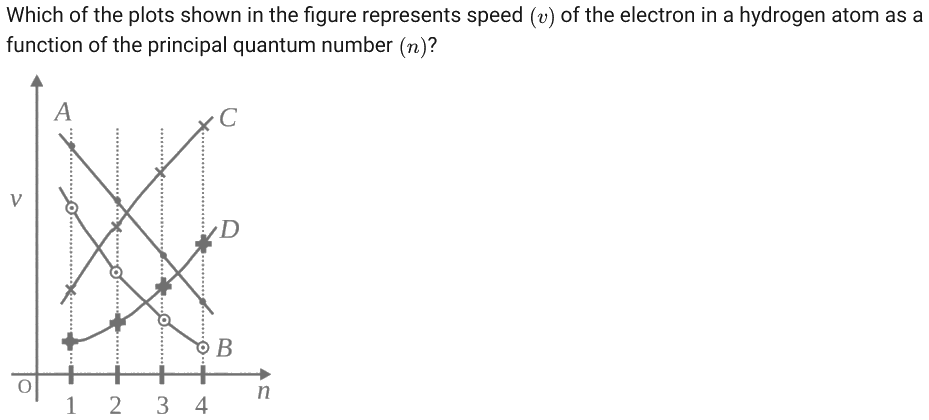
Hydrogen (), Deuterium (), singly ionised Helium () and doubly ionised lithium () all have one electron around the nucleus. Consider an electron transition from to . If the wavelengths of emitted radiation are and respectively then approximately which one of the following is correct?
Answer: C
Answer: A
The counting rate observed from a radioactive source at was , and , it was . The counting rate observed as at will be
Answer: D
A hypothetical atom has only three energy levels. The ground level has energy, . The two excited states have energies, and . Then which of the following wavelengths will not be present in the emission spectrum of this atom?
Answer: B
A doubly ionised atom is excited from its ground state to state. The wavelengths of the spectral lines are given by and . The ratio and are, respectively
Answer: C
The electron of a hydrogen atom makes a transition from the orbit to the orbit. For large the wavelength of the emitted radiation is proportional to
Answer: B
Answer: C
A sample originally contained radioactive atoms, which emit -particles. The ratio of particles emitted in the third year to that emitted during the second year is 0.3. How many particles were emitted in the first year?
Answer: D
Statement - 1 : When ultraviolet light is incident on a photocell, its stopping potential is and the maximum kinetic energy of the photoelectrons is . When the ultraviolet light is replaced by -rays, both and increase. Statement - 2 : Photoelectrons are emitted with speeds ranging from zero to a maximum value because of the range of frequencies present in the incident light.
Answer: D
A nucleus of mass is at rest and decays into two daughter nuclei of equal mass each. Speed of light is . The binding energy per nucleon for the parent nucleus is and that for the daughter nuclei is . Then
Answer: C
A nucleus of mass is at rest and decays into two daughter nuclei of equal mass each. Speed of light is . The speed of daughter nuclei is
Answer: B
A radioactive nucleus (initial mass number and atomic number emits - particles and positrons. The ratio of number of neutrons to that of protons in the final nucleus will be
Answer: B
