187 questions asked across 19 exam years, newest first
The trajectory of a projectile near the surface of the earth is given as . If it were launched at an angle with speed then () :
Answer: A
Answer: B
A particle is moving with speed along positive x-axis. Calculate the speed of the particle at time (assume that the particle is at origin )
Answer: C
Two particles are projected from the same point with the same speed u such that they have the same range R, but different maximum heights, and . Which of the following is correct ?
Answer: B
A ball is thrown upward with an initial velocity from the surface of the earth. The motion of the ball is affected by a drag force equal to (where m is mass of the ball, u is its instantaneous velocity and is a constant). Time taken by the ball to rise to its zenith is :
Answer: A
Answer: C
A source of sound S is moving with a velocity of 50 m/s towards a stationary observer. The observer measures the frequency of the source as 1000 Hz. What will be the apparent frequency of the source when it is moving away from the observer after crossing him? (Take velocity of sound in air is 350 m/s)
Answer: A
The stream of a river is flowing with a speed of 2km/h. A swimmer can swim at a speed of 4km/h. What should be the direction of the swimmer with respect to the flow of the river to cross the river straight ?
Answer: B

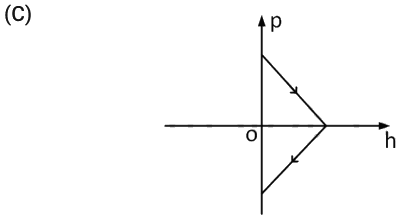
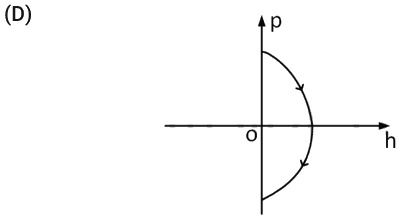
Answer: D
A particle of mass 'm' is moving with speed '2v' and collides with a mass '2m' moving with speed 'v' in the same direction. After collision, the first mass is stopped completely while the second one splits into two particles each of mass 'm', which move at angle with respect to the origianl direction. The speed of each of the moving particle will be :-
Answer: A
A wedge of mass M = 4m lies on a frictionless plane. A particle of mass m approaches the wedge with speed v. There is no friction between the particle and the plane or between the particle and the wedge. The maximum height climbed by the particle on the wedge is given by :-
Answer: D
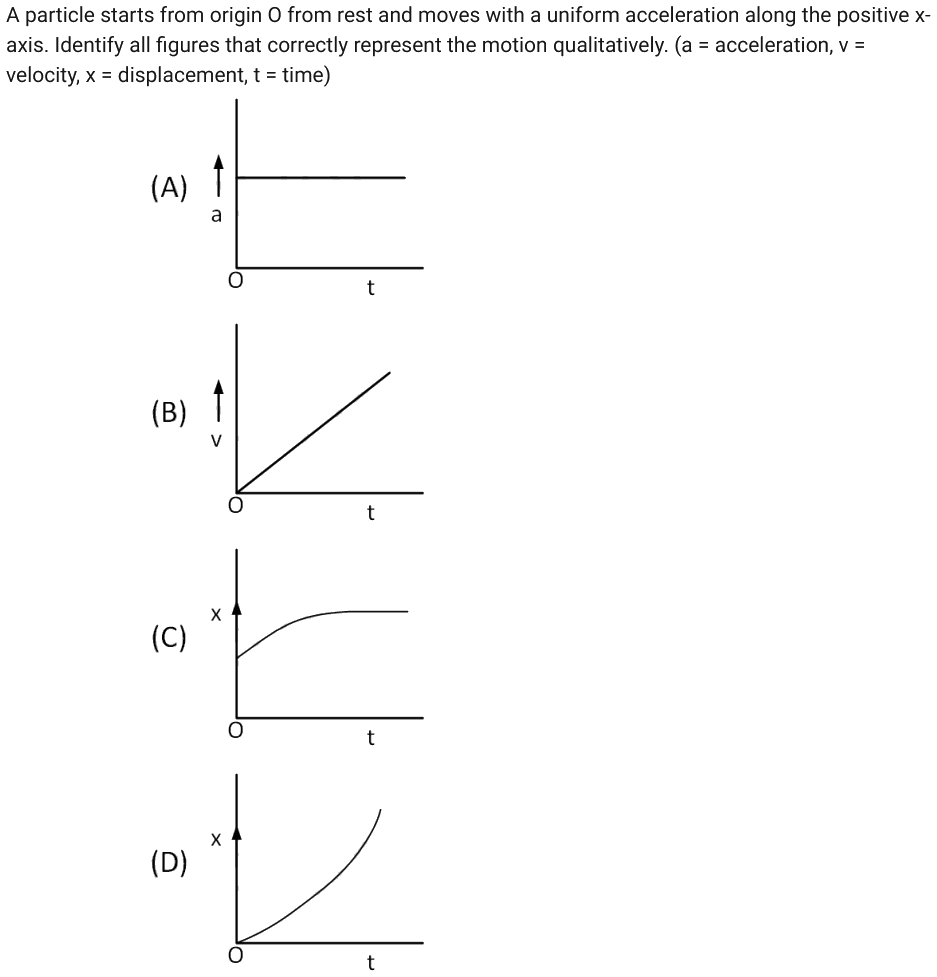
Answer: D
A solid sphere and solid cylinder of identical radii approach an incline with the same linear velocity (see figure). Both roll without slipping all throughout. The two climb maximum heights and on the incline. The ratio is given by :-
Answer: B
A body of mass moving with an unknown velocity of , undergoes a collinear collision with a body of mass moving with a velocity . After collision, and move with velocities of and , respectively. If and , then is :-
Answer: C
A passenger train of length travels at a speed of . Another freight train of length travels at a speed of . The ratio of times taken by the passenger train to completely cross the freight train when : (i) they are moving in the same direction , and (ii) in the opposite direction is :
Answer: C
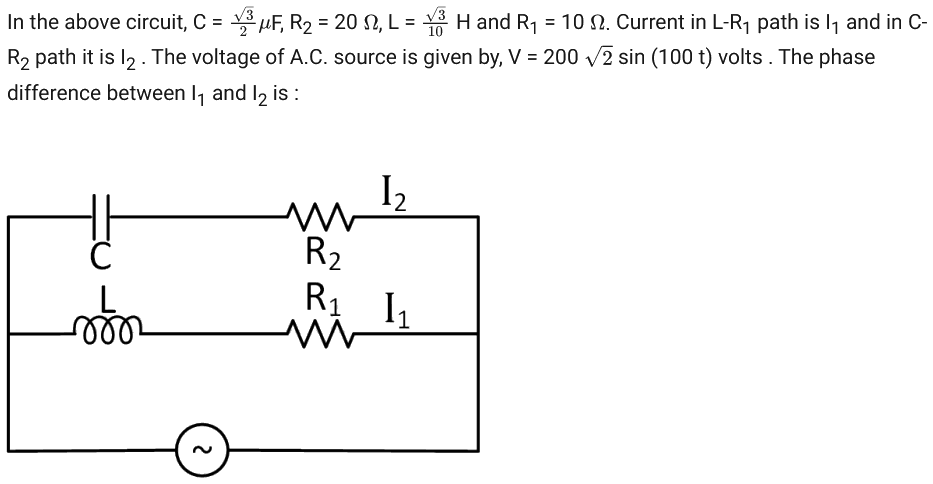
Answer: C
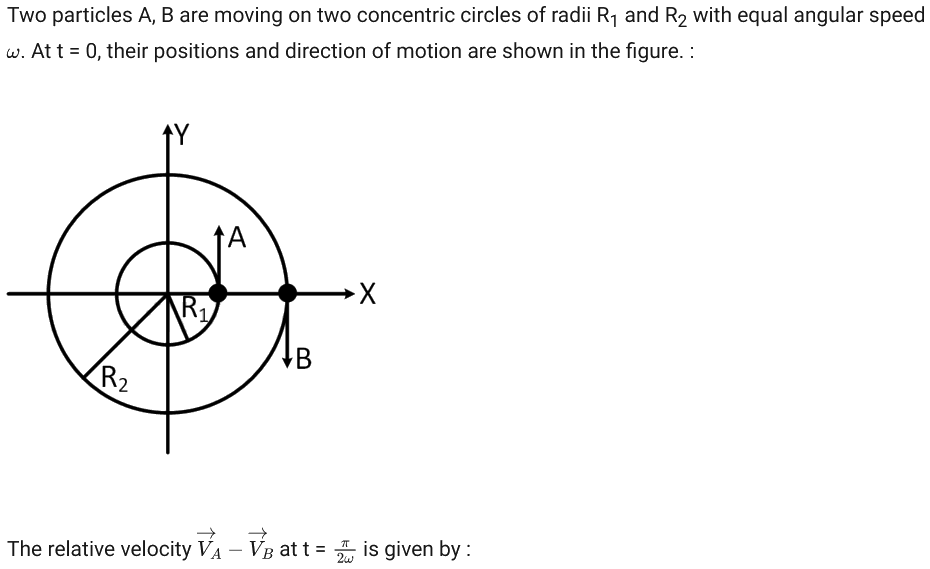
Answer: B
A particle moves from the point , at , with an initial velocity . It is acted upon by a constant force which produces a constant acceleration . What is the distance of the particle from the origin at time 2 s?
Answer: B
A particle is moving with a velocity The general equation for its path is :
Answer: C
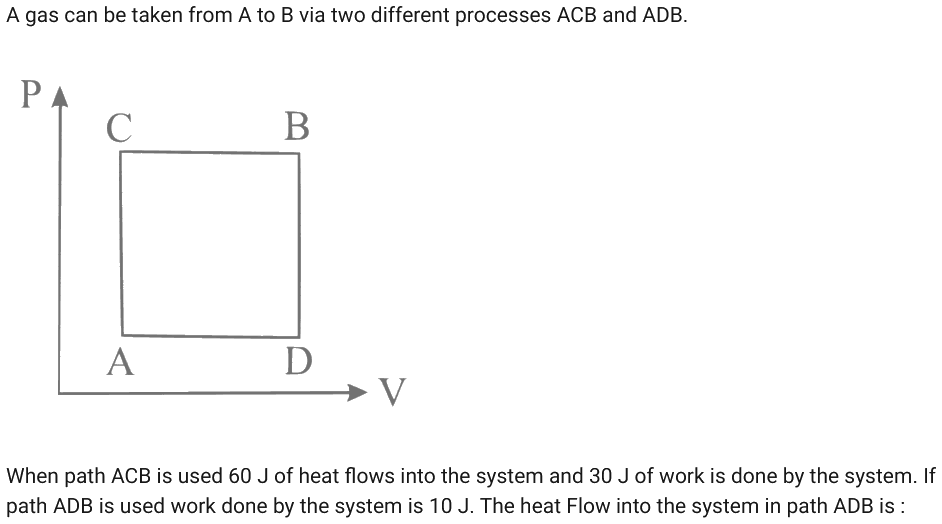
Answer: A
