179 questions asked across 19 exam years, newest first
If minimum possible work is done by a refrigerator in converting 100 grams of water at to ice, how much heat (in calories) is released to the surroundings at temperature (Latent heat of ice = 80 Cal/gram) to the nearest integer ?
Answer: 8791
An engine takes in 5 moles of air at and , and compresses it adiabatically to of the original volume. Assuming air to be a diatomic ideal gas made up of rigid molecules, the change in its internal energy during this process comes out to be . The value of to the nearest integer is ____.
Answer: 46
A heat engine is involved with exchange of heat of 1915 J, – 40J, + 125 J and –Q J, during one cycle achieving an efficiency of 50.0%. The value of Q is
Answer: A
Consider two ideal diatomic gases A and B at some temperature T. Molecules of the gas A are rigid, and have a mass m. Molecules of the gas B have an additional vibrational mode, and have a mass . The ratio of the specific heats ( and ) of gas A and B, respectively is :
Answer: B
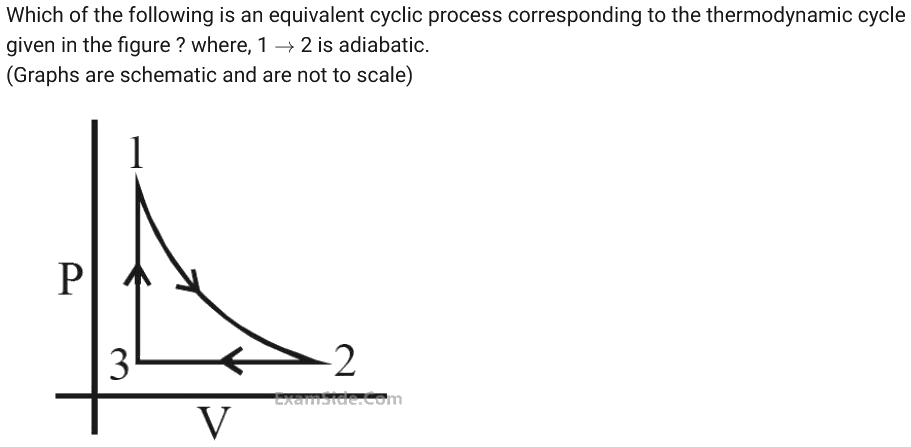
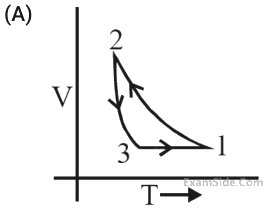
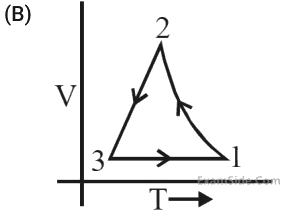
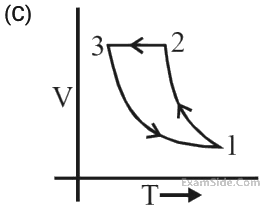
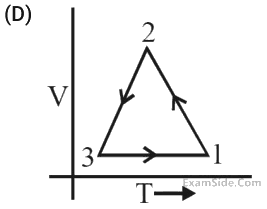
Answer: B
Starting at temperature 300 K, one mole of an ideal diatomic gas () is first compressed adiabatically from volume to . It is then allowed to expand isobarically to volume . If all the processes are the quasi-static then the final temperature of the gas (in ) is (to the nearest integer) _______.
Answer: 1818 to 1819
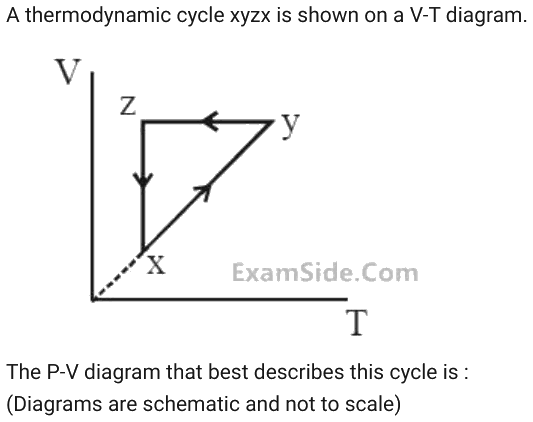
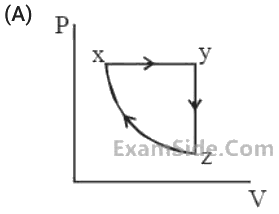
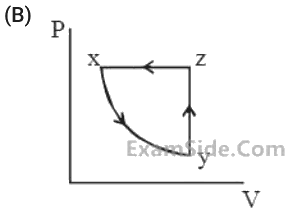
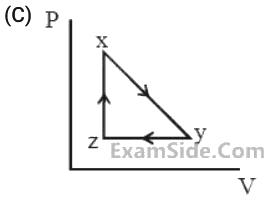
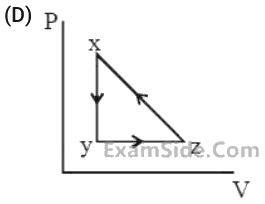
Answer: A
Consider a mixture of n moles of helium gas and 2n moles of oxygen gas (molecules taken to be rigid) as an ideal gas. Its value will be :
Answer: D
A carnot engine having an efficiency of is being used as a refrigerator. If the work done on the refrigerator is 10 J, the amount of heat absorbed from the reservoir at lower temperature is :
Answer: A
A litre of dry air at STP expands adiabatically to a volume of 3 litres. If , the work done by air is : () [Take air to be an ideal gas]
Answer: C
A Carnot engine operates between two reservoirs of temperatures 900 K and 300 K. The engine performs 1200 J of work per cycle. The heat energy (in J) delivered by the engine to the low temperature reservoir, in a cycle, is _______.
Answer: 600
Under an adiabatic process, the volume of an ideal gas gets doubled. Consequently the mean collision time between the gas molecule changes from to . If for this gas then a good estimate for is given by :
Answer: A
Two ideal Carnot engines operate in cascade (all heat given up by one engine is used by the other engine to produce work) between temperature, and . The temperature of the hot reservoir of the first engine is and the temperature of the cold reservoir of the second engine is . T is temperature of the sink of first engine which is also the source for the second engine. How is T related to and , if both engines perform equal amount of work?
Answer: C
Two moles of helium gas is mixed with three moles of hydrogen molecules (taken to be rigid). What is the molar specific heat of mixture at constant volume ? (R = 8.3 J/mol K)
Answer: B
When gram of ice at (specific heat = ) is added to gram of water at , finally no ice is left and the water is at . The value of latent heat of ice, in is :
Answer: A
One kg of water, at , heated in an electric kettle whose heating element has a mean (temperature averaged) resistance of . The rms voltage in the mains is 200 V. Ignoring heat loss from the kettle, time taken for water to evaporate fully, is close to : [Specific heat of water = , Latent heat of water = ]
Answer: B
A Carnot engine has an efficiency of . When the temperature of the sink is reduced by , its efficiency is doubled. The temperatures of the source and the sink are, respectively
Answer: A
n moles of an ideal gas with constant volume heat capcity undergo an isobaric expansion by certain volume. The ratio of the work done in the process, to the heat supplied is :
Answer: D
A massless spring (k = 800 N/m), attached with a mass (500 g) is completely immersed in 1 kg of water. The spring is stretched by 2 cm and released so that it starts vibrating. What would be the order of magnitude of the change in the temperature of water when the vibrations stop completely ? (Assume that the water container and spring receive negligible heat and specific heat of mass = 400 J/kg K, specific heat of water = 4184 J/kg K)
Answer: C
The specific heats, and of a gas of diatomic molecules, A, are given (in units of ) by 29 and 22, respectively. Another gas of diatomic molecules, B, has the corresponding values 30 and 21. If they are treated as ideal gases, then :-
Answer: B
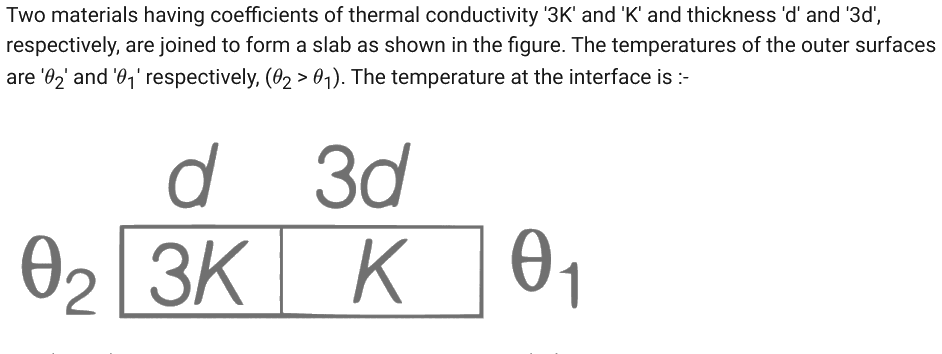
Answer: A
In a conductor, if the number of conduction electrons per unit volume is and mean free time is 25fs (femto second), it's approximate resistivity is :- ()
Answer: A
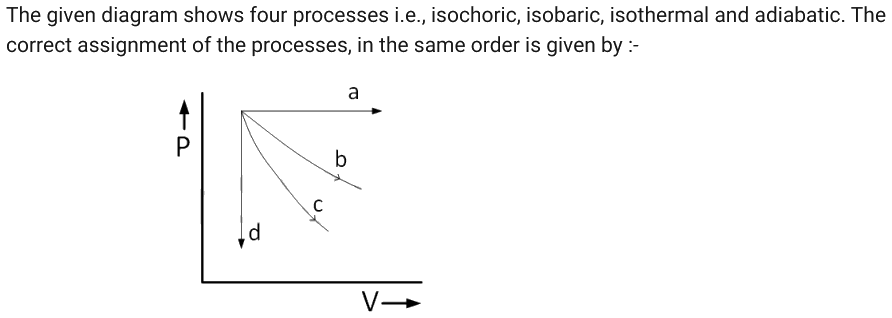
Answer: A
A cylinder of radius R is surrounded by a cylindrical shell of inner radius R and outer radius 2R. The thermal conductivity of the material of the inner cylinder is and the of the outer cylinder is . Assuming no loss of heat, the effective thermal conductivity of the system for heat flowing along the length of the cylinder is :
Answer: B
A metal ball of mass is heated upto and dropped into a vessel of heat capacity and containing water. The initial temperature of water and vessel is . What is the approximate percentage increment in the temperature of the water? [Specific Heat Capacities of water and metal are, respectively, and ]
Answer: A
