179 questions asked across 19 exam years, newest first
Initial pressure and volume of a monoatomic ideal gas are and . The change in internal energy of this gas in adiabatic expansion to volume is ____ .
Answer: C
A monochromatic source of light operating at emits . The region of an electromagnetic spectrum to which the emitted electromagnetic radiation belongs to ____ . (Take and ).
Answer: D
A certain gas is isothermally compressed to of its initial volume () by applying required pressure. If the bulk modulus of the gas is , the magnitude of work done on the gas is ____ .
Answer: 600
A cylinder with adiabatic walls is closed at both ends and is divided into two compartments by a frictionless adiabatic piston. Ideal gas is filled in both (left and right) the compartments at same , , . Heating is started from left side until pressure changes to . If initial volume of each compartment was 9 litres then the final volume in right-hand side compartment is ____ litres. (for this ideal gas )
Answer: B
Given below are two statements: one is labelled as Assertion A and the other is labelled as Reason R Statement I: Change in internal energy of a system containing mole of ideal gas can be written as , where , , . Statement II: Relation between degree of freedom and () is Choose the correct answer from the options given below
Answer: B
Consider the following statements: A. Zeroth law of thermodynamics gives concept of temperature B. First law of thermodynamics gives concept of internal energy C. In isothermal expansion of ideal gas, D. Product of intensive and extensive variables is extensive E. The ratio of any extensive variable to mass will be an extensive variable Choose the correct combination of statements from the options given below:
Answer: C
The heat extracted out of of water initially at to cool it down to is sufficient to evaporate of water also initially at . The value of (closest integer ) is ____. (Take latent heat of water , specific heat capacity of water )
Answer: 922
The temperature of a metal strip having coefficient of linear expansion is increased from to resulting in increase of its length by . The temperature is further increased from to such that the increase in its length is . Given and , the value of is ____.
Answer: D
A vessel contains of a gas at pressure and temperature with and . It is expanded adiabatically till pressure falls to . The work done during this process is ____ . ( is gas constant)
Answer: 120
5 moles of unknown gas is heated at constant volume from to . The molar specific heat of this gas at constant pressure and . The change in the internal energy of the gas is ____ calorie.
Answer: 300

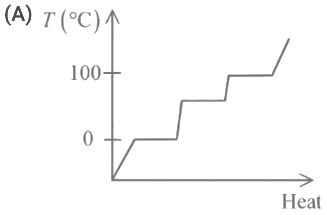
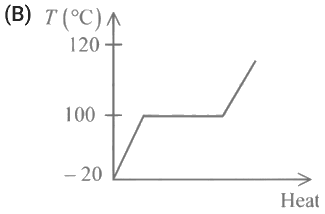
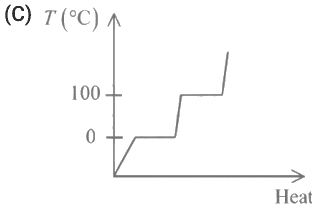
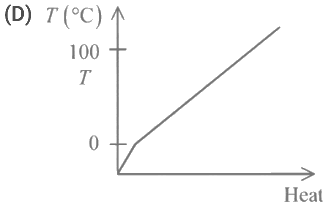
Answer: C
of ice at is added to of water to lower its temperature from . Consider no heat exchange to surroundings. The decrement to the temperature of water is ____ . (specific heat of , specific heat of , latent heat of fusion of )
Answer: B
Density of water at and are and respectively. The increase in internal energy of of water when it is heated from to is ____ J. (specific heat capacity of water and )
Answer: A
In a perfectly inelastic collision, two spheres made of the same material with masses 15 kg and 25 kg , moving in opposite directions with speeds of and , respectively, strike each other and stick together. The rise in temperature (in ), if all the heat produced during the collision is retained by these spheres, is : (specific heat of sphere material and )
Answer: B
One mole of an ideal diatomic gas expands from volume to isothermally at a temperature and does joule of work. If the gas undergoes same magnitude of expansion adiabatically from doing the same amount of work , then its final temperature will be (close to) _____ .
Answer: A
Match the LIST-I with LIST-II Choose the correct answer from the options given below:
Answer: D
A gas based geyser heats water flowing at the rate of 5.0 litres per minute from to . The rate of consumption of the gas is ____ . (Take heat of combustion of gas , specific heat capacity of water )
Answer: D
10 mole of oxygen is heated at constant volume from to . The change in the internal energy of the gas is ____ cal. (The molecular specific heat of oxygen at constant pressure, and )
Answer: 500
A diatomic gas does 100 J of work when it is expanded isobarically. Then the heat given to the gas ____ J.
Answer: 350
