449 questions asked across 20 exam years, newest first
Two metal spheres of radius and have same surface charge density . If they are brought in contact and then separated, the surface charge density on smaller and bigger sphere becomes and , respectively. The ratio is
Answer: D
Given below are two statements: one is labelled as Assertion and the other is labelled as Reason Assertion A : Work done in moving a test charge between two points inside a uniformly charged spherical shell is zero, no matter which path is chosen. Reason R : Electrostatic potential inside a uniformly charged spherical shell is constant and is same as that on the surface of the shell. In the light of the above statements, choose the correct answer from the options given below.
Answer: B
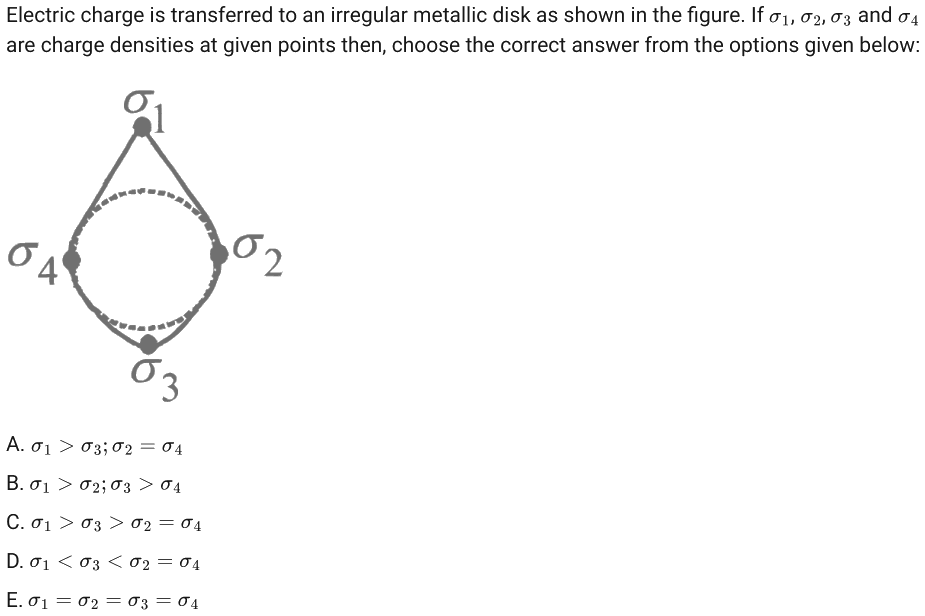
Answer: D
An infinitely long wire has uniform linear charge density . The net flux through a Gaussian cube of side length , if the wire passes through any two corners of the cube, that are maximally displaced from each other, would be , where is: [Neglect any edge effects and use ]
Answer: D
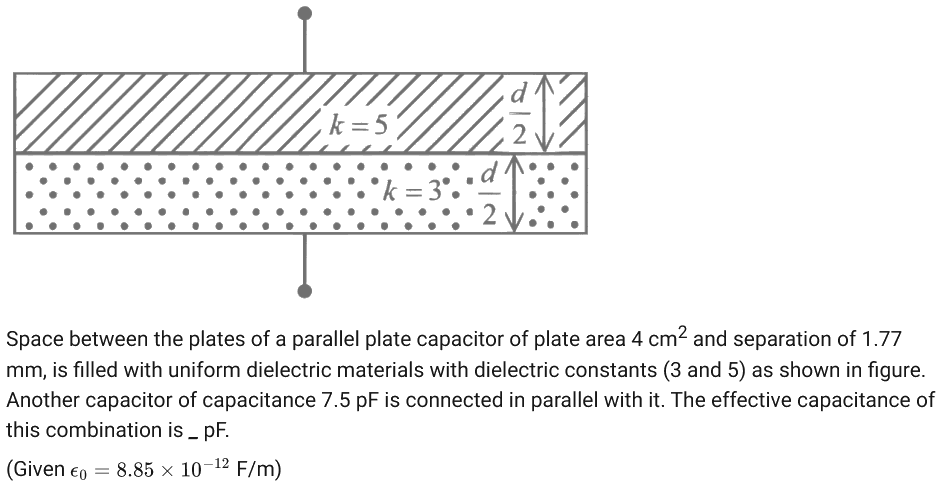
Answer: 15
Current passing through a wire as function of time is given as . The charge that will flow through the wire from to is
Answer: D
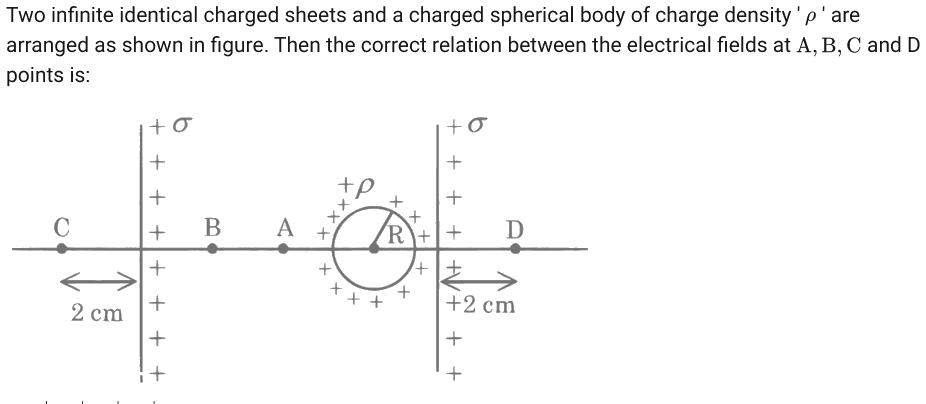
Answer: C
Two small spherical balls of mass 10 g each with charges and , are attached to two ends of very light rigid rod of length 20 cm . The arrangement is now placed near an infinite nonconducting charge sheet with uniform charge density of such that length of rod makes an angle of with electric field generated by charge sheet. Net torque acting on the rod is: (Take )
Answer: A
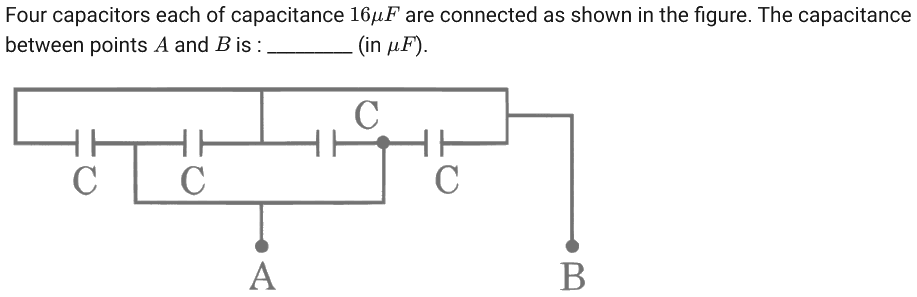
Answer: 64
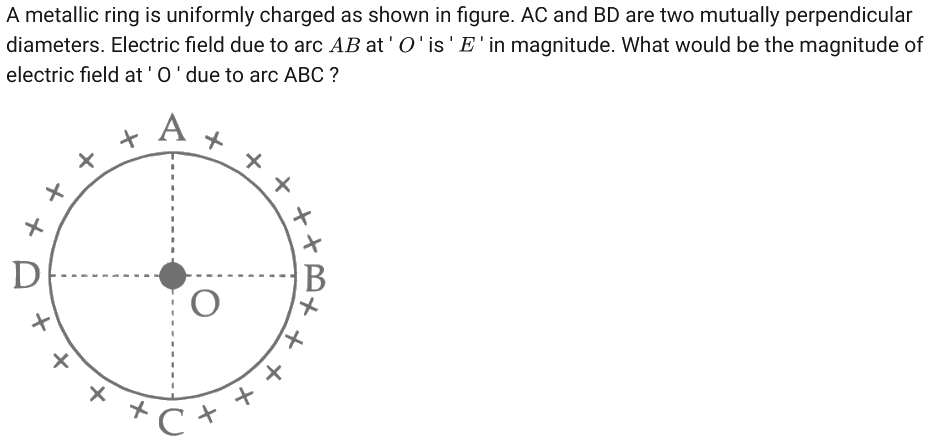
Answer: D
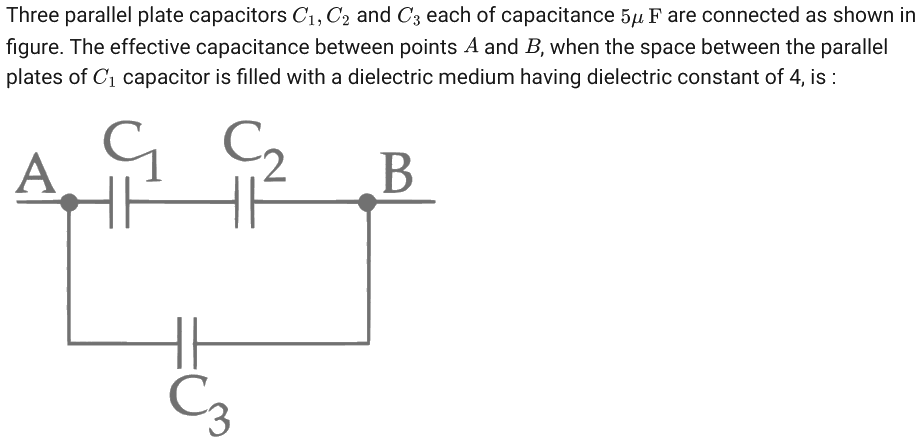
Answer: A
If an optical medium possesses a relative permeability of and relative permittivity of , then the velocity of light is greater in vacuum than that in this medium by ____ times.
Answer: 6
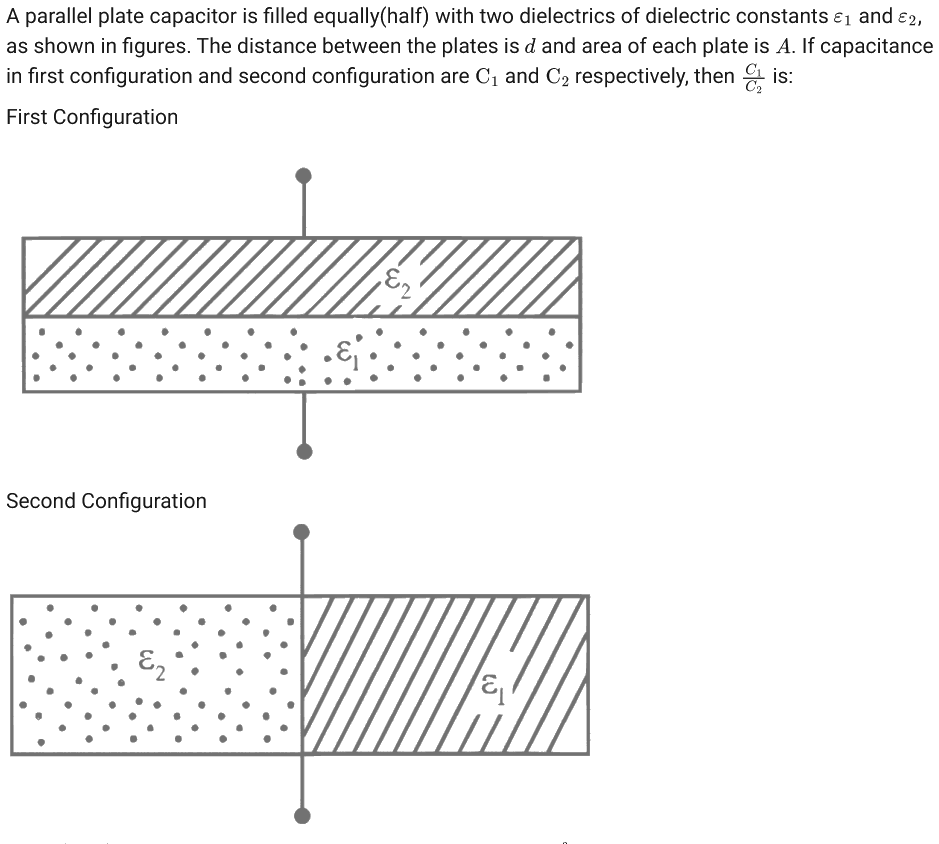
Answer: C
The electrostatic potential on the surface of uniformly charged spherical shell of radius is . The potential at the centre of shell, at a distance from centre, and at a distance from the centre of the shell respectively, are:
Answer: B
Using a battery, a 100 pF capacitor is charged to 60 V and then the battery is removed. After that, a second uncharged capacitor is connected to the first capacitor in parallel. If the final voltage across the second capacitor is 20 V , its capacitance is: (in pF )
Answer: D
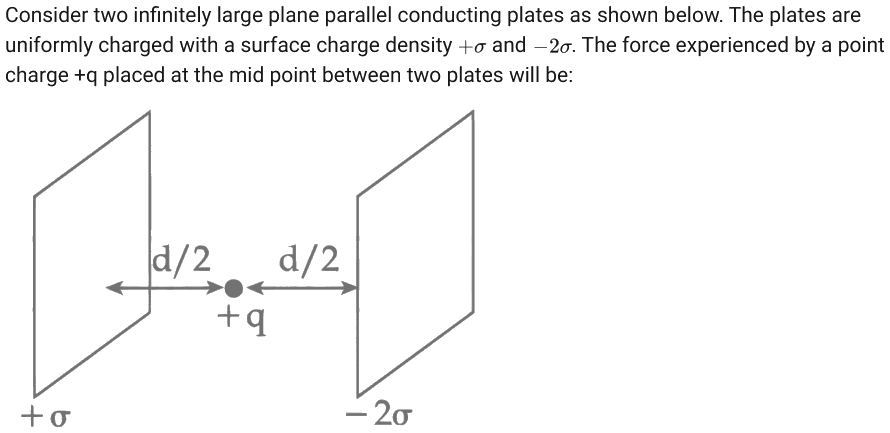
Answer: B
A point charge is placed at the origin. A second point charge is placed at in Cartesian coordinate system. The point in between them where the electric field vanishes is:
Answer: B
Given below are two statements : one is labelled as Assertion (A) and the other is labelled as Reason (R). Assertion (A) : Net dipole moment of a polar linear isotropic dielectric substance is not zero even in the absence of an external electric field. Reason (R) : In absence of an external electric field, the different permanent dipoles of a polar dielectric substance are oriented in random directions. In the light of the above statements, choose the most appropriate answer from the options given below :
Answer: C
Consider a circular loop that is uniformly charged and has a radius . Find the position along the positive -axis of the cartesian coordinate system where the electric field is maximum if the ring was assumed to be placed in plane at the origin :
Answer: A
A plane electromagnetic wave propagates along the direction in free space. The components of the electric field, and magnetic field, vectors associated with the wave in Cartesian frame are
Answer: C
A point charge causes an electric flux of to pass through a spherical Gaussian surface of radius, centred on the charge. The value of the point charge is : (Given )
Answer: B
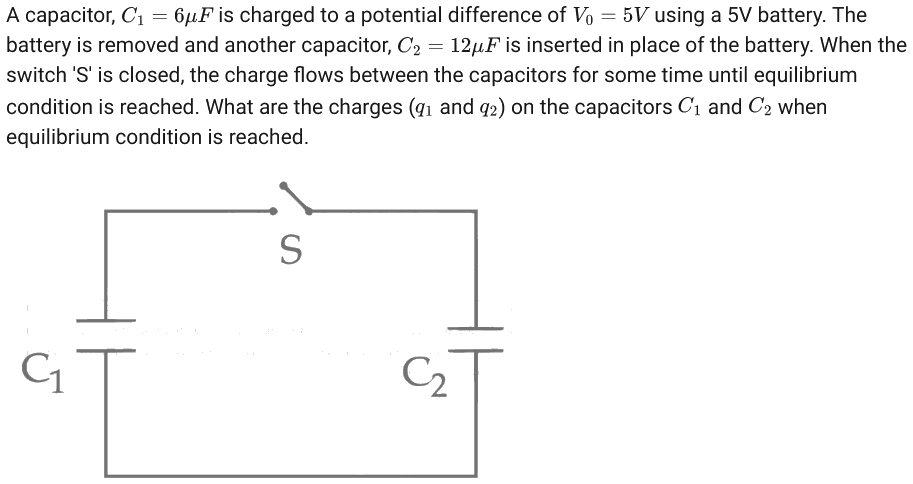
Answer: A
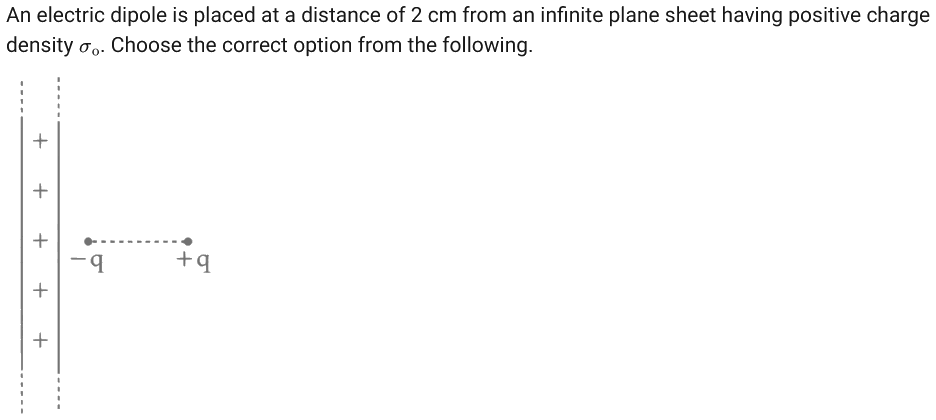
Answer: B
A parallel plate capacitor consisting of two circular plates of radius is being charged by a constant current of . If the rate of change of potential difference between the plates is then the integer value of the distance between the parallel plates is ( Take, ) ____ .
Answer: 1320
Consider a long thin conducting wire carrying a uniform current I. A particle having mass " " and charge " " is released at a distance " " from the wire with a speed along the direction of current in the wire. The particle gets attracted to the wire due to magnetic force. The particle turns round when it is at distance from the wire. The value of is [ is vacuum permeability]
Answer: B
