449 questions asked across 20 exam years, newest first
In series LCR circuit, the capacitance is changed from to . To keep the resonance frequency unchanged, the new inductance should be:
Answer: C
Two identical charged spheres are suspended by strings of equal lengths. The strings make an angle with each other. When suspended in water the angle remains the same. If density of the material of the sphere is , the dielectric constant of water will be ____. (Take density of water )
Answer: 3
The current in a conductor is expressed as , where is in Ampere and is in second. The amount of electric charge that flows through a section of the conductor during to is ____ C.
Answer: 22
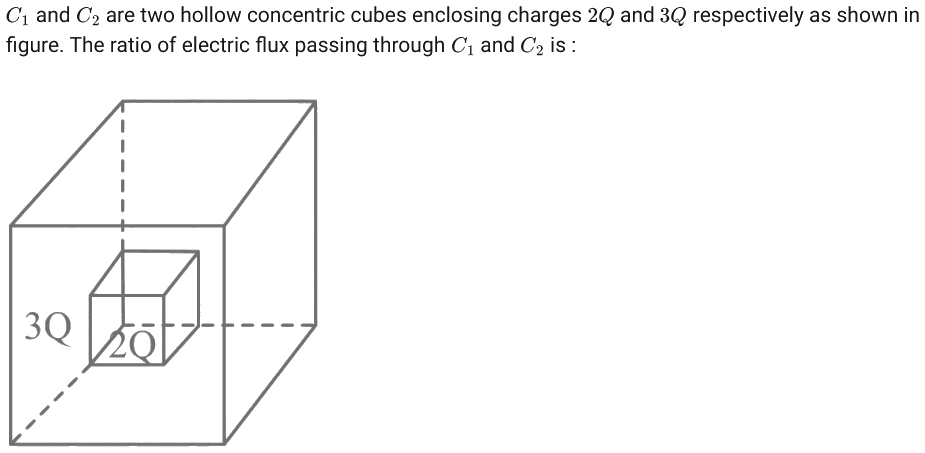
Answer: C
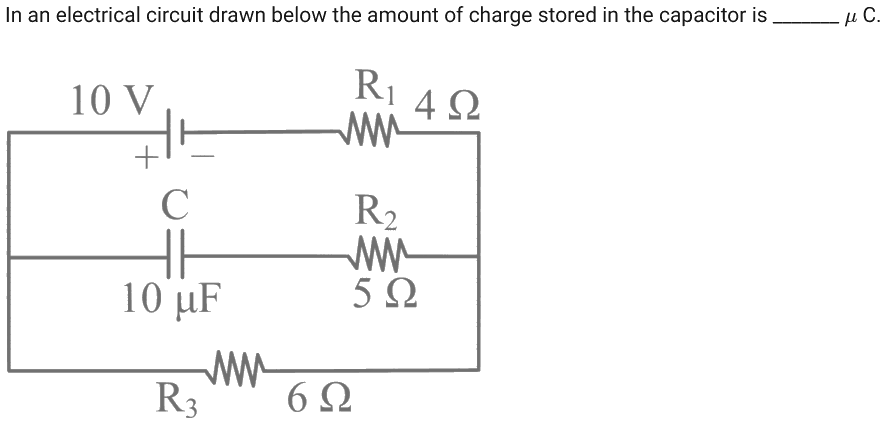
Answer: 60
Suppose a uniformly charged wall provides a uniform electric field of normally. A charged particle of mass being suspended through a silk thread of length and remain stayed at a distance of from the wall. Then the charge on the particle will be where ________ .
Answer: 3
Two charges and are separated by a distance '' in air. At a distance from charge , the resultant electric field is zero. The value of is :
Answer: C
In a plane EM wave, the electric field oscillates sinusoidally at a frequency of and an amplitude of . The total average energy density of the electromagnetic field of the wave is : [Use ]
Answer: D
A parallel plate capacitor with plate separation is charged up by a battery. It is found that on introducing a dielectric sheet of thickness , while keeping the battery connections intact, the capacitor draws more charge from the battery than before. The dielectric constant of the sheet is ____.
Answer: 2
Force between two point charges and placed in vacuum at '' cm apart is . Force between them when placed in a medium having dielectric constant at '' cm apart will be:
Answer: A
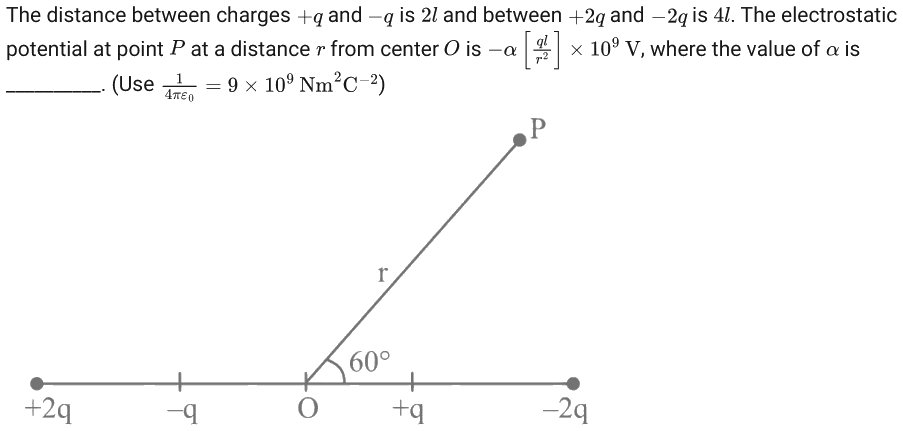
Answer: 27
The electrostatic potential due to an electric dipole at a distance '' varies as :
Answer: C
The electric field of an electromagnetic wave in free space is represented as . The corresponding magnetic induction vector will be :
Answer: B
A capacitor of capacitance and potential has energy . It is connected to another capacitor of capacitance and potential . Then the loss of energy is , where is _________.
Answer: 2
A capacitor of capacitance is charged to a potential of and connected to a inductor to produce oscillations. The maximum current in the circuit would be :
Answer: C
Two charges of and are situated at the points and respectively. The electric flux through a sphere of radius '' having center at origin is :
Answer: D
Match List I with List II | | List - I | | List - II | | :--- | :--- | :--- | :--- | | (A) | | (I) | Gauss' law for electricity | | (B) | | (II) | Gauss' law for magnetism | | (C) | | (III) | Faraday law | | (D) | | (IV) | Ampere - Maxwell law | Choose the correct answer from the options given below:
Answer: A
The electric current through a wire varies with time as , where and . The amount of electric charge crossed through a section of the wire in is :
Answer: C
An electron is moving under the influence of the electric field of a uniformly charged infinite plane sheet S having surface charge density . The electron at is at a distance of from and has a speed of . The maximum value of if the electron strikes at is , the value of is _______.
Answer: 8
An electric field is given by . The electric flux through a surface area lying in YZ-plane (in SI unit) is :
Answer: C
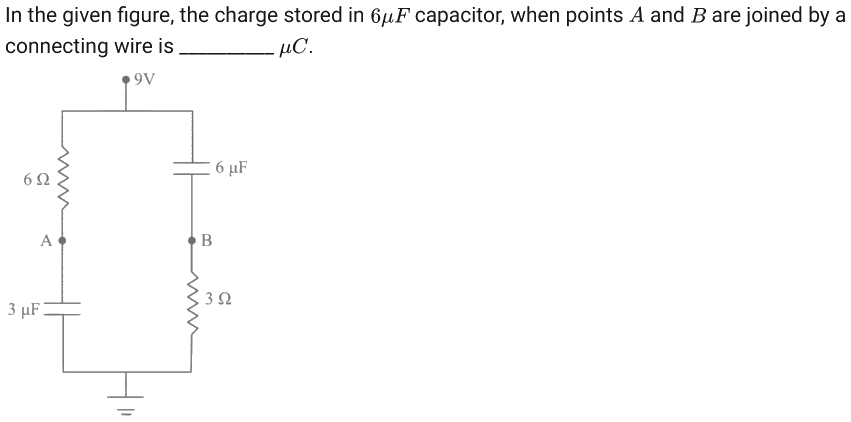
Answer: 36
An electric charge is placed at origin of co-ordinate system. Two points P and Q are situated at and respectively. The potential difference between the points P and Q will be :
Answer: C
A thin metallic wire having cross sectional area of is used to make a ring of radius . A positive charge of is uniformly distributed over the ring, while another positive charge of is kept at the centre of the ring. The tension in the ring is _____ ; provided that the ring does not get deformed (neglect the influence of gravity). (given, )
Answer: 3
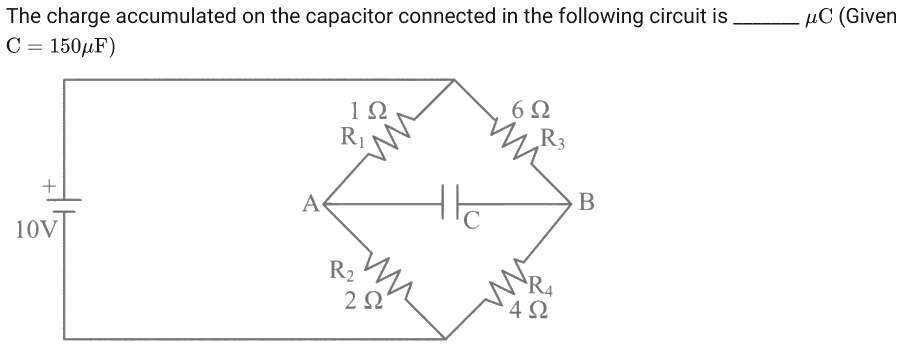
Answer: 400
Given below are two statements : one is labelled as Assertion (A) and the other is labelled as Reason (R). Assertion (A) : Work done by electric field on moving a positive charge on an equipotential surface is always zero. Reason (R) : Electric lines of forces are always perpendicular to equipotential surfaces. In the light of the above statements, choose the most appropriate answer from the options given below :
Answer: A
