115 questions asked across 16 exam years, newest first
A solution is prepared by dissolving 0.6 g of urea () and 1.8 g of glucose () in 100 mL of water at . The osmotic pressure of the solution is : ()
Answer: C
1 g of a non-volatile non-electrolyte solute is dissolved in 100 g of two different solvents A and B whose ebullioscopic constants are in the ratio of 1 : 5. The ratio of the elevation in their boiling points, , is :
Answer: D
The osmotic pressure of a dilute solution of an ionic compound XY in water is four times that of a solution of 0.01 M in water. Assuming complete dissociation of the given ionic compounds in water, the concentration of XY (in ) in solution is :
Answer: B
Liquid 'M' and liquid 'N' form an ideal solution. The vapour pressures of pure liquids 'M' and 'N' are 450 and 700 mmHg, respectively, at the same temperature. Then correct statement is: ( = Mole fraction of 'M' in solution ; = Mole fraction of 'N' in solution ; = Mole fraction of 'M' in vapour phase ; = Mole fraction of 'N' in vapour phase)
Answer: D
Molal depression constant for a solvent is . The depression in the freezing point of the solvent for solution of is : (Assume complete dissociation of the electrolyte)
Answer: C
HF has highest boiling point among hydrogen halides, because it has :
Answer: B

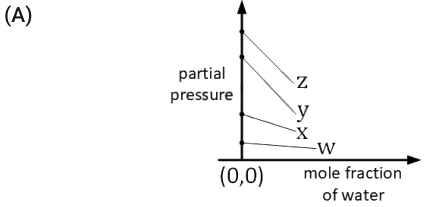
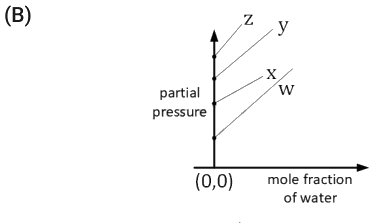
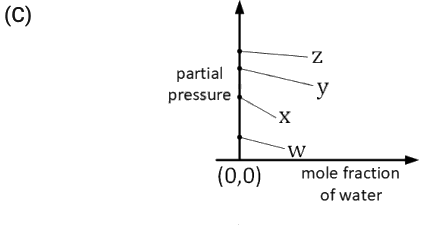
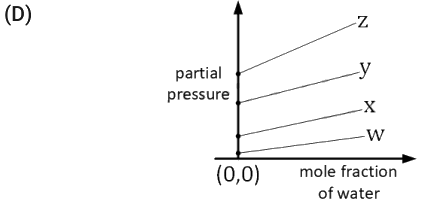
Answer: A
Freezing point of a 4% aqueous solution of X is equal to freezing point of 12% aqueous solution of Y. If molecular weight of X is A, then molecular weight of Y is -
Answer: C
Molecules of benzoic acid dimerise in benzene. 'w' g of the acid dissolved in 30 g of benzene shows a depression in freezing point equal to 2K. If the percentage association of the acid to form dimmer in the solution is 80, then w is – (Its given that , Molar mass of benzoic acid = )
Answer: D
is 40% ionised in aqueous solution. The value of its van't Hoff factor (i) is:
Answer: D
Which one of the following statements regarding Henry's law is not correct ?
Answer: A
