169 questions asked across 16 exam years, newest first
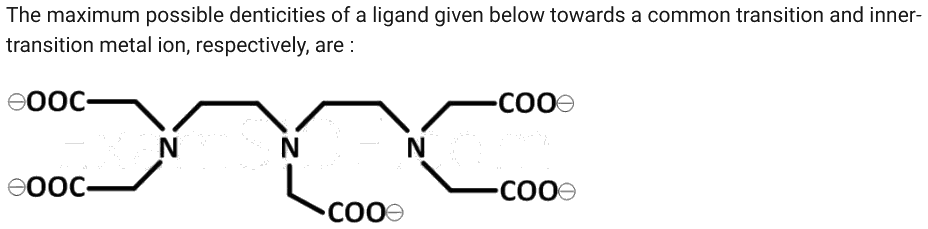
Answer: C
The correct statements among I to III are : (I) Valence bond theory cannot explain the color exhibited by transition metal complexes. (II) Valence bond theory can predict quantitatively the magnetic properties of transition metal complexes. (III) Valence bond theory cannot distinguish ligands as weak and strong field ones.
Answer: D
The metal d-orbitals that are directly facing the ligands in are -
Answer: A
The magnetic moment of an octahedral homoleptic Mn(II) complex is 5.9 BM. The suitable ligand for this complex is -
Answer: C
The number of bridging CO ligand(s) and Co-Co bond(s) in , respectively are :
Answer: D
Two complexes (A) and (B) are violet and yellow coloured, respectively. The incorrect statement regarding them is :
Answer: A

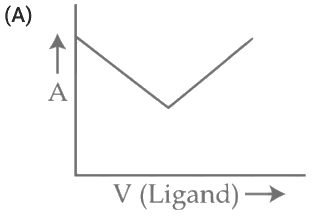
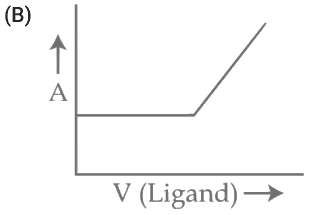
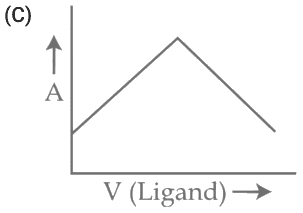
Answer: B
Consider the following reaction and statements: (I) Two isomers are produced if the reactant complex ion is a cis-isomer (II) Two isomers are produced if the reactant complex ion is a trans-isomer (III) Only one isomer is produced if the reactant complex ion is a trans-isomer (IV) Only one isomer is produced if the reactant complex ion is a cis – isomer The correct statements are
Answer: C
The number of geometric isomers that can exist for square planar is (py = pyridine) :
Answer: A
The octahedral complex of a metal ion with four monodentate ligands and absorb wavelengths in the region of red, green, yellow and blue, respectively. The increasing order of ligand strength of the four ligands is :
Answer: D
The complex ion will give
Answer: B
Which of the following complex ions will exhibit optical isomerism? (en = 1,2-diamine ethane).
Answer: B
A solution containing 2.675g of (molar mass = ) is passed through a cation exchanger. The chloride ions obtained in solution were treated with excess of to give 4.78 g of AgCl (molar mass = ). The formula of the complex is : (At. Mass of Ag = 108 u)
Answer: A
Nickel () combines with a uninegative monodentate ligand to form a paramagnetic complex . The number of unpaired electron(s) in the nickel and geometry of this complex ion are, respectively
Answer: B
The IUPAC name for the complex is
Answer: D
The IUPAC name of the coordination compound is
Answer: B
The coordination number of central metal atom in a complex is determined by :
Answer: A
Coordination compound have great importance in biological systems. In this context which of the following statements is incorrect?
Answer: A
Among the properties (a) reducing (b) oxidising (c) complexing, the set of properties shown by ion towards metal species is :
Answer: A
