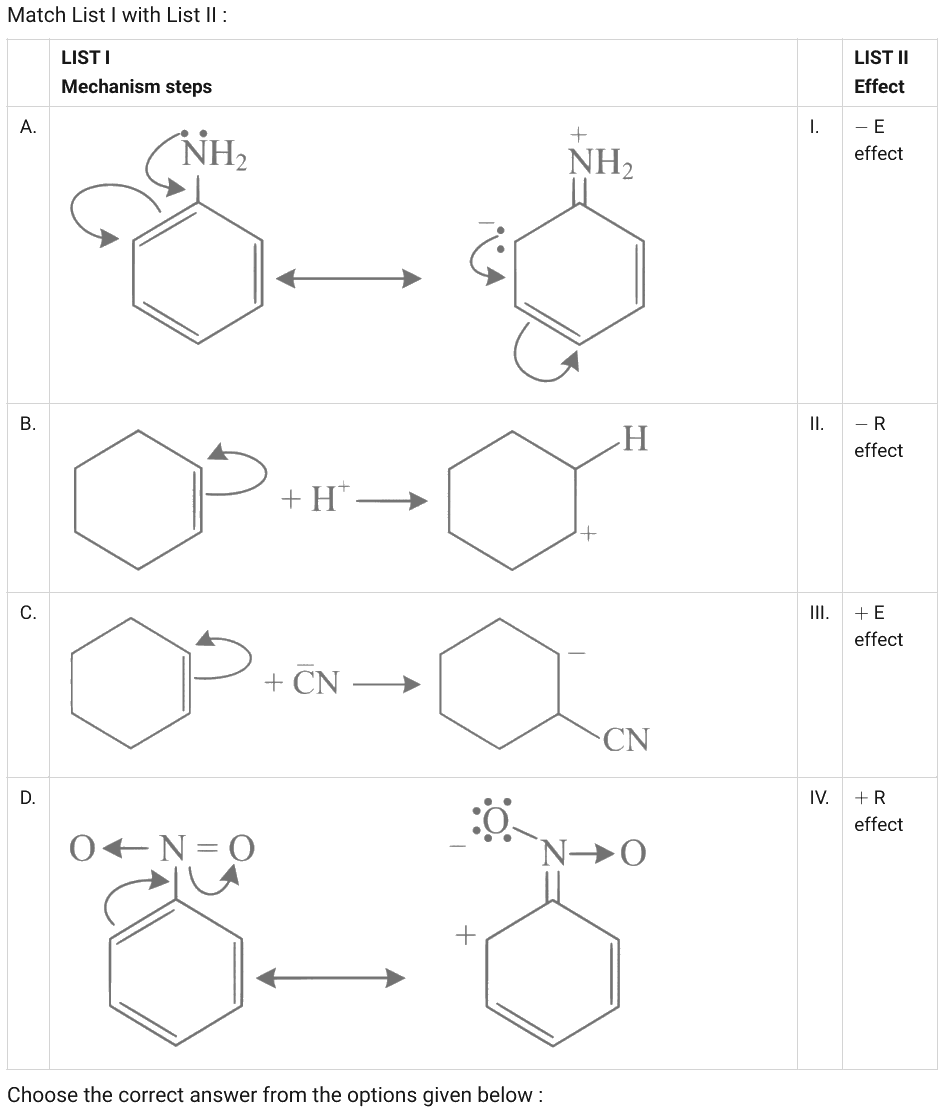
Match List I with List II.
A.B.C.D.LIST IIClICl3ClF5IF7I.II.III.IV.LIST IIT - shapeSquare pyramidalPentagonal bipyramidalLinear
Choose the correct answer from the options given below :
Number of elements from the following that CANNOT form compounds with valencies which match with their respective group valencies is ________. B, C, N, S, O, F, P, Al, Si
The number of white coloured salts, among the following is
(a) SrSO4
(b) Mg(NH4)PO4
(c) BaCrO4
(d) Mn(OH)2
(e) PbSO4
(f) PbCrO4
(g) AgBr
(h) PbI2
(i) CaC2O4
(j) [Fe(OH)2(CH3COO)]
The potential for the given half cell at 298 K is (−) ________ ×10−2 V (Nearest integer)
2H(aq)++2e−⟶H2(g)[H+]=1 M, PH2=2 atm
(Given : 2.303RT/F=0.06 V, log2=0.3)
Among the following oxides of p-block elements, number of oxides having amphoteric nature is ________ .
Cl2O7, CO, PbO2, N2O, NO, Al2O3, SiO2, N2O5, SnO2
Given below are two statements :
Statement (I) : A π bonding MO has lower electron density above and below the inter-nuclear axis.
Statement (II) : The π∗ antibonding MO has a node between the nuclei.
In the light of the above statements, choose the most appropriate answer from the options given below :
Molar mass of the salt from NaBr,NaNO3,KI and CaF2 which does not evolve coloured vapours on heating with concentrated H2SO4 is ____ gmol−1.
(Molar mass in gmol−1 : Na:23,N:14,K:39,O:16,Br:80,I:127,F:19,Ca:40)