With increase of temperature, which of these changes?
A. molality B. weight fraction of solute C. molarity D. mole fraction Show answer Answer: C
Number of atoms in 558.5 gram Fe (at. wt. of Fe = 55.85 g mo l − 1
A. twice that in 60 g carbon B. 6.023 × 1 0 22 C. half that in 8 g He D. 558.5 × 6.023 × 1 0 23 Show answer Answer: A
In a hydrogen atom, if energy of an electron in ground state is -13.6 eV, then that in the 2n d
A. -1.51 eV B. -3.4 eV C. -6.04 eV D. -13.6 eV Show answer Answer: A
Which of the following are arranged in an increasing order of their bond strengths?
A. O 2 − < O 2 < O 2 + < O 2 2 − B. O 2 2 − < O 2 − < O 2 < O 2 + C. O 2 − < O 2 2 − < O 2 < O 2 + D. O 2 + < O 2 < O 2 − < O 2 2 − Show answer Answer: B
For the reactions
C + O 2 → C O 2 Δ H 2Zn + O 2 → 2ZnO Δ H
A. carbon can oxidise Zn B. oxidation of carbon is not feasible C. oxidation of Zn is not feasible D. Zn can oxidise carbon Show answer Answer: D
1 M NaCl and 1 M HCl are present in an aqueous solution. The solution is
A. not a buffer solution with pH < 7 B. not a buffer solution with pH > 7 C. a buffer solution with pH < 7 D. a buffer solution with pH > 7 Show answer Answer: A
Change in volume of the system does not alter which of the following equilibria?
A. N 2 ( g ) + O 2 ( g ) ⇋ 2NO ( g ) B. PC l 5 ( g ) ⇋ PC l 3 ( g ) + C l 2 ( g ) C. N 2 ( g ) + 3 H 2 ( g ) ⇋ 2N H 3 ( g ) D. S O 2 C l 2 ( g ) ⇋ S O 2 ( g ) + C l 2 ( g ) Show answer Answer: A
Racemic mixture is formed by mixing two
A. isomeric compounds B. enantiomers with chiral compounds C. meso compounds D. optical isomers Show answer Answer: B
The reaction :
( C H 3 ) 3 C − Br H 2 O ( C H 3 ) 3 C − OH
A. elimination reaction B. substitution reaction C. free radical reaction D. displacement reaction Show answer Answer: B
In a mixture of A and B, components show negative deviation when :
A. Δ V mi x > 0 , Δ S mi x > 0 B. Δ V mi x = 0 , Δ S mi x > 0 C. A - B interaction is weaker than A - A and B - B interaction D. A - B interaction is stronger than A - A and B - B interaction Show answer Answer: D
EMF of a cell in terms of reduction potential of its left and right electrodes is :
A. E = E l e f t − E r i g h t B. E = E l e f t + E r i g h t C. E = E r i g h t − E l e f t D. E = − ( E r i g h t + E l e f t ) Show answer Answer: C
For the following cell with hydrogen electrodes at two different pressures p 1 p 2 p 1 Pt ( H 2 ) ∣ 1 M H + ( aq ) ∣ p 2 Pt ( H 2 )
A. F R T log e P 2 P 1 B. 2 F R T log e P 2 P 1 C. F R T log e P 1 P 2 D. none of these Show answer Answer: B
The integrated rate equation is R t = log C 0 − log C t
A. time vs log C t B. t im e 1 C t C. time vs C t D. t im e 1 C t 1 Show answer Answer: A
β
A. conversion of proton to neutron B. from outermost orbit C. conversion of neutron to proton D. β Show answer Answer: C
Which of the following statements is true?
A. HF is less polar than HBr B. absolutely pure water does not contain any ions C. chemical bond formation takes place when forces of attraction overcome the forces of repulsion D. in covalency transference of electron takes place Show answer Answer: C
C H 3
A. Mg - Br bond B. C - Mg bond C. C - Br bond D. C - H bond Show answer Answer: B
The most stable ion is :
A. [ Fe ( OH ) 3 ] 3 − B. [ Fe ( Cl ) 6 ] 3 − C. [ Fe ( CN ) 6 ] 3 − D. [ Fe ( H 2 O ) 6 ] 3 + Show answer Answer: C
C H 3 C H 2 COOH C l 2 red P A Alc. KOH B
A. C H 3 C H 2 COCl B. C H 3 C H 2 CHO C. C H 2 = CHCOOH D. ClC H 2 C H 2 COOH Show answer Answer: C
How do we differentiate between F e 3 + C r 3 +
A. by taking excess of N H 4 OH B. by increasing N H 4 + C. by decreasing O H − D. both (b) and (c) Show answer Answer: B
On vigorous oxidation by permanaganate solution.
( C H 3 ) 2 C = CH − C H 2 − CHO
A. ( C H 3 ) 2 CO OHC − C H 2 − CHO B. ( C H 3 ) 2 C ( OH ) − CH ( OH ) − C H 2 CHO C. ( C H 3 ) 2 CO OHC − C H 2 − COOH D. ( C H 3 ) 2 CO C H 2 ( COOH ) 2 Show answer Answer: D
Kinetic theory of gases proves
A. only Boyle's law B. only Charle's law C. only Avogadro's law D. All of these Show answer Answer: D
A metal M readily forms its sulphate MS O 4 M ( OH ) 2
A. Mg B. Ba C. Ca D. Be Show answer Answer: D
Alum helps in purifying water by :
A. forming Si complex with clay particles B. sulphate part which combines with the dirt and removes it C. coagulating the mud particles D. making mud water soluble Show answer Answer: C
When H 2 S H g 2 S
A. HgS B. HgS + H g 2 S C. H g 2 S D. H g 2 S 2 Show answer Answer: B
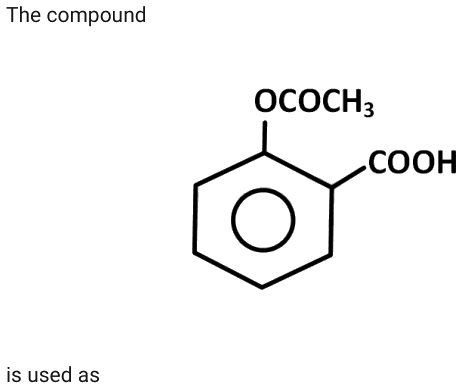
A. antiseptic B. antibiotic C. analgesic D. pesticide Show answer Answer: C