The mass of gas adsorbed, x, per unit mass of adsorbate, m, was measured at various pressures, p. A graph between logmx and logp gives a straight line with slope equal to 2 and the intercept equal to 0.4771. The value of mx at a pressure of 4 atm is :
(Given log3=0.4771)
Show answer
Answer: 48
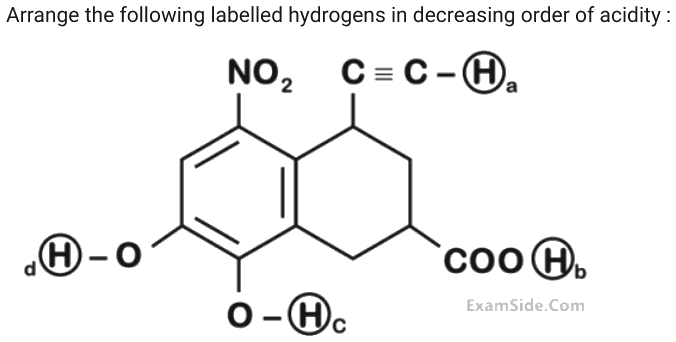
- A.b>c>d>a
- B.b>a>c>d
- C.c>b>d>a
- D.c>b>a>d
Show answer
Answer: A
If you spill a chemical toilet cleaning liquid on your hand, your first aid would be
- A.aqueous NaOH
- B.aqueous NaHCO3
- C.aqueous NH3
- D.vinegar
Show answer
Answer: B
The size of a raw mango shrinks to a much smaller size when kept in a concentrated salt solution. Which one of the following processes can explain this?
- A.Osmosis
- B.Reverse osmosis
- C.Diffusion
- D.Dialysis
Show answer
Answer: A
Match the type of interaction in column A with the distance dependence of their interaction energy in column B
| A | B |
| :--- | :--- |
| (i) ion-ion | (a) r1 |
| (ii) dipole-dipole | (b) r21 |
| (iii) London dispersion | (c) r31 |
| | (d) r61 |
- A.(I)-(a), (II)-(b), (III)-(d)
- B.(I)-(b), (II)-(d), (III)-(c)
- C.(I)-(a), (II)-(b), (III)-(c)
- D.(I)-(a), (II)-(c), (III)-(d)
Show answer
Answer: D
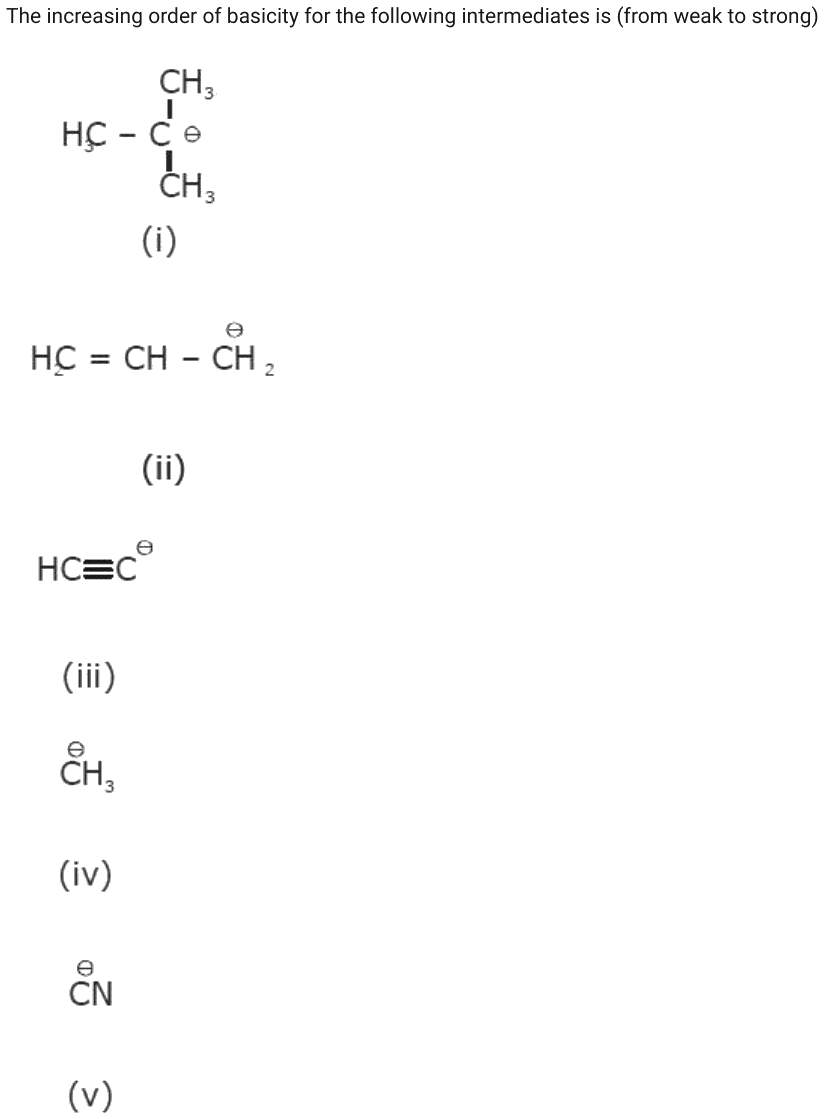
- A.(iii) < (i) < (ii) < (iv) < (v)
- B.(iii) < (iv) < (ii) < (i) < (v)
- C.(v) < (i) < (iv) < (ii) < (iii)
- D.(v) < (iii) < (ii) < (iv) < (i)
Show answer
Answer: D
The acidic, basic and amphoteric oxides, respectively, are :
- A.Cl2O, CaO, P4O10
- B.N2O3, Li2O, Al2O3
- C.MgO, Cl2O, Al2O3
- D.Na2O, SO3, Al2O3
Show answer
Answer: B
'X' melts at low temperature and is a bad conductor of electricity in both liquid and solid state. X is :
- A.Mercury
- B.Carbon tetrachloride
- C.Zinc sulphide
- D.Silicon carbide
Show answer
Answer: B
Which of the following has the shortest C-Cl bond?
- A.Cl−CH=CH−CH3
- B.Cl−CH=CH−NO2
- C.Cl−CH=CH−OCH3
- D.Cl−CH=CH2
Show answer
Answer: B
A, B and C are three biomolecules. The results of the tests performed on them are given below:
ABCMolisch’s TestPositivePositiveNegativeBarfoed TestNegativePositiveNegativeBiuret TestNegativeNegativePositive
A, B and C are respectively :
- A.A = Lactose, B = Glucose, C = Albumin
- B.A = Lactose, B = Fructose, C = Alanine
- C.A = Lactose, B = Glucose, C = Alanine
- D.A = Glucose, B = Fructose, C = Albumin
Show answer
Answer: A
The true statement amongst the following is :
- A.S is a function of temperature but ΔS is not a function of temperature.
- B.Both S and ΔS are not functions of temperature.
- C.Both ΔS and S are functions of temperature.
- D.S is not a function of temperature but ΔS is a function of temperature.
Show answer
Answer: C

- A.
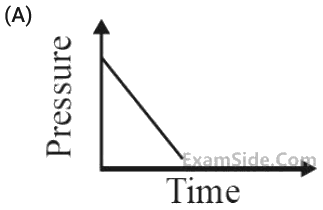
- B.
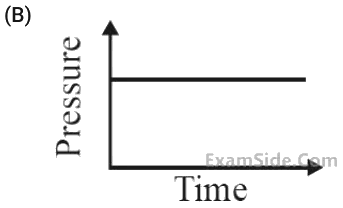
- C.
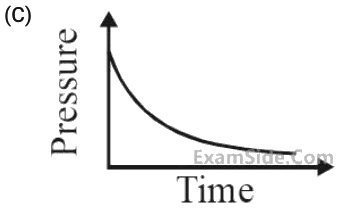
- D.
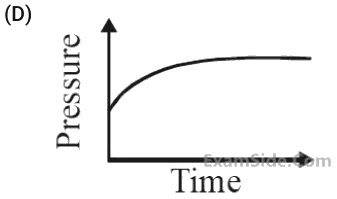
Show answer
Answer: C
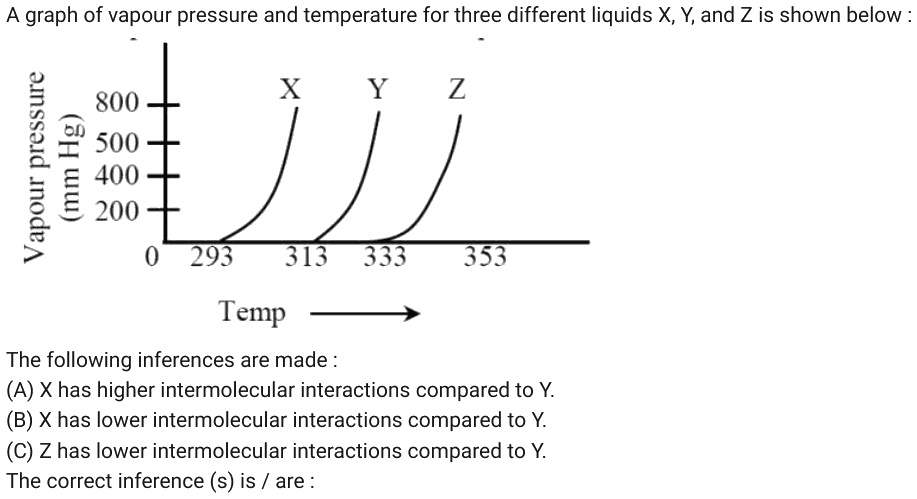
- A.(B)
- B.(A)
- C.(C)
- D.(A) and (C)
Show answer
Answer: A
The predominant intermolecular forces present in ethyl acetate, a liquid, are:
- A.Dipole-dipole and hydrogen bonding
- B.hydrogen bonding and London dispersion
- C.London dispersion, dipole-dipole and hydrogen bonding
- D.London dispersion and dipole-dipole
Show answer
Answer: D
A flask contains a mixture of isohexane and 3-methylpentane. One of the liquids boils at 63∘C while the other boils at 60∘C What is the best way to separate the two liquids and which one will be distilled out first ?
- A.fractional distillation, 3-methylpentane
- B.simple distillation, 3-methylpentane
- C.fractional distillation, isohexane
- D.simple distillation, isohexane
Show answer
Answer: C
Arrange the following bonds according to their average bond energies in descending order :
C–Cl, C–Br, C–F, C–I
- A.C–Br > C–I > C–Cl > C–F
- B.C–Cl > C–Br > C–I > C–F
- C.C–I > C–Br > C–Cl > C–F
- D.C–F > C–Cl > C–Br > C–I
Show answer
Answer: D
Hydrogen has three isotopes (A), (B) and (C). If the number of neutron(s) in (A), (B) and (C) respectively, are (x), (y) and (z), the sum of (x), (y) an (z) is :
- A.3
- B.1
- C.4
- D.2
Show answer
Answer: A
NaClO3 is used, even in spacecrafts, to produce O2. The daily consumption of pure O2 by a person is 492L at 1atm,300K. How much amount of NaClO3, in grams, is required to produce O2 for the daily consumption of a person at 1atm,300K?
NaClO3(s)+Fe(s)→O2(g)+NaCl(s)+FeO(s)
R=0.082L atm mol−1K−1
Show answer
Answer: 2120 to 2140
Amongst the following statements, that which was not proposed by Dalton was :
- A.Matter consists of indivisible atoms.
- B.Chemical reactions involve reorganization of atoms. These are neither created nor destroyed in a chemical reaction.
- C.When gases combine or are produced in a chemical reaction they do so in a simple ratio by volume provided all gases are at the same T & P.
- D.All the atoms of a given element have identical properties including identical mass. Atoms of different elements differ in mass.
Show answer
Answer: C
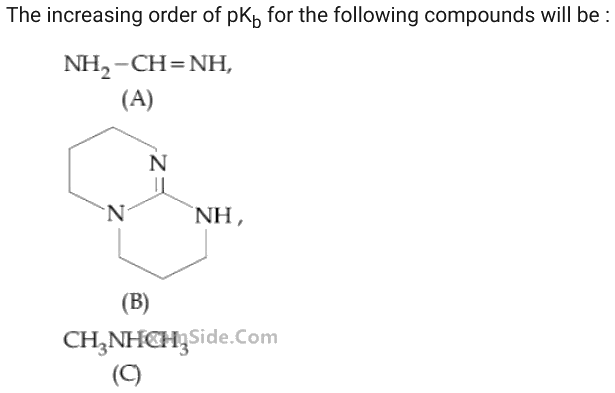
- A.(A)<(B)<(C)
- B.(C)<(A)<(B)
- C.(B)<(A)<(C)
- D.(B)<(C)<(A)
Show answer
Answer: C

- A.
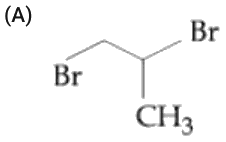
- B.
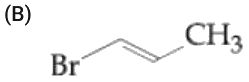
- C.
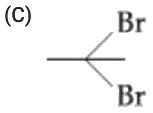
- D.
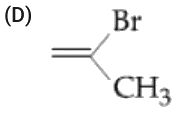
Show answer
Answer: A
The relative strength of interionic/intermolecular forces in decreasing order is :
- A.dipole-dipole > ion-dipole > ion-ion
- B.ion-dipole > dipole-dipole > ion-ion
- C.ion-dipole > ion-ion > dipole-dipole
- D.ion-ion > ion-dipole > dipole-dipole
Show answer
Answer: D
The dipole of CCl4, CHCl3 and CH4 are in the order :
- A.CCl4<CH4<CHCl3
- B.CH4=CCl4<CHCl3
- C.CH4<CCl4<CHCl3
- D.CHCl3<CH4=CCl4
Show answer
Answer: B
For the reaction
2H2(g)+2NO(g)→N2(g)+2H2O(g)
the observed rate expression is, rate=Kf[NO]2[H2]. The rate expression for the reverse reaction is :
- A.Kb[N2][H2O]
- B.Kb[N2][H2O]2/[H2]
- C.Kb[N2][H2O]2/[NO]
- D.Kb[N2][H2O]2
Show answer
Answer: B
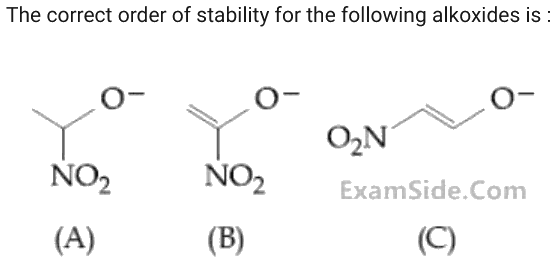
- A.(C) > (B) > (A)
- B.(C) > (A) > (B)
- C.(B) > (C) > (A)
- D.(B) > (A) > (C)
Show answer
Answer: A
