PaperYodha

Prepare

Mock TestsLive TestsPrevious Year PapersPractice
PaperYodha
Previous Year Papers· Real papers, shift-wise

PaperYodha

One platform for SSC, Defence and Engineering entrance exams: mocks in each exam's official pattern, weekly all-India live tests, real previous-year papers and topic-wise practice.

Coming soon: IBPS PO · SBI Clerk · MPPSC · CAT

SSC

  • SSC CGL
  • SSC CHSL
  • SSC MTS
  • SSC GD Constable

Defence & Engineering

  • NDA
  • JEE Main
  • JEE Advanced

Platform

  • Mock tests
  • Live tests
  • Previous year papers
  • Practice

AboutContactPrivacy noticeTerms of usePricingRefunds & cancellationYour data

PaperYodha is an independent preparation platform and is not affiliated with the Staff Selection Commission, UPSC, the National Testing Agency or the IITs. Mock questions are original. Exam patterns are taken from published sources; always confirm details in the official notification.

MocksLivePYQsPractice
Mock TestsLive TestsPrevious Year PapersPractice
MocksLivePYQsPractice
← JEE Main topics

Other Chemistry · JEE Main previous year questions

650 questions asked across 20 exam years, newest first

Other Chemistry has appeared 650 times in JEE Main papers between 2002 and 2026, about 4.7 questions per paper, from 25 per paper in 2002 to 2.6 per paper in 2026. Every question is listed below with its answer and the paper it came from. Use Practise this topic to attempt them as a timed set.

Year-wise papersTopic-wise questions
Practise this topic
All years 6502026 442025 342024 852023 962022 742021 582020 542019 552018 142017 142016 92015 62014 62012 282010 72009 52006 92005 132004 142002 25

2022 74 questions

  1. Q672022 · 25 Jun 2022 · Shift 2

    The correct order of reduction potentials of the following pairs is A. Cl2​/Cl− B. I2​/I− C. Ag+/Ag D. Na+/Na E. Li+/Li Choose the correct answer from the options given below.

    1. A.A>C>B>D>E
    2. B.A>B>C>D>E
    3. C.A>C>B>E>D
    4. D.A>B>C>E>D
    Show answer

    Answer: A

  2. Q722022 · 25 Jun 2022 · Shift 2
    Chemistry question 12 as printed in the paper
    1. A.benzyl bromide
    2. B.bromobenzene
    3. C.cyclohexyl bromide
    4. D.methyl bromide
    Show answer

    Answer: B

  3. Q762022 · 25 Jun 2022 · Shift 2

    Match List I with List II A.B.C.D.​List - IZymaseDiastaseUreasePepsin​I.II.III.IV.​List -IIStomachYeastMaltSoyabean​​ Choose the correct answer from the options given below :

    1. A.A-II, B-III, C-I, D-IV
    2. B.A-II, B-III, C-IV, D-I
    3. C.A-III, B-II, C-IV, D-I
    4. D.A-III, B-II, C-I, D-IV
    Show answer

    Answer: B

  4. Q662022 · 24 Jun 2022 · Shift 2

    Metals generally melt at very high temperature. Amongst the following, the metal with the highest melting point will be :

    1. A.Hg
    2. B.Ag
    3. C.Ga
    4. D.Cs
    Show answer

    Answer: B

  5. Q752022 · 24 Jun 2022 · Shift 2

    Which of the following chemical reactions represents Hall-Heroult Process?

    1. A.Cr2​O3​+2Al→Al2​O3​+2Cr
    2. B.2Al2​O3​+3C→4Al+3CO2​
    3. C.FeO+CO→Fe+CO2​
    4. D.2[Au(CN)2​](aq)−​+Zn(s)→2Au(s)+[Zn(CN)4​]2−
    Show answer

    Answer: B

  6. Q762022 · 24 Jun 2022 · Shift 2

    In the industrial production of which of the following, molecular hydrogen is obtained as a byproduct?

    1. A.NaOH
    2. B.NaCl
    3. C.Na metal
    4. D.Na2​CO3​
    Show answer

    Answer: A

  7. Q772022 · 24 Jun 2022 · Shift 2

    Which one of the following compounds is used as a chemical in certain type of fire extinguishers?

    1. A.Baking soda
    2. B.Soda ash
    3. C.Washing soda
    4. D.Caustic soda
    Show answer

    Answer: A

  8. Q882022 · 24 Jun 2022 · Shift 2· Numerical answer

    At 300 K, a sample of 3.0 g of gas A occupies the same volume as 0.2 g of hydrogen at 200 K at the same pressure. The molar mass of gas A is ​ g mol−1. (nearest integer) Assume that the behaviour of gases as ideal. (Given : The molar mass of hydrogen (H2​) gas is 2.0 g mol−1.)

    Show answer

    Answer: 45

2021 58 questions

  1. Q822021 · 1 Sept 2021 · Shift 2· Numerical answer

    For the reaction, 2NO2​(g)⇌N2​O4​(g), when ΔS=−176.0 JK−1 and ΔH=−57.8 kJ mol−1, the magnitude of ΔG at 298 K for the reaction is ____ kJ mol−1. (Nearest integer)

    Show answer

    Answer: 5

  2. Q732021 · 26 Aug 2021 · Shift 2

    The interaction energy of London forces between two particles is proportional to rx, where r is the distance between the particles. The value of x is :

    1. A.3
    2. B.−3
    3. C.−6
    4. D.6
    Show answer

    Answer: C

  3. Q802021 · 26 Aug 2021 · Shift 2

    Chalcogen group elements are :

    1. A.Se, Tb and Pu.
    2. B.Se, Te and Po.
    3. C.S, Te and Pm.
    4. D.O, Ti and Po.
    Show answer

    Answer: B

  4. Q672021 · 27 Jul 2021 · Shift 2

    R−CN(i)DIBAL−H(ii)H2​O​R−Y Consider the above reaction and identify "Y"

    1. A.−CH2​NH2​
    2. B.−CONH2​
    3. C.−CHO
    4. D.−COOH
    Show answer

    Answer: C

  5. Q682021 · 27 Jul 2021 · Shift 2
    Chemistry question 8 as printed in the paper
    1. A.The reaction is not possible in acidic medium
    2. B.Both compounds A and B are formed equally
    3. C.Compound A will be the major product
    4. D.Compound B will be the major product
    Show answer

    Answer: C

  6. Q732021 · 27 Jul 2021 · Shift 2

    The number of neutrons and electrons, respectively, present in the radioactive isotope of hydrogen is :

    1. A.1 and 1
    2. B.3 and 1
    3. C.2 and 1
    4. D.2 and 2
    Show answer

    Answer: C

  7. Q772021 · 27 Jul 2021 · Shift 2

    If the Thomson model of the atom was correct, then the result of Rutherford's gold foil experiment would have been :

    1. A.All of the α-particles pass through the gold foil without decrease in speed.
    2. B.α-particles are deflected over a wide range of angles.
    3. C.All α-particles get bounced back by 180∘
    4. D.α-particles pass through the gold foil deflected by small angles and with reduced speed.
    Show answer

    Answer: D

  8. Q782021 · 27 Jul 2021 · Shift 2

    Number of Cl = O bonds in chlorous acid, chloric acid and perchloric acid respectively are :

    1. A.3, 1 and 1
    2. B.4, 1 and 0
    3. C.1, 1 and 3
    4. D.1, 2 and 3
    Show answer

    Answer: D

  9. Q822021 · 27 Jul 2021 · Shift 2· Numerical answer

    When 400 mL of 0.2 M H2​SO4​ solution is mixed with 600 mL of 0.1 M NaOH solution, the increase in temperature of the final solution is __________ × 10−2 K. (Round off to the nearest integer). [Use : H+(aq)+OH−(aq)→H2​O:Δr​H=−57.1 kJ mol−1] Specific heat of H2​O=4.18 J K−1 g−1 density of H2​O=1.0 g cm−3 Assume no change in volume of solution on mixing.

    Show answer

    Answer: 82

  10. Q882021 · 27 Jul 2021 · Shift 2· Numerical answer

    The dihedral angle in staggered form of Newman projection of 1, 1, 1-Trichloro ethane is ___________ degree. (Round off to the nearest integer)

    Show answer

    Answer: 60

  11. Q702021 · 25 Jul 2021 · Shift 1

    Which one of the following compounds of Group-14 elements is not known?

    1. A.[GeCl6​]2−
    2. B.[Sn(OH)6​]2−
    3. C.[SiCl6​]2−
    4. D.[SiF6​]2−
    Show answer

    Answer: C

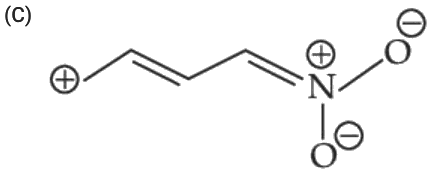
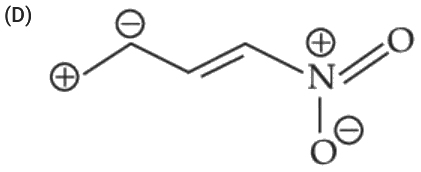
  12. Q712021 · 25 Jul 2021 · Shift 1
    Chemistry question 11 as printed in the paper
    1. A.Option 1
    2. B.Option 2
    3. C.Option 3
    4. D.Option 4
    Show answer

    Answer: A

  13. Q732021 · 25 Jul 2021 · Shift 1

    Which one of the following compounds will liberate CO2​, when treated with NaHCO3​ ?

    1. A.(CH3​)3​N⊕HCl⊖
    2. B.(CH3​)4​N⊕O⊖H
    3. C.CH3​−C∥O−NH2​
    4. D.CH3​NH2​
    Show answer

    Answer: A

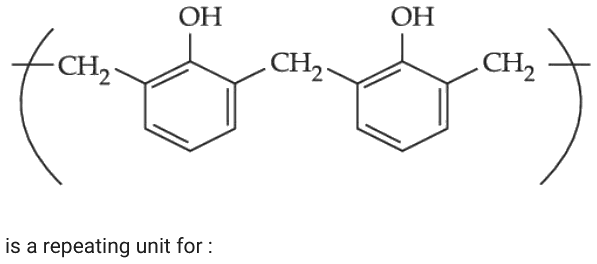
  14. Q752021 · 25 Jul 2021 · Shift 1
    Chemistry question 15 as printed in the paper
    1. A.Novolac
    2. B.Buna-N
    3. C.Acrilan
    4. D.Neoprene
    Show answer

    Answer: A

  15. Q792021 · 25 Jul 2021 · Shift 1

    Which one of the following chemical agent is not being used for dry-cleaning of clothes?

    1. A.H2​O2​
    2. B.CCl4​
    3. C.Liquid CO2​
    4. D.Cl2​C=CCl2​
    Show answer

    Answer: A

  16. Q892021 · 25 Jul 2021 · Shift 1· Numerical answer

    Consider the complete combustion of butane, the amount of butane utilized to produce 72.0 g of water is ____ ×10−1 g. (in nearest integer)

    Show answer

    Answer: 464

  17. Q642021 · 25 Jul 2021 · Shift 2

    The correct decreasing order of densities of the following compounds is : (A) [structure: benzene] (B) [structure: chlorobenzene] (C) [structure: 1,3-dichlorobenzene] (D) [structure: 1-bromo-3-chlorobenzene]

    1. A.(D) > (C) > (B) > (A)
    2. B.(C) > (D) > (A) > (B)
    3. C.(C) > (B) > (A) > (D)
    4. D.(A) > (B) > (C) > (D)
    Show answer

    Answer: A

More Chemistry topics in JEE Main

  • Chemical & Ionic Equilibrium (277)
  • Organic Reactions & Conversions (262)
  • General Organic Chemistry & Isomerism (235)
  • p-Block Elements (193)
  • Mole Concept & Stoichiometry (179)
  • Atomic Structure (177)
  • Chemical Bonding (174)
  • Coordination Compounds (169)
← PreviousPage 14 of 26Next →