125 questions asked across 17 exam years, newest first
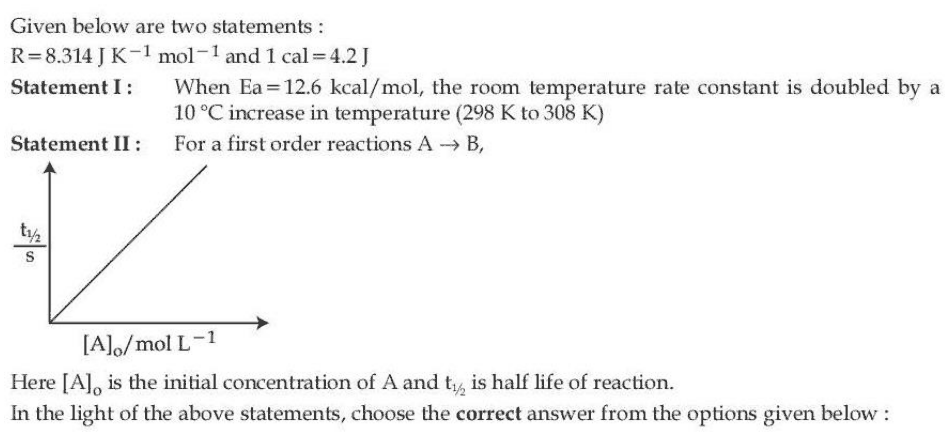
Answer: C
Decomposition of a hydrocarbon follows the equation . The activation energy of reaction is ________ . (Nearest Integer) Given :
Answer: 232
First order gas phase reaction initial pressure of gas , total pressure of the reaction mixture at time Expression of rate constant is
Answer: A
If the half life of a first order reaction is then the time required for completion of of the reaction will be _______ minutes . (Given : )
Answer: 46
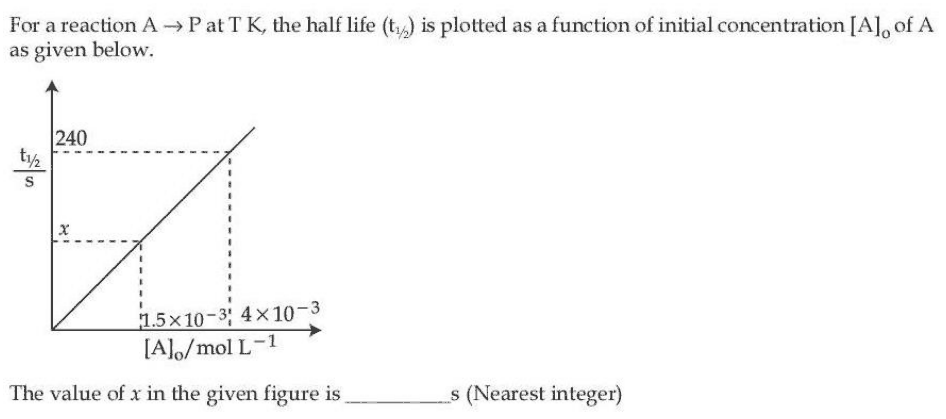
Answer: 90
Consider the first order reaction . The fraction of molecules decomposed in the given first order reaction can be expressed as
Answer: D
For a first order reaction ____ . (Nearest integer)
Answer: 7
is the time required for the completion of the reaction while is the time required for of the reaction to be completed. Which of the following option correctly represents the relation between and for zero and first order reactions respectively ?
Answer: B
For reaction , rate constant at If activation energy for the above reaction is , then the temperature (in ) at which rate constant, is ____. (Nearest integer) Given : , , ,
Answer: 41
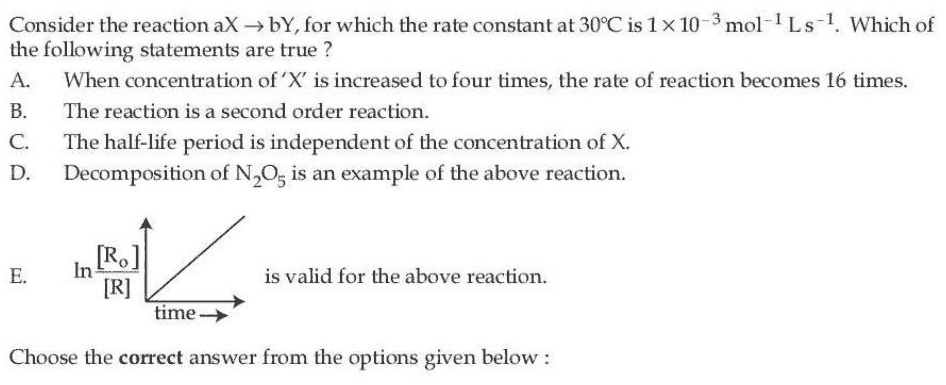
Answer: A
An organic compound undergoes first order decomposition. The time taken for decomposition to and of its initial concentration are and respectively. What is the value of ?
Answer: B
(first reaction) (second reaction) Consider the above two first-order reactions. The rate constant for first reaction at 500 K is double of the same at 300 K. At 500 K, 50% of the reaction becomes complete in 2 hour. The activation energy of the second reaction is half of that of first reaction. If the rate constant at 500 K of the second reaction becomes double of the rate constant of first reaction at the same temperature; then rate constant for the second reaction at 300 K is ________ (nearest integer).
Answer: 5
At in presence of a catalyst, activation energy of a reaction is lowered by . The logarithm of ratio of is.... (Consider that the frequency factor for both the reactions is same)
Answer: A
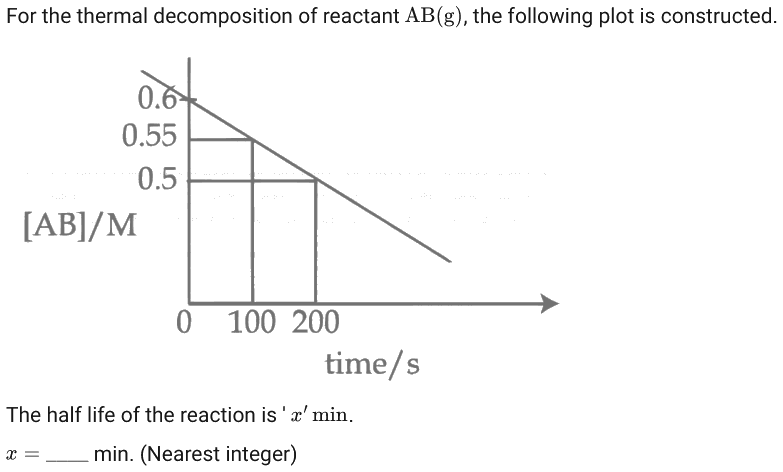
Answer: 10
Observe the following reactions at . I. . II. Both the reactions are started at 10.00 am . The rates of these reactions at 10.10 am are same. The value of at 10.10 am is . The concentration of A at 10.10 am is . What is the first order rate constant (in ) of reaction ?
Answer: A
product (First order reaction). Three sets of experiment were performed for a reaction under similar experimental conditions: Run of 10 M solution of reactant A Run of 10 M solution of reactant A Run of 10 M solution of reactant of added. The correct variation of rate of reaction is
Answer: D
The temperature at which the rate constants of the given below two gaseous reactions become equal is ____ K. (Nearest integer) Given :
Answer: 1303
Pre-exponential factors of two different reactions of same order are identical. Let activation energy of first reaction exceeds the activation energy of second reaction by . If and are the rate constants of first and second reaction respectively at 300 K , then will be ____. (nearest integer)
Answer: 8
The correct order of the rate of the reaction for the following reaction with respect to nucleophiles is :
Answer: B
Decomposition of A is a first order reaction at T(K) and is given by . In a closed 1 L vessel, 1 bar A(g) is allowed to decompose at T(K). After 100 minutes, the total pressure was 1.5 bar. What is the rate constant (in ) of the reaction? (log 2 = 0.3)
Answer: B
In a first order decomposition reaction, the time taken for the decomposition of reactant to one fourth and one eighth of its initial concentration are and (s), respectively. The ratio will be:
Answer: D
Rate law for a reaction between and is given by If concentration of is doubled and concentration of is halved from their initial value, the ratio of new rate of reaction to the initial rate of reaction is
Answer: B
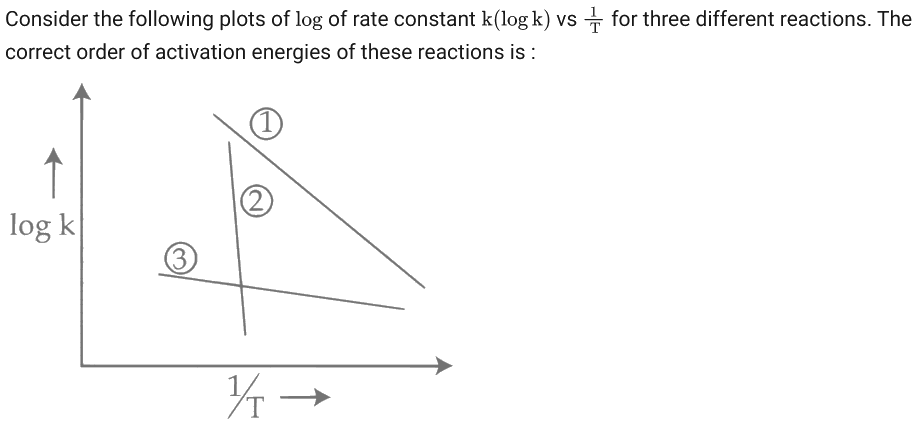
Answer: A
Half life of zero order reaction is , when initial concentration of reactant is . The time required to decrease concentration of A from to is :
Answer: B
In a reaction , initial concentrations of and are related as . The half lives of and are and , respectively. If they start to disappear at the same time, both following first order kinetics, after how much time will the concentration of both the reactants be same?
Answer: B
