125 questions asked across 17 exam years, newest first
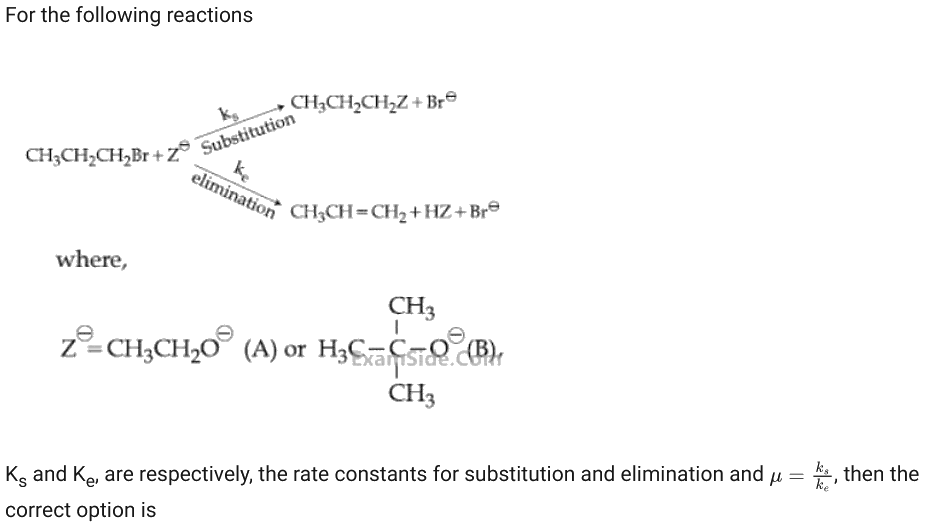
Answer: B
For the reaction of with , the rate constant is at and at . The activation energy for the reaction, in is : ( )
Answer: B
In the following reaction Rate of the reaction is the highest for :
Answer: C
Decomposition of X exhibits a rate constant of . How many years are required for the decomposition of of X into ?
Answer: A
For a reaction consider the plot of versus given in the figure. If the rate constant of this reaction at 400 K is , then the rate constant at 500 K is – [Figure: straight line plot of vs , Slope = −4606 K]
Answer: A
The reaction is a zeroth order reaction. If the initial concentration of X is , the half-life is . When the initial concentration of X is , the time required to reach its final concentration of will be:
Answer: A
The following results were obtained during kinetic studies of the reaction ; The time (in minutes) required to consume half of A is :
Answer: A
decomposes to and and follows first order kinetics. After 50 minutes, the pressure inside the vessel increases from 50 mmHg to 87.5 mmHg. The pressure of the gaseous mixture after 100 minute at constant temperature will be :
Answer: D
At the rate of decomposition of a sample of gaseous acetaldehyde initially at a pressure of 363 Torr, was when 5% had reacted and when 33% had reacted. The order of the reaction is
Answer: B
The rate of a reaction quadruples when the temperature changes from 300 to 310 K. The activation energy of this reaction is : (Assume activation energy and preexponential factor are independent of temperature; ; )
Answer: A
The rate of a reaction A doubles on increasing the temperature from 300 to 310 K. By how much, the temperature of reaction B should be Increased from 300 K so that rate doubles if activation energy of the reaction B is twice to that of reaction A.
Answer: B
Decomposition of follows a first order reaction. In fifty minutes the concentration of decreases from to in one such decomposition. When the concentration of reaches , the rate of formation of will be :
Answer: A
The activation energy for a reaction which doubles the rate when the temperature is raised from 298 K to 308 K is
Answer: C
In a chemical reaction is converted into . The rates of reaction, starting with initial concentrations of as and , are equal to and respectively. The order of reaction with respect to reactant will be
Answer: D
The time for half life period of a certain reaction is 1 hour. When the initial concentration of the reactant 'A', is , how much time does it take for its concentration to come from 0.50 to if it is a zero order reaction ?
Answer: C
A reaction was found to be second order with respect to the concentration of carbon monoxide. If the concentration of carbon monoxide is doubled, with everything else kept the same, the rate of reaction will
Answer: C
Rate of a reaction can be expressed by Arrhenius equation as: In this equation, E represents
Answer: B
The following mechanism has been proposed for the reaction of NO with to form NOBr: If the second step is the rate determining step, the order of the reaction with respect to NO(g) is
Answer: D
can be taken as the time taken for the concentration of a reactant to drop to of its initial value. If the rate constant for a first order reaction is , the can be written as
Answer: B
In a first order reaction, the concentration of the reactant decreases from 0.8 M to 0.4 M in 15 minutes. The time taken for the concentration to change from 0.1 M to 0.025 M is
Answer: A
Rate of the reaction is fastest when is
Answer: C
Units of rate constant of first and zero order reactions in terms of molarity M unit are respectively
Answer: A
For the reaction , rate is given by R = [A] [B] then the order of the reaction is
Answer: A
The differential rate law for the reaction is
Answer: D
If half-life of a substance is 5 yrs, then the total amount of substance left after 15 years, when initial amount is 64 grams is
Answer: D
