125 questions asked across 17 exam years, newest first
For a given chemical reaction Concentration of changes from to in . Rate of appearance of is times the rate of disappearance of which is twice the rate of disappearance . The rate of appearance of has been experimentally determined to be . Therefore, the rate of reaction is . (Nearest Integer)
Answer: 1
At 345 K, the half life for the decomposition of a sample of a gaseous compound initially at 55.5 kPa was 340 s. When the pressure was 27.8 kPa, the half life was found to be 170 s. The order of the reaction is ____________. [integer answer]
Answer: 0
For a first order reaction, the time required for completion of 90% reaction is 'x' times the half life of the reaction. The value of 'x' is (Given : ln 10 = 2.303 and log 2 = 0.3010)
Answer: C

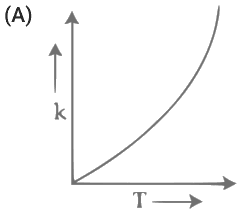
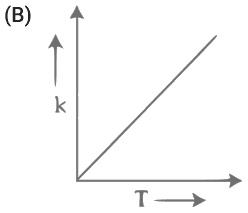
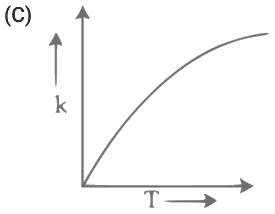
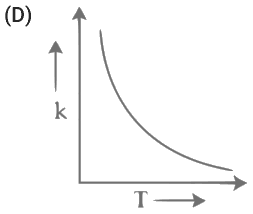
Answer: A
Given below are two statements : one is labelled as Assertion (A) and the other is labelled as Reason (R). Assertion (A) : Heavy water is used for the study of reaction mechanism. Reason (R) : The rate of reaction for the cleavage of O - H bond is slower than that of O - D bond. Choose the most appropriate answer from the options given below :
Answer: D
Select the correct statements (A) Crystalline solids have long range order. (B) Crystalline solids are isotropic (C) Amorphous solid are sometimes called pseudo solids. (D) Amorphous solids soften over a range of temperatures. (E) Amorphous solids have a definite heat of fusion. Choose the most appropriate answer from the options given below.
Answer: D
For the first order reaction , 1 mole of reactant A gives 0.2 moles of B after 100 minutes. The half life of the reaction is __________ min. Properties of logarithms : ; (Round off to the nearest integer)
Answer: 600 to 700
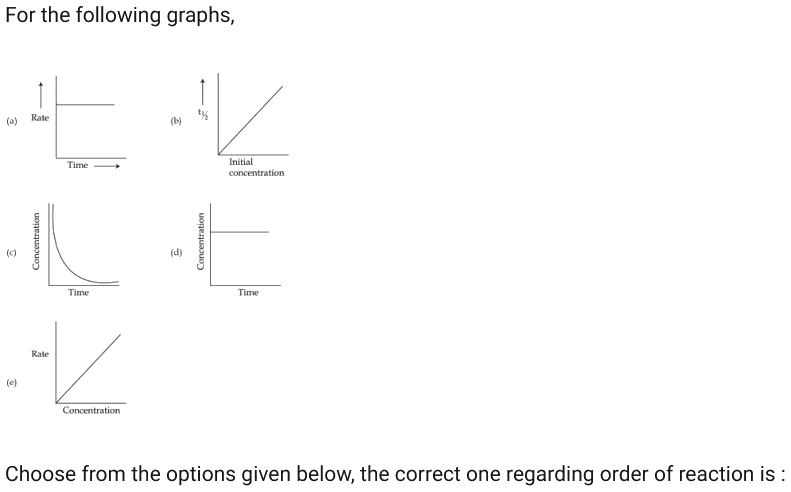
Answer: D
For a chemical reaction , it was found that concentration of B is increased by 0.2 mol in 30 min. The average rate of the reaction is ____ . (in nearest integer)
Answer: 4
Isotope(s) of hydrogen which emits low energy particles with value > 12 years is/are
Answer: B
In the above first order reaction the initial concentration of is at 318 K. The concentration of after 1 hour was . The rate constant of the reaction at 318 K is ____ . (Nearest integer) [Given : log 3 = 0.477, log 5 = 0.699]
Answer: 7
The inactivation rate of a viral preparation is proportional to the amount of virus. In the first minute after preparation, of the virus is inactivated. The rate constant for viral inactivation is ________ . (Nearest integer) [Use : ; ; property of logarithm : ]
Answer: 106
This reaction was studied at and the following data was obtained and are the initial concentrations and is the initial reaction rate. The overall order of the reaction is ____. (Round off to the Nearest Integer).
Answer: 3
A reaction has a half life of 1 min. The time required for 99.9% completion of the reaction is _________ min. (Round off to the Nearest Integer). [Use : ln 2 = 0.69; ln 10 = 2.3]
Answer: 10
The decomposition of formic acid on gold surface follows first order kinetics. If the rate constant at 300 K is and the activation energy , the rate constant at 200 K is _______ . (Round off to the Nearest Integer). (Given : )
Answer: 10
An exothermic reaction has an activation energy . If energy change during the reaction is , then the activation energy for the reverse reaction in kJ is _________. (Integer answer)
Answer: 50
If the activation energy of a reaction is , the fraction of molecules at 700 K, having enough energy to react to form products is . The value of x is _________. (Rounded off to the nearest integer) [Use ]
Answer: 14
The rate constant of a reaction increases by five times on increase in temperature from to . The value of activation energy in is ____. (Rounded off to the nearest integer)
Answer: 52
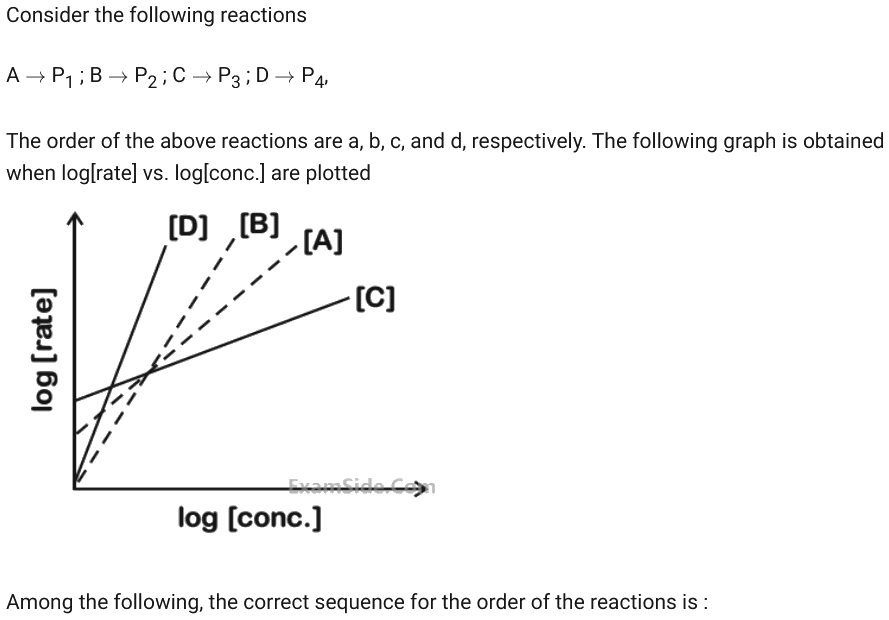
Answer: A
The rate of a reaction decreased by 3.555 times when the temperature was changed from to . The activation energy (in ) of the reaction is ______ . Take;
Answer: 100
For the following reactions it was found that is decreased by 30 kJ/mol in the presence of catalyst. If the rate remains unchanged, the activation energy for catalysed reaction is (Assume pre exponential factor is same):
Answer: D
A sample of milk splits after 60 min. at 300 K and after 40 min. at 400 K when the population of lactobacillus acidophilus in it doubles. The activation energy (in kJ/ mol) for this process is closest to________. (Given, , , )
Answer: 3.98 to 3.99
The rate of a certain biochemical reaction at physiological temperature (T) occurs times faster with enzyme than without. The change in the activation energy upon adding enzyme is :
Answer: B
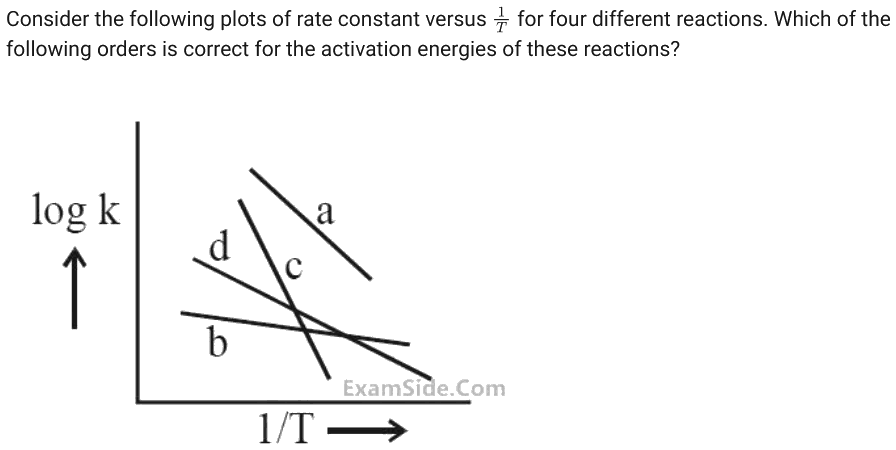
Answer: A
During the nuclear explosion, one of the products is with half life of . If of was absorbed in the bones of newly born baby in place of Ca, how much time, in years, is required to reduce it by 90% if it is not lost metabolically?
Answer: 23 to 23.03
