125 questions asked across 17 exam years, newest first
The number of given statement/s which is/are correct is __________. (A) The stronger the temperature dependence of the rate constant, the higher is the activation energy. (B) If a reaction has zero activation energy, its rate is independent of temperature. (C) The stronger the temperature dependence of the rate constant, the smaller is the activation energy. (D) If there is no correlation between the temperature and the rate constant then it means that the reaction has negative activation energy.
Answer: 2
For the adsorption of hydrogen on platinum, the activation energy is and for the adsorption of hydrogen on nickel, the activation energy is . The logarithm of the ratio of the rates of chemisorption on equal areas of the metals at is ________ (Nearest integer) Given:
Answer: 2
A and B are two substances undergoing radioactive decay in a container. The half life of A is 15 min and that of B is 5 min. If the initial concentration of B is 4 times that of A and they both start decaying at the same time, how much time will it take for the concentration of both of them to be same? _____________ min.
Answer: 15
The rate constants of the above reaction at and are and respectively. The activation energy for the reaction is ___________ (Nearest integer) (Given : )
Answer: 2520
The rate constant for a first order reaction is . The time required for the initial concentration of the reactant to reduce to its level is ___________ . (Nearest integer) (Given : and )
Answer: 17
If compound A reacts with B following first order kinetics with rate constant . The time taken by A (in seconds) to reduce from to will be ___________. (Nearest Integer)
Answer: 623
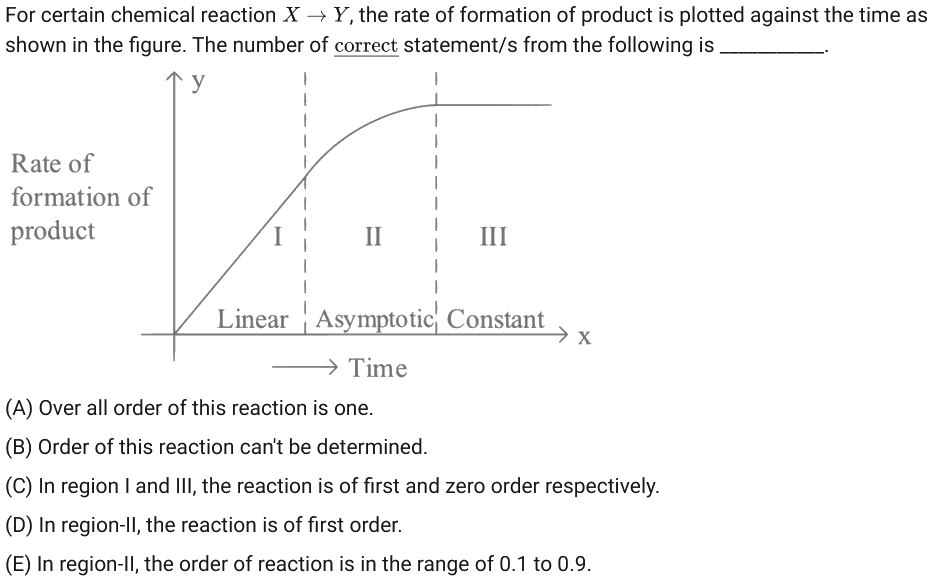
Answer: 1
For conversion of compound , the rate constant of the reaction was found to be . The order of the reaction is ____.
Answer: 2
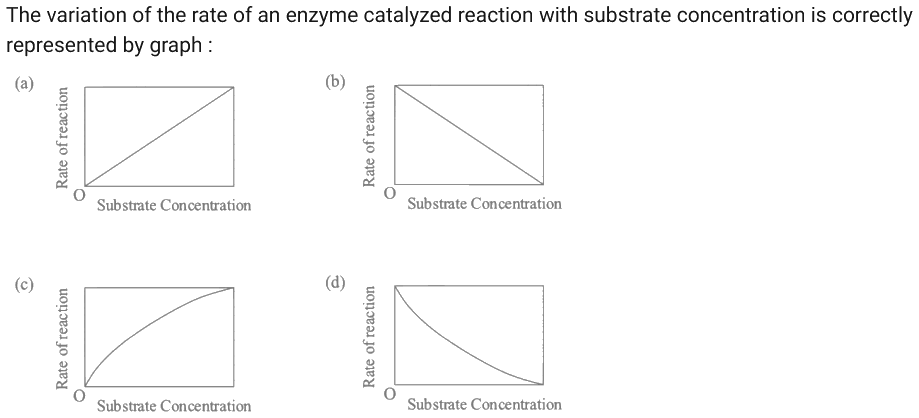
Answer: D
For the first order reaction , the half life is 30 min. The time taken for 75% completion of the reaction is ____ min. (Nearest integer) Given : log 2 = 0.3010 log 3 = 0.4771 log 5 = 0.6989
Answer: 60
A first order reaction has the rate constant, . The number of correct statement/s from the following is/are ____ Given : A. Reaction completes in 1000 s. B. The reaction has a half-life of 500 s. C. The time required for 10% completion is 25 times the time required for 90% completion. D. The degree of dissociation is equal to E. The rate and the rate constant have the same unit.
Answer: 1
The number of correct statement/s from the following is ____ A. Larger the activation energy, smaller is the value of the rate constant. B. The higher is the activation energy, higher is the value of the temperature coefficient. C. At lower temperatures, increase in temperature causes more change in the value of k than at higher temperature D. A plot of vs is a straight line with slope equal to
Answer: 3
A student has studied the decomposition of a gas at . He obtained the following data. The order of the reaction is
Answer: A
The number of statement/s which are the characteristics of physisorption is __________ A. It is highly specific in nature B. Enthalpy of adsorption is high C. It decreases with increase in temperature D. It results into unimolecular layer E. No activation energy is needed
Answer: 2
Assuming of trace radioactive element X with a half life of 30 years is absorbed by a growing tree. The amount of X remaining in the tree after 100 years is ____ .
Answer: 1
For the given first order reaction the half life of the reaction is . The ratio of the initial concentration of reactant to the concentration of reactant at time will be equal to _________. (Nearest integer)
Answer: 100
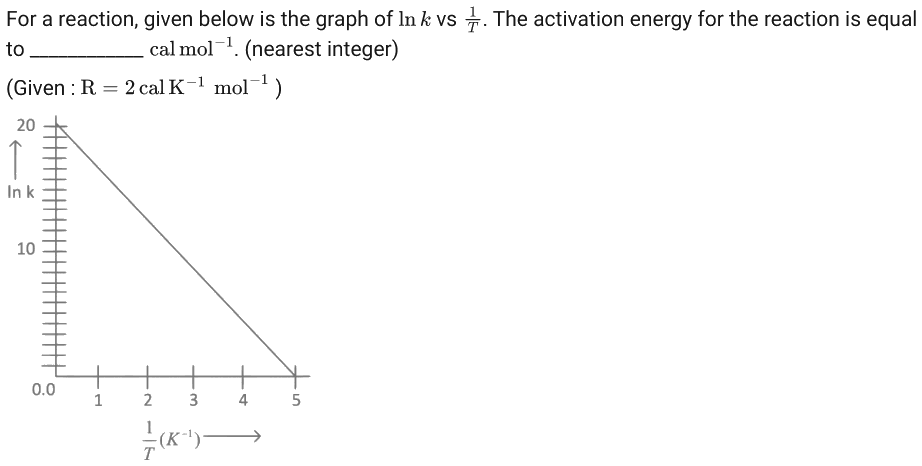
Answer: 8
If formation of compound follows the first order of kinetics and after 70 minutes the concentration of was found to be half of its initial concentration. Then the rate constant of the reaction is . The value of is ____. (Nearest Integer)
Answer: 165
For a reaction the half lives are and when the concentration of reactant is and respectively. The order of the reaction is ____. (Nearest Integer)
Answer: 2
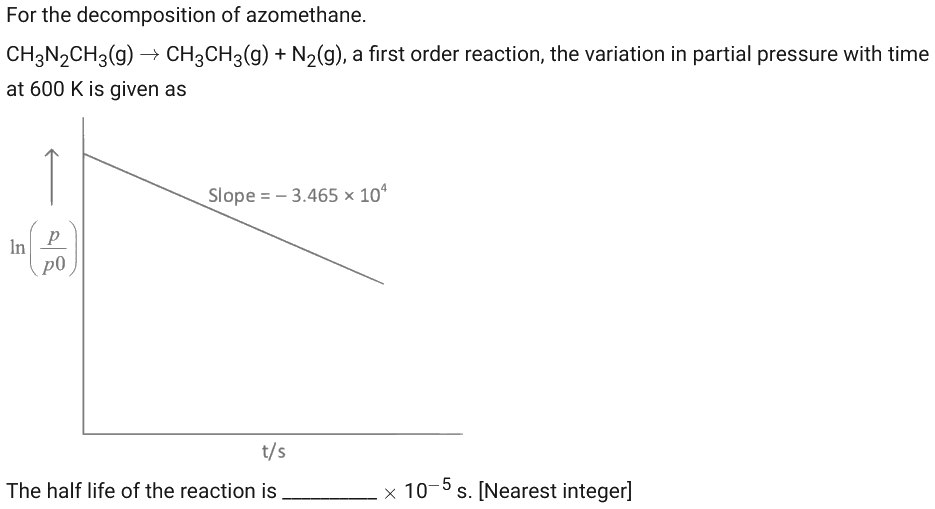
Answer: 2
For the reaction , the values of frequency factor A and activation energy are and respectively. If the reaction is of first order, the temperature at which the rate constant is is ___________ . (Given : , , )
Answer: 225
A radioactive element has a half life of 200 days. The percentage of original activity remaining after 83 days is ___________. (Nearest integer) (Given : antilog 0.125 = 1.333, antilog 0.693 = 4.93)
Answer: 75
The rate constant for a first order reaction is given by the following equation: The activation energy for the reaction is given by ____ . (In nearest integer) (Given : )
Answer: 166
It has been found that for a chemical reaction with rise in temperature by the rate constant gets doubled. Assuming a reaction to be occurring at , the value of activation energy is found to be ________ . [nearest integer] (Given , , )
Answer: 59
Catalyst A reduces the activation energy for a reaction by at . The ratio of rate constants, is . The value of is ____. [nearest integer] [Assume that the pre-exponential factor is same in both the cases. Given ]
Answer: 4
