125 questions asked across 17 exam years, newest first
Consider the following statements related to temperature dependence of rate constants. Identify the correct statements. A. The Arrhenius equation holds true only for an elementary homogenous reaction. B. The unit of is same as that of in Arrhenius equation. C. At a given temperature, a low activation energy means a fast reaction. D. A and as used in Arrhenius equation depend on temperature. E. When , A and become interdependent. Choose the correct answer from the options given below:
Answer: C
For a given reaction , is related to as given in table. Given: Which of the following is true? A. The order of the reaction is . B. If is , then is C. The order of the reaction changes to if the concentration of reactant changes from to . D. is for Choose the correct answer from the options given below:
Answer: B
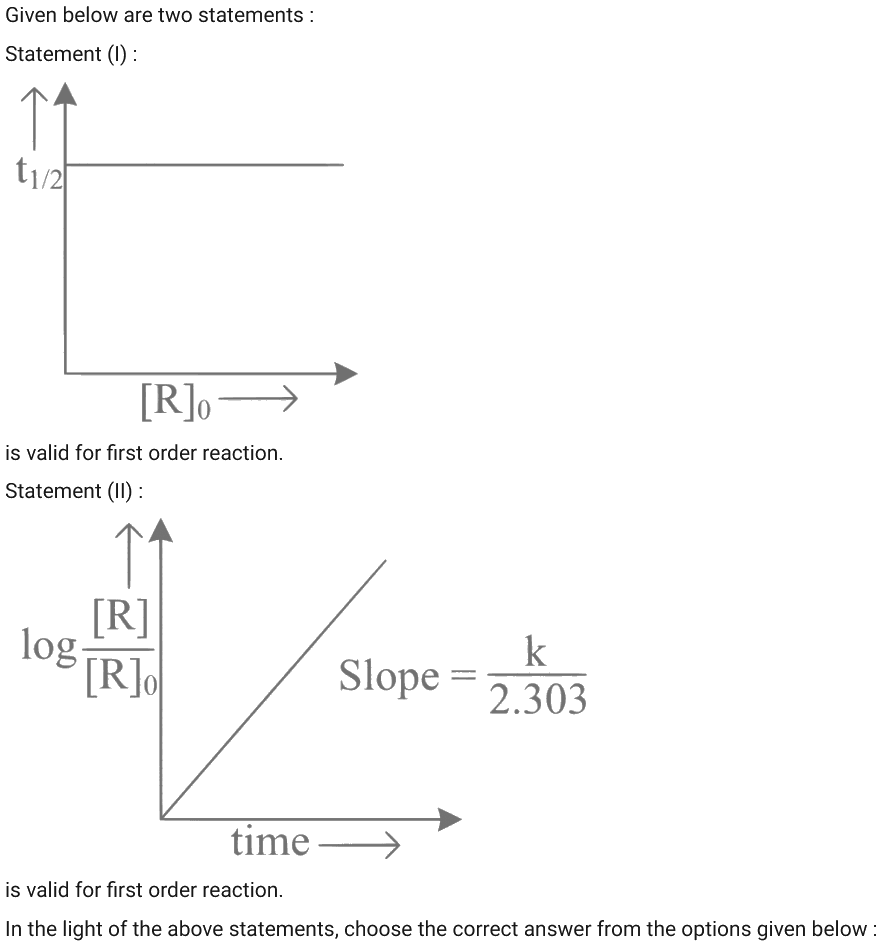
Answer: B
Consider a complex reaction taking place in three steps with rate constants and respectively. The overall rate constant is given by the expression . If the activation energies of the three steps are , and respectively, then the overall energy of activation in is ____ . (Nearest integer)
Answer: 20

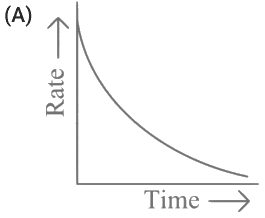
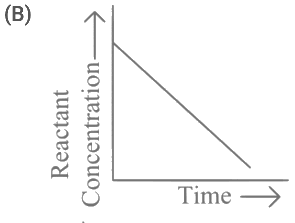
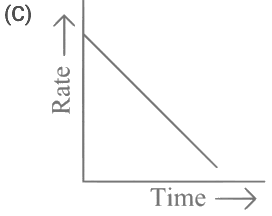
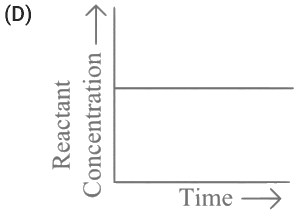
Answer: B
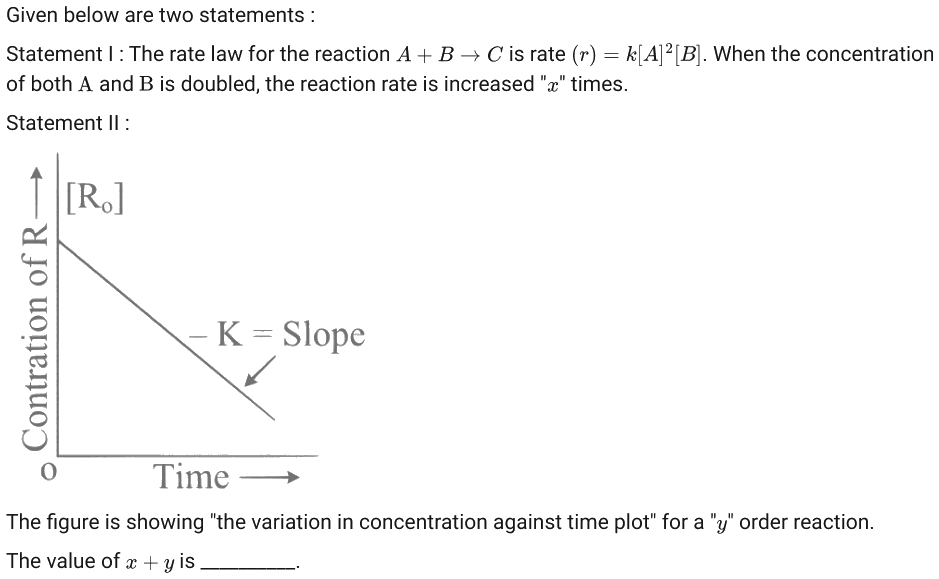
Answer: 8
Consider the following first order gas phase reaction at constant temperature If the total pressure of the gases is found to be after . and upon the complete decomposition of A after a very long time, then the rate constant of the given reaction is ____ (nearest integer) [Given : ]
Answer: 3
Consider the following reaction The time taken for A to become of its initial concentration is twice the time taken to become of the same. Also, when the change of concentration of B is plotted against time, the resulting graph gives a straight line with a negative slope and a positive intercept on the concentration axis. The overall order of the reaction is ____.
Answer: 1
Consider the two different first order reactions given below (Reaction 1) (Reaction 2) The ratio of the half life of Reaction 1 : Reaction 2 is If and represent the time taken to complete and of Reaction 1 and Reaction 2 , respectively, then the value of the ratio is ________ (nearest integer). [Given : and ]
Answer: 17
Consider the following single step reaction in gas phase at constant temperature. The initial rate of the reaction is recorded as when the reaction starts with pressure of A and pressure of B. After some time, the rate is recorded when the pressure of C becomes . The ratio is ____ . (Nearest integer)
Answer: 315
Consider the following transformation involving first order elementary reaction in each step at constant temperature as shown below. Some details of the above reactions are listed below. If the overall rate constant of the above transformation (k) is given as and the overall activation energy () is , then the value of is ____ (nearest integer)
Answer: 100
Consider the following reaction, the rate expression of which is given below The reaction is initiated by taking concentration of A and B each. If the rate constant () is , then the time taken for A to become is ________ sec. (nearest integer)
Answer: 50
The ratio of in a piece of wood is part that of atmosphere. If half life of is , the age of wood sample is ________ years.
Answer: 17190
The following data were obtained during the first order thermal decomposition of a gas A at constant volume : | S.No. | Time /s | Total pressure /(atm) | | :--- | :--- | :--- | | 1. | 0 | 0.1 | | 2. | 115 | 0.28 | The rate constant of the reaction is ________ (nearest integer)
Answer: 2
Integrated rate law equation for a first order gas phase reaction is given by (where is initial pressure and is total pressure at time ) (Take the reaction to be of the type .)
Answer: A
The rate of a first order reaction is at 10 minutes and at 20 minutes after initiation. Half life of the reaction is _________ minutes. (Given )
Answer: 24
For a reaction taking place in three steps at same temperature, overall rate constant . If and are 40, 50 and respectively, the overall Ea is _________ .
Answer: 30
The half-life of radioisotope bromine - 82 is 36 hours. The fraction which remains after one day is _________ . (Given antilog )
Answer: 63
Consider the following data for the given reaction | | 1 | 2 | 3 | | :--- | :--- | :--- | :--- | | | | | | | | | | | The order of the reaction is ________.
Answer: 2
Time required for completion of of a First order reaction is _______ times of half life () of the reaction.
Answer: 10
is the time required for the reaction to undergo completion and is the time required for the reaction to undergo completion. The relation between and for a first order reaction is The value of is ___________. (Nearest integer)
Answer: 3
is a first order reaction. The initial pressure of the system was found to be which increased to after . The total pressure of the system after will be ___________ mm Hg. (Nearest integer)
Answer: 2200
The reaction takes places through the mechanism given below: The overall order of the reaction is __________.
Answer: 3
A molecule undergoes two independent first order reactions whose respective half lives are 12 min and 3 min. If both the reactions are occurring then the time taken for the 50% consumption of the reactant is ___________ min. (Nearest integer)
Answer: 2
The number of incorrect statement/s from the following is _________ A. The successive half lives of zero order reactions decreases with time. B. A substance appearing as reactant in the chemical equation may not affect the rate of reaction C. Order and molecularity of a chemical reaction can be a fractional number D. The rate constant units of zero and second order reaction are and respectively
Answer: 1
